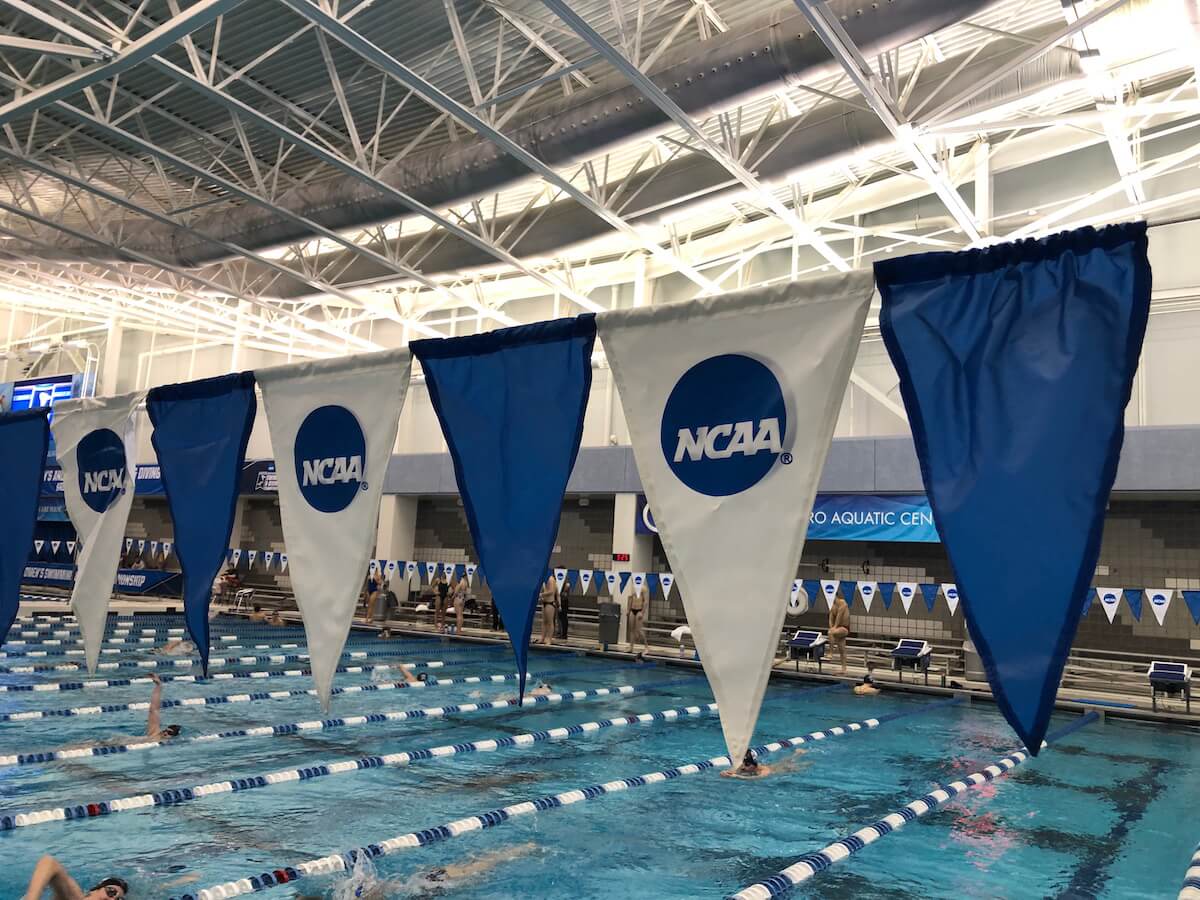
‘We’re the Recruits Living This Nightmare’; How House vs. NCAA Reshaped College Recruiting
A Firsthand Look at How House vs. NCAA is Changing Recruiting Away From D-I Programs
The New College Recruiting Reality: House vs. NCAA and the Future of Olympic Sports
Op-Ed: This article is an op-ed. The views expressed are solely those of the authors, Grayson Bloes and Atlas Metin, and do not necessarily reflect
the views of Swimming World Magazine or its staff.
By Grayson Bloes and Atlas Metin
Part Three: High School Swimmers Enter a New NCAA Reality After House vs. NCAA
Few realize that America’s Olympic success is built not on government funding, but on the unique power of college sports For decades, the NCAA has functioned as the United States’ de facto Olympic pipeline, producing 92% of U.S. Olympic swimmers and 100% of U.S. Olympic water polo athletes in 2024.
That pipeline is now under unprecedented threat.
The Money Shift That Changes Everything
When the House v. NCAA settlement was finalized, it marked a turning point in college athletics. Under the new model, universities may share up to $22 million per year from football and basketball revenues directly with those athletes.
The principle is straightforward: athletes who helped build billion-dollar industries deserve compensation.
Yet the unintended consequence is equally clear. The ruling severs the financial lifeline that sustained non-revenue sports including swimming, diving, water polo, track & field, and rowing through the NCAA’s long-standing cross-subsidization model.
That model wasn’t perfect. It was, however, the reason Olympic sports could afford facilities, scholarships, coaching, and travel at scale.
What the Cuts Look Like in Real Life
Cal Poly swimmers find out their program was cut
The effects are already visible and accelerating.
- Cal Poly and Cal Baptist eliminated their swimming programs over the past year, citing “budget constraints” after the settlement
- What shocked many wasn’t just the cut, but the decision to reject a reported $7 million fundraising offer from Cal Poly supporters to reinstate the program
- Georgia Tech, one of the nation’s top-50 athletic departments by revenue, saw roster reductions reportedly dropping from 34 to 14 men and 36 to 16 women
- In the SEC, men’s swim rosters now average roughly 22 athletes per program, with further reductions expected by 2027
These are not isolated decisions. They are signals that the NCAA’s Olympic-sport infrastructure is quickly and quietly being resized.
The Part Nobody Talks About: The High School Athlete
Let’s examine two high school swimmers. The kind of athletes who, just a year ago, could reasonably imagine multiple Division I doors opening. Their recruiting landscape now feels fundamentally different.
Recruiting isn’t simply more competitive. It is more constrained.
When a program trims a roster, it doesn’t only cut the bottom. It narrows the middle. A developmental swimmer who becomes an All-American by year three, the late bloomer, or athlete who needs one college season to bridge the gap from great to elite.
The new reality is that more athletes are chasing fewer spots, and coaches are being forced to make decisions earlier, with far less margin for development.
Here’s the Twist: New Doors Open at DII and DIII
This shift is painful, but it also changes where opportunity lives.
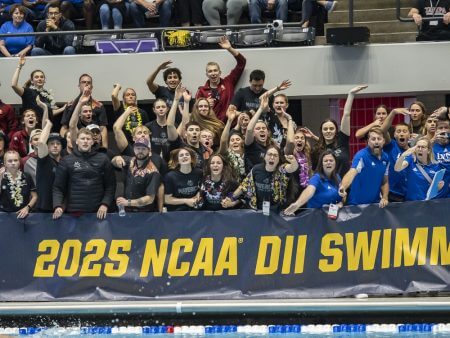
2025 DII NCAA Championships
As Division I programs tighten, many athletes will find a stronger fit at the Division II or Division III level, where the financial model is often less exposed to NIL-driven pressure and where roster math can still support meaningful development.
For families navigating recruiting right now, that isn’t a consolation prize. It’s a reframe.
- DII and DIII can offer stability when Division I programs are shrinking
- Development and leadership opportunities can be greater with more continuity
- Education-first environments can align better with what most athletes actually need long-term
The danger is not that athletes will stop swimming. The danger is that the United States will lose the depth engine that turns many good athletes into a few great ones. A loss of a culture that sustains coaching and athletic greatness across generations.
Reader Poll Results (Part Two)
Do you believe the House v. NCAA settlement puts America’s Olympic pipeline at risk?
Yes — Olympic sports are already being harmed: 33%
Possibly — the full impact hasn’t surfaced yet: 33%
No — programs will adapt: 33%
Not sure / too early to tell: 1%
Source: Swimming World reader poll
What Comes Next? What Can Still Be Saved
This is not an argument against athlete compensation.
It is an argument against allowing Olympic sports to become collateral damage in a new era of college athletics.
If non-revenue sports continue to disappear, the United States risks losing the depth and infrastructure that have made it a dominant Olympic power. Not through a dramatic collapse, but through slow and incremental erosion.
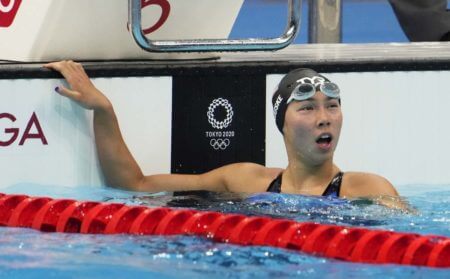
Photo Courtesy: Rob Schumacher/USA Today Sports
The path forward will not be a single solution. It will require a combination of:
- New funding models that protect Olympic sports within athletic departments
- Alumni engagement that is welcomed rather than turned away
- Sponsorship and community partnerships that treat Olympic sports as national assets
- Policies that prevent roster cuts from quietly dismantling opportunity
The tragedy of House v. NCAA is not its intent, but its unintended consequences: a fair deal for some, at the cost of the nation’s Olympic future.
America built an Olympic machine through college sports. If that machine breaks, the United States will need a replacement.
Right now, no replacement exists.
New Reader Poll: Where will the next generation of elite U.S. swimmers most likely develop?
#1. Where will the next generation of elite U.S. swimmers most likely develop?
The path forward won’t be one solution. It will be a mix:
- New funding models that protect Olympic sports inside athletic departments
- Alumni engagement that is welcomed by Universities…not turned away
- Sponsorship and community partnerships that treat Olympic sports as national assets
- Policies that prevent roster cuts from quietly dismantling opportunity
The tragedy of House vs. NCAA is not its intent, but its unintended consequences: a fair deal for some, at the cost of the nation’s Olympic future.
America built an Olympic machine through college sports.
If we break it, we need a replacement — and right now, no replacement exists.
