Debutants. Underdogs. Minnows. Having never reached the UEFA Women’s Champions League (UWCL) before, Belgian side OH Leuven were given every label imaginable and written off before a ball was even kicked. They arrived with humble expectations, but not even those inside the club dared to dream of a fairytale run that ultimately saw them seal the final spot in the knockout-phase playoffs as the 12th-best team in Europe.
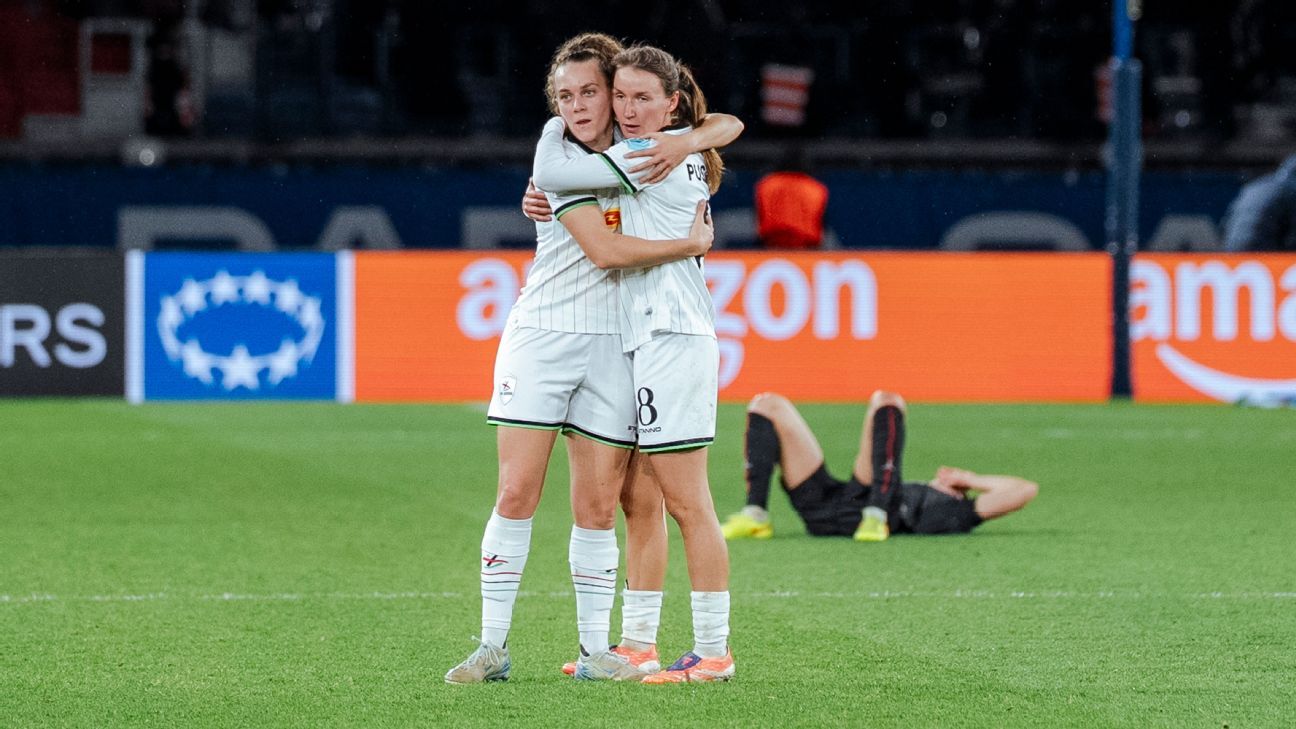
On Wednesday night, after a 3-0 defeat to Arsenal and Valerenga‘s loss to Bayern Munich ensured the lowest-ranked side in the competition would advance to the knockout stages, they celebrated as if they had lifted the trophy itself.
The celebrations were understandably emphatic; Leuven had authored a fairytale, a true “David and Goliath” story, as club CEO Frédéric van den Steen aptly described it and, remarkably, it is a story that is not over yet.
“We really came from the bottom to the top, and it’s been difficult and one with disappointments and a lot of tears,” midfielder/defender Zenia Mertens, who has over 100 caps for Leuven, told ESPN. “But if you see that you can get these moments instead, then it makes it more beautiful.
“They always said that we’re not a team for taking trophies and that we’re made for second place. So if you know that all the things were said in the past and that you’re now doing this, I think we can only be proud of that as a team.”
Emerging from the shadows
Between 2020-2023, Leuven lived in the shadow of rivals Anderlecht, repeatedly watching the Belgian Women’s Super League title slip through their fingers as they finished as runners-up three times. But then they finally broke the cycle to lift the championship at the end of the 2024-25 season.
That domestic triumph opened the door to the UWCL qualifiers, but the challenge was only just beginning. Belgium’s modest European standing, with no previous representatives in the competition, meant Leuven were denied a direct path. Instead, they were forced to navigate two qualifying rounds to earn a place at Europe’s top table.
“After the championship, we thought, ‘okay, let’s go in Europe and let’s see what we can do without any big ambition, without big focus on that,’ because it was new. It was a new adventure. It was absolutely an unknown,” Van den Steen told ESPN.
“When we qualified, there were a lot of other teams in Belgium, and other clubs told us, ‘you’re going to lose every game, 8-0, 9-0, 10-0.’ Maybe it’s going to be a poisoned chalice to play the Champions League for your club. There was a lot of negative perception around this qualification.”
Expectations were virtually non-existent among the players, staff, and supporters alike. With the men’s team unlikely to ever reach the Champions League, this felt like a once-in-a-lifetime experience; something to be savored for all it was worth.
Progressing beyond the qualifiers was barely part of the conversation. After all, even domestic giants Anderlecht had never managed it. Yet Leuven refused to treat the moment casually. Backed by Thai owners King Power, who also hold a stake in English Championship side Leicester City, the club increased its budget by 20% and made a decisive shift from semi-professional operations to a full-time professional setup.
Psychology staff were brought in, alongside a social education coach and a nutritionist. On the pitch, they delivered. Victories over Bosnia and Herzegovina’s Sarajevo and Sweden’s Rosengard in a home mini-tournament set the tone, before a composed two-legged tie against Ukraine’s Vorskla Poltava sealed their passage to the 18-team league phase.
Simply qualifying was a statement in itself. The minnows of Leuven, the most inexperienced side among the 18, had already begun proving the doubters wrong.
“I heard some people say, ‘What is Leuven going to do in the Champions League?’ And they were laughing at it,” midfielder Mertens told ESPN.
Staying humble
With the competition’s shift to the Swiss-model format — moving away from the traditional group phase that ultimately worked in Leuven’s favor — it was guaranteed that they would face top talent. The draw delivered precisely that. Barcelona and Arsenal, last season’s finalists and the two most recent champions, stood in their path. But there was no shock, no visible nerves. Instead, the room erupted in cheers and laughter when they discovered their fate. This was what they wanted.
“We wanted to have Barcelona because it’s a team with the big stars, and we wanted to see how we are compared to them,” Mertens said. “When you are playing in Champions League, you don’t want to play little games. We just wanted to have challenges, and I think we had it with the draw, and it just made us happy because you’re playing against the best players in the world.”
Regardless of the caliber of opposition — Barcelona, Arsenal, Paris Saint-Germain, Roma, Paris FC and Twente — expectations inside the club remained deliberately humble, according to Van den Steen. Leuven were not measuring success in wins or a top-four finish; survival, experience, and small milestones mattered more.
“When we qualified, we said maybe we want to score a goal, or maybe we want to win one game,” Mertens admitted.
But what had begun as a dream quickly edged toward reality. In their opening match, Leuven came from behind to draw 2-2 with Paris FC, a result that sent a jolt of belief through the squad. Mertens admitted that the team came out at halftime like “monsters” and with the “mentality that we’ve got to show them what we’re able to do.” And it was down to advice from the coach Arno van den Abbeel, who told the players: “You’re playing on the biggest stage in Europe, so you don’t need to be scared, you just need to do your thing.”
Leuven went on to defeat Twente 2-1 in the second fixture — realizing one of their goals for the competition inside just two games. They then contained the all-conquering Barcelona to just a 3-0 defeat, as around 250 fans made the journey to Spain to cheer on their side. “They’ve [the team] been performing better than everyone would’ve expected, so of course it helps with the atmosphere at home and at away games,” Stein Jansen, president of the LeuvElles fan club, told ESPN. “It’s great. I don’t have any other words for it than just insane and amazing.”
If Leuven had witnessed a steady rise in supporters joining the excitement surrounding the club throughout their campaign, it went up to a new whole new level when they sealed two impressive draws against veteran sides Roma (1-1) and PSG (0-0) — a result that knocked the French giants out of the competition.
“It’s an insane phrase to even say, it’s actually crazy,” Jansen added. “I’ve been there since we were so small, and winning the league seemed a super big thing, and it is a big thing, but now we’re on the biggest stage ever, and to say, for example, last week we eliminated PSG, it’s crazy.”
The next step
By the time the sixth matchday rolled around, Leuven’s fate was not entirely in their own hands. Facing defending champions Arsenal at home, an unlikely win would have guaranteed qualification, but even defeat would be enough provided Norwegian side Valerenga failed to beat German giants Bayern Munich.
Leuven’s players and staff were ready to have one eye on that fixture — ready instruct the players if they needed to push harder for a goal. So, when Bayern struck two goals inside 11 minutes, the roar of celebration was likely louder in Belgium than in Germany.
On the pitch, things did not unfold as planned for Leuven, as they conceded three goals against the Gunners and failed to register a single shot on target. Yet, it hardly mattered in the end. A record-breaking crowd of 9,285 understood the magnitude of the moment, with some embracing the players at full-time in scenes of pure joy.
Leuven still play in front of modest crowds of just a few hundred at their training-ground Den Dreef stadium, where they host most of their regular games. For the championship at the end of last season, knowing that Leuven were inching toward victory, that number swelled to a few thousand.
But Jansen and other fans hope that the club’s Champions League run is more than a fleeting moment. They want it to spark a sustained rise in attendance for all of Leuven’s matches. To keep the momentum going, the fan club, the LeuvElles, organized pre-game meetups and gave away regular and season tickets for league matches, aiming to turn casual spectators into loyal, long-term supporters.
Taking inspiration from the boost that England had off the back of the Euro 2022 victory on home soil, Jansen said: “I hope we can do that; it’s not going to be as big here. There’s going to be a lot of new faces that haven’t seen a lot of football, so we’re hoping we can get them actually to come to league games as well. And then I’m going to be very, very proud if we can get some more audience there.”
What Leuven have already achieved is historic. As the first Belgian side to reach the competition — let alone first to break into the knockouts — they have defied every expectation, accomplishing what established names like Roma and PSG could not. In doing so, the perception of what was once dismissed as a perennial ‘second-place side’ has unmistakably shifted.
“I know that a lot of people talk s— about Leuven. I’m just going to say that, honestly. It broke me in the past, but now it gives me a little bit more motivation,” Mertens said. “I think we’re just right at our place in the Champions League.
“I think now they’re going to look a little bit different at us, I think because you’re playing against the best teams in Europe and that we’re doing it for the first time and that we are doing it so well.”
Ultimately, this is more than just a triumph on the pitch. Fans can clearly see how much the club cares about the team; it’s not treated as a mere business venture, but as a genuine commitment to support and nurture the players. In turn, the supporters feel a responsibility to contribute in their own way, helping to bring more fans into the stadium and amplify the team’s momentum.
“We’re on our way, where everyone is taking their responsibility, and we’ll get there eventually,” Jansen said.
And the real winner? Women’s football.
“I think it’s kind of a double battle that we’re fighting,” she added. “Against the big teams, we’re just the underdog. That’s one thing, but it’s also for women’s football in Belgium, I think a lot of nonbelievers in women’s football, they underestimated us as well. I think that’s a second victory to be able to show how well they’re performing. It’s nice to get both big victories for the club and for women’s football in Belgium.”
So what is next? After the knockout draw, the modest club are still keeping realistic. “We are still small, we have to stay humble,” Van den Steen admitted. “Yes, we dream big, but let’s keep our feet on the ground.”
For now, the spotlight shifts to the playoffs, where Leuven could face the reigning champions Arsenal once again, or perhaps Manchester United, while also maintaining their strong position in the domestic league. Currently at the top of the domestic table, they hold a slim lead, but a bruised Anderlecht lurk just two points behind. Yet for this humble Belgian club, the future has never looked brighter.
