How NCAA Swimmers Navigate the 400 IM – Arguably Swimming’s Hardest Race
For sprinters, there’s no joy like the rush of energy that comes from a 50 freestyle. For distance swimmers, the grinding battle often generates a sense of pride. These are two very different swimmers, also training in vastly different ways. But the mere mention of one race often strikes fear into both: the 400 individual medley.
Featuring all strokes, the 400 IM is largely regarded as one of swimming’s greatest challenges. Strength in all four strokes is needed, along with a strong aerobic capacity to handle the race’s length. This combination makes it a unique event, one requiring a special type of swimmer for success.
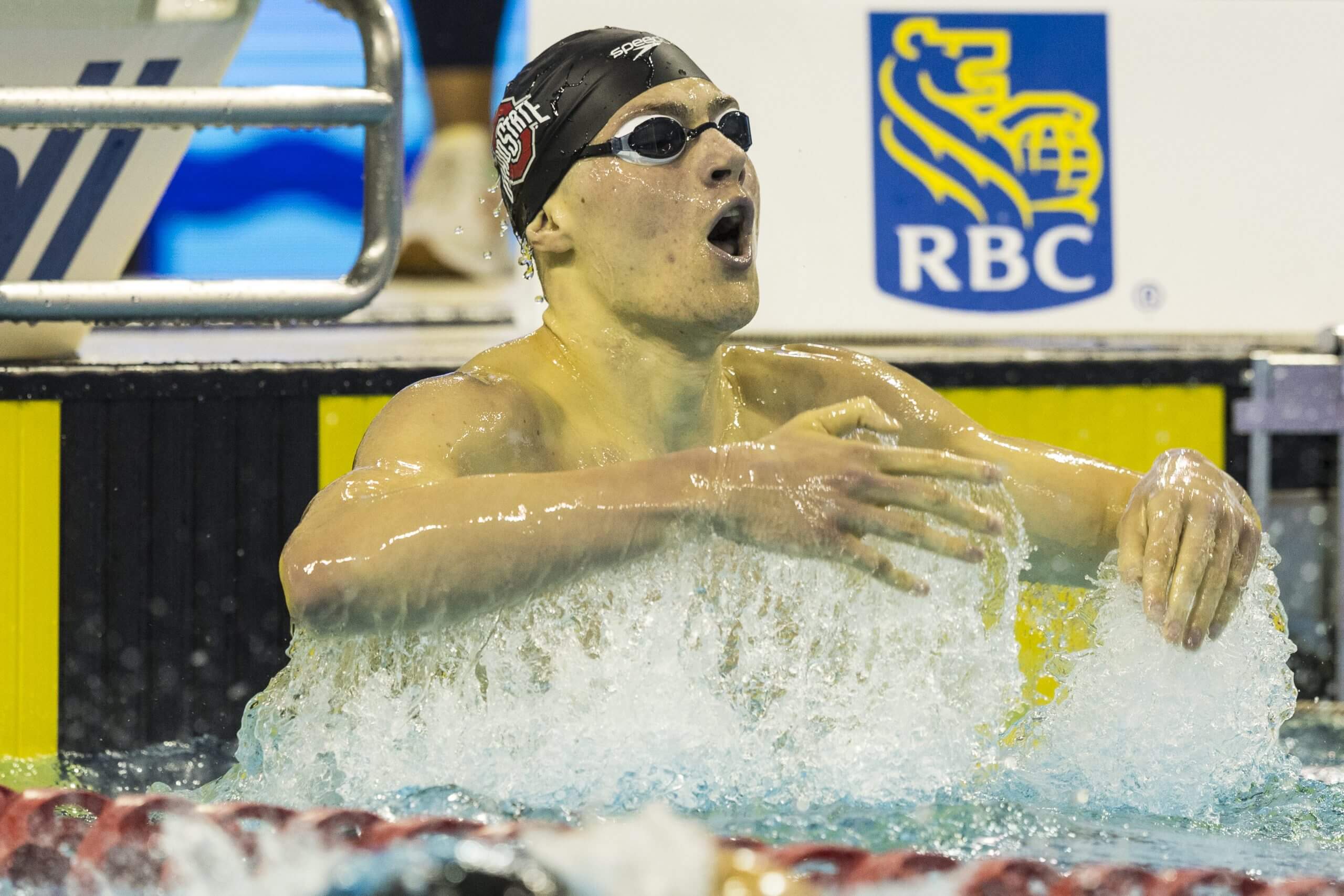
While the road to becoming a great 400 IMer is incredibly difficult, many have certainly risen to the challenge. We spoke with two of college swimming’s best in the event, Tristan Jankovics of Ohio State and Campbell Stoll of Texas, to uncover the secrets behind the race. Jankovics was the silver medalist at the 2025 NCAA Men’s Championships while Stoll finished 10th at the NCAA Women’s Champs.
Training Approach
With the 400 IM being such a unique race, training correctly is a challenge. Balancing an emphasis on the “stroke” aspect and aerobic capacity during training can be difficult, as it’s hard to combine both into one practice. Both swimmers described growing up with more of a “stroke” focus at practice, given their respective strengths. However, by adding more aerobic freestyle sets, they’ve been able to take their IMs to new heights.
Stoll pointed to the freestyle as vital to her confidence in her back half of the race. “You really need to work on the freestyle, because that’s how you end the 400,” Stoll said. “It’s helped me gain a lot of confidence at the end of the race.”
For Jankovics, additional freestyle work has helped not just provided a physical boost.
“The yardage has definitely helped with my fitness, but also just (my) mental toughness,” Jankovics said.
Working on Weaknesses
Even at the elite level known by these collegiate athletes, every swimmer has a “strong stroke” and a “weak stroke.” In order to be efficient in the IM, though, consistency in all four strokes is a necessity. It’s why the athletes emphasized that a focus on their less-developed strokes at practice was equally important.
“We like to say ‘focus on your weaknesses, but keep your strengths sharp,’” Jankovics said. “We’re constantly mixing things up, and it’s made me grow.”
Both swimmers pointed to the butterfly leg as a key focus recently, but in very different ways. For Stoll, that leg is a strength to improve upon.
“Working on gaining confidence in my butterfly, and trusting myself to go out fast,” Stoll said of her mindset. “It’s something that could transform my I.M.”
For Jankovics, the leg was something to improve upon.
“We’ve been putting a lot of work into the butterfly, just to find an easy speed to start the race off with,” he noted.
Race-Day Revelations
While it’s important to ensure all strokes are strong to be successful in the 400 IM, it’s impossible to make them all perfect. That’s when race strategy often comes into play. The swimmers pointed out that many competitors swim the race in different ways, often looking to conserve their energy for their best strokes. This thinking presents an interesting challenge, as it’s hard to know what to expect from any competitor.
“You kind of have to put your blinders on, but balance that with going out there and racing,” said Stoll. “I’m always telling myself: ‘stick to the gameplan, but don’t forget to have fun and race.’”
Jankovics referenced NCAAs last March as a learning moment. The Ohio State standout finished second, but felt like he performed outside of himself.
“My biggest takeaway was that I wasn’t used to situational racing,” he said. “I didn’t realize those around me would take it out that fast, and so I’ve got to learn there are different factors to every race, and stay true to myself.”
The old saying “swim your own race” seemingly applies more than ever in the event. But with a steady mental focus, the swimmers have learned to handle their business in the water.
Accepting the Challenge
The unpredictability and unique training required for the 400 IM place a heavy toll on those who choose to swim it. However, Jankovics and Stoll welcome the adversity.
“I just kind of get in the mindset where I know it’s going to be hard. I know it’s going to hurt, and that’s okay,” Stoll said.
