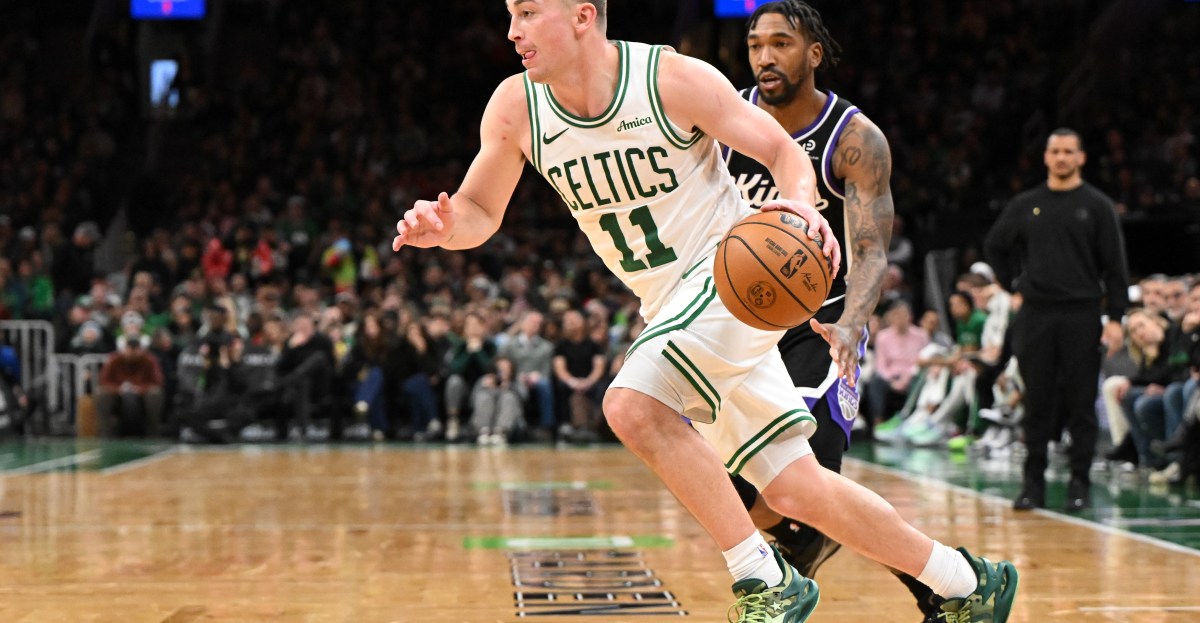
BOSTON — Celtics guard Payton Pritchard has spent years mastering the art of running an offense. The understanding of the role’s true importance didn’t come all at once for him, and it didn’t all come exclusively from basketball.
At West Linn High School in Oregon, Pritchard was a multi-sport athlete. He was the starting point guard on the basketball team, the starting shortstop in baseball, and the quarterback in football — a position ruled by responsibility and leadership, demanding more than any other in sports. He ultimately stuck with basketball, and throughout that journey from Oregon’s campus to Boston’s parquet, Pritchard held close to him a long-lasting instinct from his time on the gridiron.
That instinct proved especially valuable throughout Friday night’s 112-93 win over the Kings.
“I feel like playing football and playing quarterback taught me a lot about aspects of reading the game and getting everybody involved,” Pritchard said. “My dad was my coach, so he would allow me to call the plays — even in eighth grade — and going over it, it’s about, ‘How can you make everybody feel a part of the game?’ Your running back needs some touches, then you got your receivers, which you probably have four of out there. You can’t just target one guy all the time, so how can you spread the love?”
Pritchard’s responsibilities were amplified by Jaylen Brown’s absence against Sacramento. However, his mind didn’t immediately turn to scoring. Instead, it turned to facilitating. Pritchard knew that even without Brown, it wouldn’t take a significant scoring figure from himself to keep the team’s core principles intact. That’s where his inner-quarterback kicked in and elicited instincts that forced Pritchard to think “pass” rather than “score.” Getting others involved kept Boston’s offense lethal, even without its star player.
Mentally, he’s thinking like he’s in the pocket. Pritchard dribbles with the intention of making the best possible play. Sometimes that means he’ll quarterback sneak his way past defenders and take scoring into his own hands. Other times, he’s moving around the floor in search of targeting teammates to rack up his completions — or, as they’re called in basketball, assists. It’s very quarterback-esque how, at times, Pritchard will command a lot of the opposing defense’s attention, then use it as a means to thread the needle like a quarterback, and find those slim openings that lead teammates to scoring the basket instead.
Operating like a signal-caller has allowed Pritchard — and the Celtics — to turn the “sharing is caring” cliché into a viable way to keep their offense up to standard, no matter who’s on the floor.
“For me, that taught me — even in basketball — sometimes you can go and score, but (other times) getting this guy the ball, letting him feel it, get a shot up,” Pritchard said. “Then later in the game, knowing that opportunity might come back to me, I’ll have that spot again. So it’s stuff like that — just dictating the game.”
Pritchard understands the balance of scoring versus facilitating. In the first half, he scored 22 points as the offensive aggressor, shooting 9-of-11 from the field, including 4-of-5 from three. Then, when the second half came around, it turned over to navigating everyone else’s offense. Pritchard might be getting more touches whenever Brown is sidelined, but that doesn’t mean he’s going to switch things up and get experimental.
“The mindset never changes,” he said. “It’s always about being aggressive and being ready for my opportunities when they come.”
Pritchard recorded eight assists, with three connecting to center Neemias Queta.
“I think he’s done a tremendous job,” Pritchard said of Queta. “He’s taken a drastic step forward in learning where to be — the right places — and I still think there’s a lot of growth left in him. He’s just scratching the surface.”
Together, Pritchard and Queta have been working all season to build their chemistry. Gradually, their pick-and-roll connections have started to click, with Pritchard attacking spots around the floor and Queta stationed in the paint, ready to catch a feed and finish the possession.
“When he has the ball, and there are two guys on him, just get out the way and find a way to stay impactful at the rim,” Queta said.
Twice, Pritchard guided Queta to the rim with sleek feeds under the basket. The third time, he threw an over-the-shoulder hook pass, channeling Patrick Mahomes–level creativity to punish Sacramento for its double coverage and set Queta up for the layup. It’s clear from their growing rapport that Pritchard tapping into his quarterback instincts can elevate them both, and more importantly, Boston’s offense as a whole.
Queta’s rise as a first-time starter has made him one of the league’s most underappreciated big men, thanks in large part to Pritchard’s growth as a playmaker.
“I feel like he’s getting better at finding little pockets — windows, we call it,” Pritchard said. “I like to play at 10-foot range a lot, and it allows me to sometimes draw two (defenders), and for him, it’s finding little windows for the lob or even the dump-offs so he can go up. We still have to get better and better at it, but we’ve taken a lot of big steps, and it allows us to get easy buckets.”
