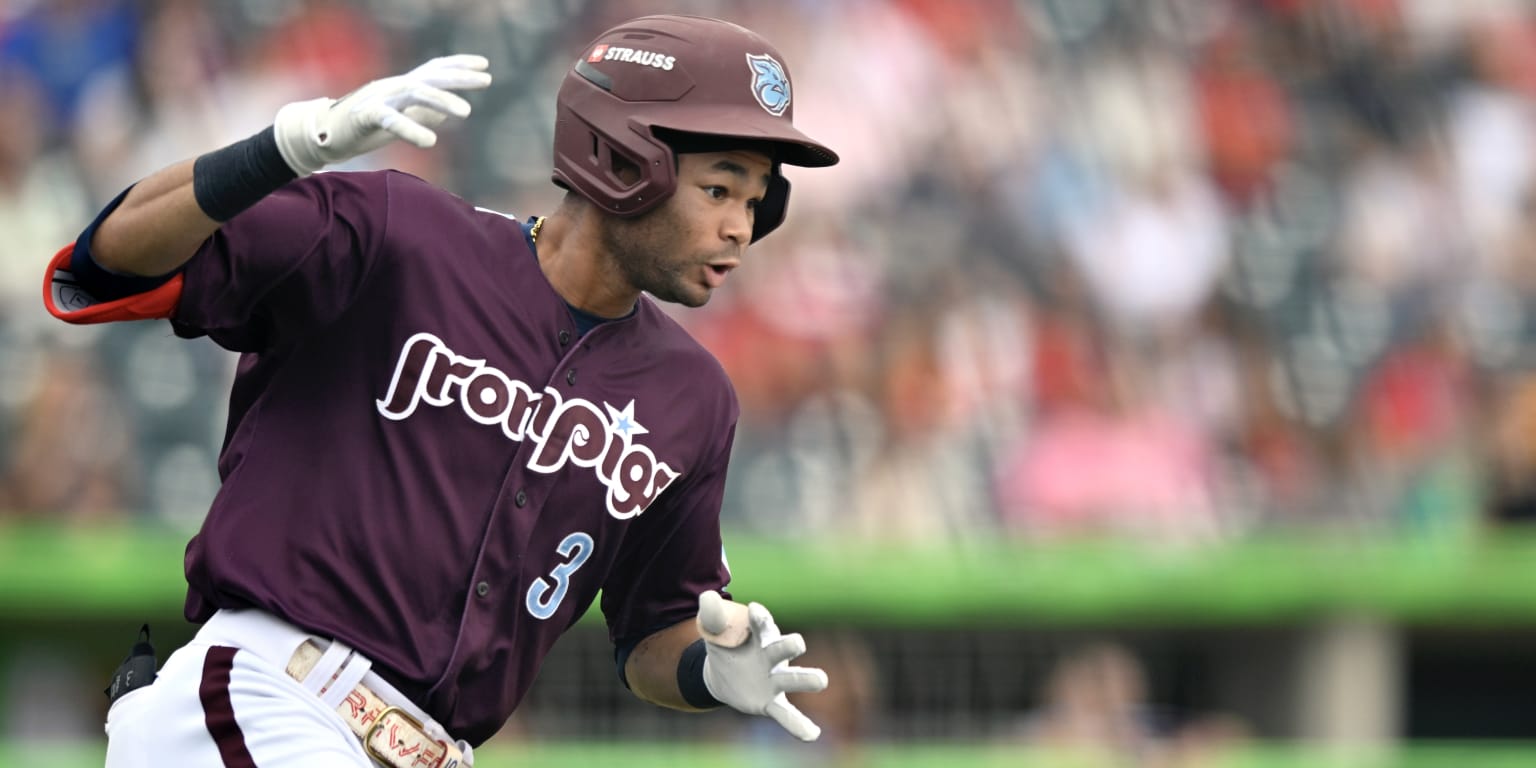
The Phillies’ outfield seems set for a shakeup this winter, and however that shakes out, it seems like Justin Crawford will be in the mix for a roster spot come Spring Training.
The club’s No. 3 prospect (MLB No. 54), the 21-year-old Crawford has little left to prove in the Minors, and with the Phillies expected to part ways with right fielder Nick Castellanos this winter, the clear path to the Majors that narrowly eluded Crawford this summer seems to be opening.
“We have some young players that we’re going to mesh into our club,” Phillies president of baseball operations Dave Dombrowski told MLB.com’s Todd Zolecki in October. “I’m not going to declare that anybody has a job, but there will be some people that we’re really open minded to be on the big league club next year coming out of Spring Training … [Crawford] needs to go to camp and just do what he’s basically been doing.”
Todd Zolecki in October. “I’m not going to declare that anybody has a job, but there will be some people that we’re really open minded to be on the big league club next year coming out of Spring Training … [Crawford] needs to go to camp and just do what he’s basically been doing.”
COMPLETE PHILLIES PROSPECT COVERAGE
The Phillies’ first-round pick (17th overall) out of the Las Vegas prep ranks in 2022, Crawford has showcased precocious plate discipline and game-changing speed, leading to a career .322 average and .385 on-base percentage with an 18.4 strikeout rate. He was nearly called up this summer before the Phillies’ outfield issues resolved themselves, with Crawford in the midst of a standout year at Triple-A that saw him hit .334 with 46 stolen bases and an .863 OPS.
Let’s take a closer look at the young speedster and how and when he might impact the Phillies for real at the big league level.
What makes him stand out as a prospect?
Crawford’s top tool is his 75-grade speed, which influences every part of his game. He’s a legitimate threat to steal bases in any count, and his quickness allows him to turn routine grounders into hits and take extra bases aggressively. He’s stolen 40 or more bases in each of his three full pro seasons while running to a strong career 82 percent success rate.
Offensively, Crawford shows a consistent contact profile, with the ability to spray the ball to all fields and reach base at a high clip. Added strength and tweaks to his stance and approach have allowed him to impact the baseball more frequently at the high levels, and his bat speed and feel for the barrel give him a chance to grow into more gap power as he matures physically. He’s managed 48 doubles, eight triples and 16 homers over the past two seasons.
What are the biggest obstacles to reaching his ceiling?
With a carrying tool like Crawford’s speed, he may never grow into a ton of power. And that could be just fine. But Crawford’s swing remains ill-suited for lift, and he still hits a ton of balls on the ground despite slicing his groundball rate in each of the past few seasons.
Another complicating factor is that Crawford might be better suited for a corner spot despite his center field-type offensive profile. Crawford can play left or center, but most agree his best position is left – where power tends to factor more heavily into the profile. That said, Crawford’s dad, the 4-time All-Star Carl, found plenty of success as kind of the ideal version of this skillset, while playing almost exclusively left during his 15-year career.
What is a reasonable comp at the Major League level?
Therein lies the most obvious answer. Carl Crawford won four MLB stolen base titles and swiped 480 career bases while pairing 123 triples with 136 homers, though his offensive production declined with his wheels in the back half of his career. His son might not have quite that kind of power. But even if he doesn’t grow into any more pop, Justin could mirror his father as a left-handed hitter with elite speed and the ability to impact the game with his legs and defense.
When should we expect to see him in the Majors?
Dombrowski has all but committed to giving Crawford a chance to win an everyday roster spot this spring, though what exactly that looks like remains to be seen and is dependent on several factors. The Phillies are always contending, so free agent signings or trades remain a possibility this winter – either could shake up the outfield.
Any potential moves of that type are largely contingent on the Phillies’ first order of business: re-signing free agent slugger Kyle Schwarber. If Schwarber signs elsewhere, the Phillies might be inclined to pursue slugging corner outfielders. That could, in turn, push Crawford’s opportunity to center, where his clearest path to the Majors is probably at his best position, which is left.
