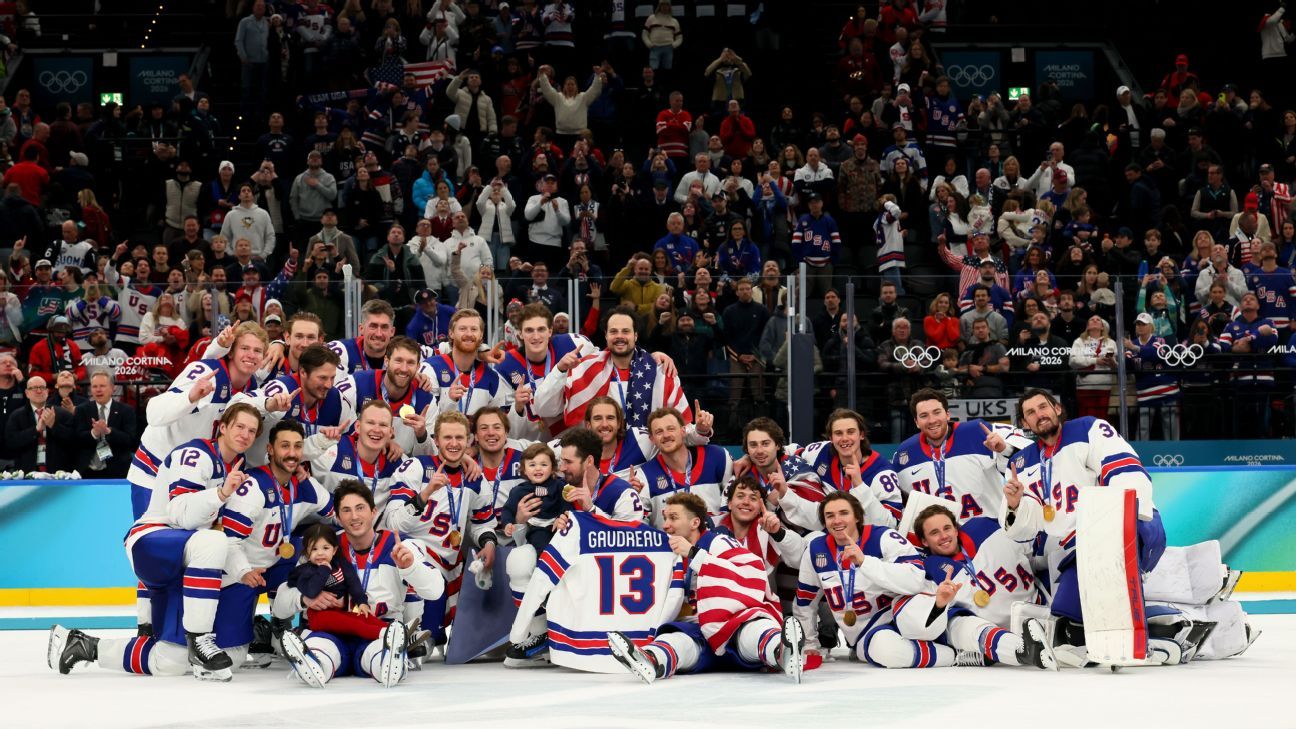
The Olympic men’s hockey gold medal game promised to be an epic showdown between the United States and Canada. And it delivered.
Following goals by Team USA’s Matt Boldy and Canada’s Cale Makar in regulation — and a slew of incredible saves by Team USA’s Connor Hellebuyck and Canada’s Jordan Binnington — the game went into overtime Sunday.
In that extra session, Jack Hughes took a pass from Zach Werenski and buried it past Binnington, giving the U.S. a 2-1 victory and its first gold medal in men’s hockey since 1980.
Here’s what went right and wrong for both teams, the MVP of the game, and what this result means for the rivalry moving forward.
Why Team USA won
It would be easy to write the words “Connor Hellebuyck” and leave it at that.
The Winnipeg Jets star is the reigning NHL MVP and winner of the Vezina Trophy as the league’s best goaltender. He cemented himself as the best netminder in the world with a gold medal game performance for the ages.
He stopped 41 of 42 shots against Canada, 27 of them coming from the slot and 17 of them coming from the inner slot, according to Hockey Stats. His paddle save on Devon Toews on a point-blank chance was the best stop by a goalie in the tournament. His breakaway stop on Macklin Celebrini was equally as clutch. The Americans have had great performances from goalies in their history, from Jim Craig in the Miracle on Ice to Ryan Miller in Vancouver. None of them top what Hellebuyck gave the Americans in this gold medal game.
THAT WAS ONE HELLE-BUYCK OF A STOP. 😳 pic.twitter.com/N3wCimdBGw
— NBC Olympics & Paralympics (@NBCOlympics) February 22, 2026
But if we’re being honest, leaning on Hellebuyck to be their best player was not exactly an ideal scenario for Team USA against Canada, who basically carried play for the final two periods with a 33-18 shot advantage.
Both Canada and the U.S. probably didn’t anticipate their special teams needing to be so vital in the championship final, but their penalty kills were also a key to the game. The Americans killed off a 5-on-3 power play for 1:42 in the second period against the best offensive talent in the world. After the U.S. failed to score on a double-minor high sticking penalty issued to Canada’s Sam Bennett late in the third period, they had to then kill off a Canadian power play after Hughes was whistled for a high stick.
There were times in which it looked like the Americans were falling back into their old role as the team trying not to lose to Canada instead of trying to win. That could have spelled the same kind of disaster they experienced in Sochi, for example. But Hellebuyck prevented the dam from breaking.
The U.S. won gold for the first time since 1980 because it converted in the 3-on-3 overtime. This format is, of course, entirely unfair to the two teams that battled for 60 minutes in a traditional hockey game. Let’s face it: There’s a reality in the multiverse in which the U.S. and Canada don’t even make the gold medal game if their 3-on-3 luck was different in the quarterfinals.
But if there’s going to be 3-on-3 to decide the gold medal, there are few American players you want out there more than Hughes. The New Jersey Devils star is fast and creative and has been a force in the NHL overtime with nine game winners in 404 games, the second most in team history.
JACK HUGHES DELIVERS AMERICA’S GOLDEN MOMENT IN OVERTIME. pic.twitter.com/4foFDOri53
— NBC Olympics & Paralympics (@NBCOlympics) February 22, 2026
Hughes’ goal doesn’t happen without a great forechecking play by Werenski, who knocked Nathan MacKinnon off the puck and then slid a pass to the streaking Hughes for the golden goal.
The American players brought out the late Johnny Gaudreau’s Team USA jersey on the ice during their celebration. Werenski was a teammate and a close friend. That’s one of those “hockey family” moments you won’t forget.
For Johnny Gaudreau. ❤️ pic.twitter.com/rWycdK8NUo
— NBC Olympics & Paralympics (@NBCOlympics) February 22, 2026
Hellebuyck was the story of the gold medal game for Team USA. Jack Hughes was the story of the tournament for the Americans. He was maligned by critics for his play in the 4 Nations Face-Off, looking overwhelmed after shifting from center to wing. He started on the fourth line for Team USA, was arguably the team’s best forward in group play and earned a larger role in the elimination tournament. That he scored the golden goal was only appropriate.
Move over, Mike Eruzione. No, it wasn’t a miracle. But it was the most consequential goal ever scored in American hockey history.
Why Canada lost
There’s little question that the Canadians were “goalied” by Hellebuyck in the gold medal game, but they also had a multitude of chances that they should’ve cashed in on — even against otherworldly goaltending. MacKinnon missed a gaping net. Celebrini had six shots on goal, including a breakaway chance, but the 19-year-old couldn’t conjure the magic that he had earlier in the tournament.
Coach Jon Cooper put his lines in a blender during the game, hoping to spark something that would lead to a potential game-winning goal. He never found the right mix.
Some credit has to go to the American defense corps. While the goaltending disparity between these team got the most attention, it was the depth of Team USA’s defense that was its greatest advantage. In the first period, those defenders did a great job of disrupting plays in the attacking zone. The rest of the game was bending, not breaking, and then having Hellebuyck clean up the rest. They didn’t really activate offensively enough because of their responsibility in the D zone, but in the end, that group won out against the Canadians’ incredible offensive forces.
But let’s face it: There is also a Sidney Crosby-sized caveat to the Americans’ victory. The Team Canada captain and Pittsburgh Penguins star sustained a lower-body injury against Czechia, missed the Canadians’ semifinal game against Finland and was questionable for the gold medal game. That he couldn’t go was a surprise — Hockey Canada was using his photo to promote the game, for what it’s worth — and his absence was felt heavily.
Nick Suzuki, Crosby’s replacement between Mitch Marner and Mark Stone, lost six of seven faceoffs in the game. It’s hard not to believe that one of those Canadian power plays might have converted with the Penguins star out there; Crosby is 12th in NHL history with 607 power-play points. That’s not to mention the loss of his leadership. In such a tight game, having a two-time gold medal winner — capturing one of those golds against the Americans in overtime, no less — could have made a difference.
For a year, American fans have talked about not having Quinn Hughes, Charlie McAvoy or a healthy Matthew Tkachuk in the final of the 4 Nations Face-Off. That Crosby didn’t play in this gold medal game might serve as the same asterisk for Canadian fans.
There has also been some early quibbling about the officiating from Canadian fans, including a slash on McDavid that was ignored and a non-call on a Team USA too many men penalty. But they had ample chances to beat Hellebuyck and couldn’t. They had the puck in overtime and couldn’t find a hero until Hughes accepted the mantle for the Americans.
The Canadians deserved gold with this effort. The Americans ended up with the medal around their necks. Now it’s a real rivalry.
Gold medal game MVP: Connor Hellebuyck
As Jack Hughes caught his breath in a postgame interview with NBC, the only thing he praised more than the brotherhood of USA Hockey was the play of his goaltender.
“He was our best player today by a mile. That was a ballsy, gutsy win. That’s American hockey right there,” Hughes said.
Hellebuyck played well in the 4 Nations Face-Off, but losing the title game conjured up past criticisms from his NHL career, claiming he doesn’t play his best when the pressure is turned up in the playoffs. Team USA management shook that off and made Hellebuyck the starter for the 2026 Olympics, outside of a failed audition by Jeremy Swayman in group play.
Hellebuyck had a .947 save percentage heading into the gold medal game and ends the tournament at .956. His goals saved above average was 5.92, the most of any goalie in the Olympics and indicative of how incredible he was in the gold medal game.
It was expected the Americans would have the goaltending advantage over Canada. That was mostly a criticism of Canada’s depth, and the suspicion that Binnington might cost them eventually. Instead, the advantage turned out to be that the Americans had a goaltender who could carry them to the gold medal on his own. As Hughes said, Hellebuyck was Team USA’s best player “by a mile.” And the reason its anthem played.
State of the U.S.-Canada rivalry
The state of the rivalry is that it’s now actually a rivalry.
The U.S. and Canada women’s rivalry became the most heated one in hockey because they are seen as equals. The U.S. won in Nagano, Canada won four straight gold medals, and now the U.S. has won two of the past three Olympics. The Americans won 11 of the past 16 IIHF world championships. Both teams had strong talent pipelines (we’ll see your Hayley Wickenheiser and raise you a Hilary Knight). Every game was one battle after another, and the winner was never predestined — even in Milan, with the U.S. almost squandering its best roster ever against its archrivals.
The U.S. and Canada men’s rivalry had, for the most part, been extremely lopsided since the NHL started sending players to the Olympics in 1998. Canada won Olympic gold in Salt Lake City against Team USA in 2002. The Canadians famously beat the U.S. in 2010 in Vancouver on Crosby’s golden goal in overtime. They sent the U.S. to the bronze medal game in Sochi in 2014. They won the World Cup of Hockey in 2016, where the U.S. was a nonfactor. They won the 4 Nations Face-Off in 2025 on McDavid’s golden goal in overtime.
Outside of preliminary-round wins in Vancouver and in that fight-filled game at 4 Nations, there weren’t many best-on-best moments for the Americans in this rivalry. Team USA was a yapping puppy, an annoying little brother, a team that entered games with Canada convinced it was the lesser of the two hockey superpowers — and frequently played that way.
But bubbling under the surface over the past two decades was a rich pipeline of American hockey talent. The Americans made inroads in the IIHF world junior championship tournament, winning more gold medals (six) than Canada (five) since 2010. The players they were churning out from their national development program weren’t the blue-collar grinders that USA Hockey felt it needed to produce in the penumbra of the Miracle on Ice. They were players like Patrick Kane and eventually the Hughes brothers, the Tkachuk brothers, Jack Eichel and Auston Matthews. Elite, skilled talents that are among the brightest offensive stars in the NHL.
And so the Americans entered the 2026 Olympics believing, for the first time in this rivalry’s history, that they were equals to the Canadians. Not necessarily based on on-ice results — although forcing overtime in 4 Nations while missing Quinn Hughes, McAvoy and having an injured Matthew Tkachuk certainly inspired confidence — but on the deepest hockey talent pool the country had ever created.
But they needed to beat Canada for any of this to matter, and now the Americans own the gold medal in men’s hockey for the first time since the miracle.
Canadian fans are already resting on the twin crutches of Crosby’s absence and Hellebuyck having the game of his life, and that’s fantastic for this rivalry. The Americans have the gold. The Canadians still have their arrogance of hockey superiority by birthright. All that means is that we’re going to be doing this dance together for a very long time, except now on equal footing.
As Jack Hughes said after winning Olympic gold for the Americans: “We wanted to go through Canada and beat them.”
Now it’s a rivalry.
