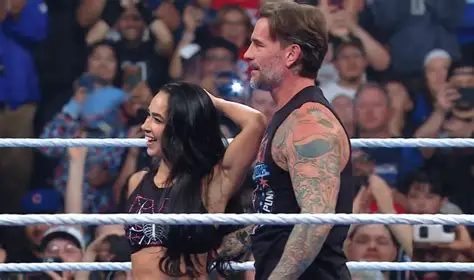
Long before their real-life relationship became public, AJ Lee and CM Punk were already sharing milestones, just not in the way most couples do. Their connection began as part of WWE storytelling, blurring the line between performance and reality in a way that feels uniquely wrestling.
Appearing on What’s Your Story?, Lee reflected on how surreal it is that one of the most personal moments of her life happened in front of a live audience. What eventually became a genuine relationship started with an on-screen kiss, years before they actually dated. That revelation led to a lighthearted exchange with Stephanie McMahon, who noted that her own relationship with Triple H followed a similarly unconventional path: one that involved storylines, breakups, and reconciliations long before romance entered the picture.
Lee acknowledged how strange that reality can be, joking that wrestling has a way of turning normal relationship timelines upside down. She also recalled moments where Punk subtly shifted scripted material to avoid crossing personal lines, choosing humor and flirtation over dialogue he felt was unnecessarily harsh. What began as friendship eventually turned into something more once timing aligned for both of them, and the transition happened quickly. In Lee’s words, it felt like one moment they were testing the idea, and the next, they were married.
Their story highlights one of wrestling’s strangest truths: sometimes the most important moments happen under bright lights, long before anyone realizes they matter.
What Fans Should Know
Wrestling has a long history of turning fiction into reality, and the AJ Lee–CM Punk story fits a familiar pattern that fans have seen play out before. From Triple H and Stephanie McMahon to Edge and Lita, WWE has often blurred personal relationships with on-screen storytelling. What makes this case stand out is timing: the emotional beats that fans remember weren’t retroactively framed as romantic, they happened years before either person knew where the relationship would lead. That context matters, because it explains why their story feels less manufactured and more organic than most wrestling romances.
From a storytelling perspective, this is also a reminder of how much trust WWE places in performers when chemistry clicks. Punk choosing to abandon scripted dialogue in favor of something more playful wasn’t just a personal moment; it was an example of a veteran understanding tone, audience perception, and character alignment. Those unscripted adjustments are often invisible to viewers, but they’re the difference between segments that feel forced and ones that resonate. Wrestling history shows that when performers are allowed to humanize angles, the audience responds more authentically.
For fans, the value in revisiting this story isn’t gossip, it’s understanding how wrestling relationships evolve differently than real-world ones. On-screen moments can come years before real emotional investment, and friendships often precede romance because of the industry’s unique demands. Knowing that context helps fans better appreciate why some wrestling relationships feel believable while others don’t and why, in this case, the line between storyline and real life blurred in a way that only wrestling can produce.
