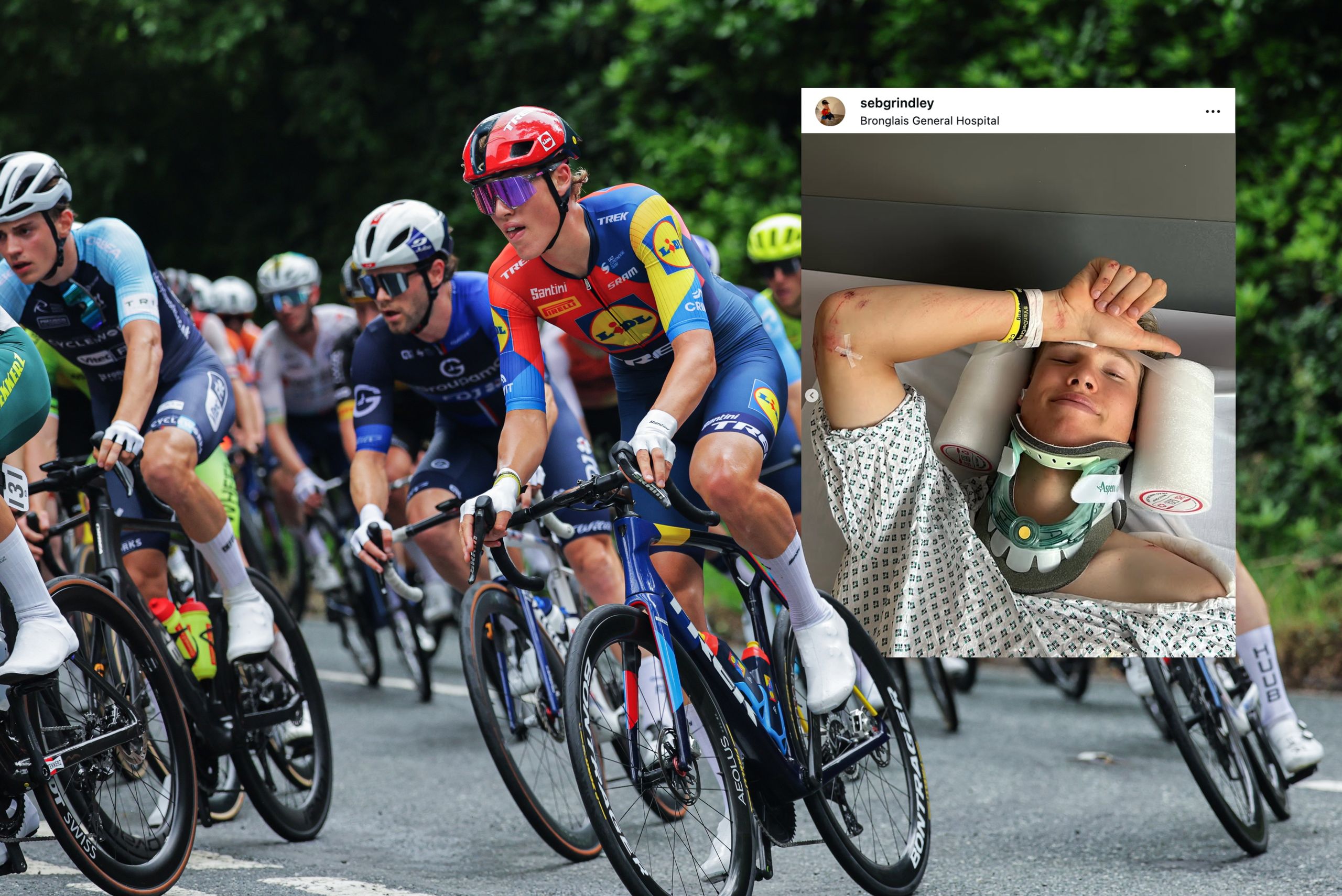
It was when Seb Grindley began searching for his sunglasses, cast off his face to the roadside during the crash, that he realised something was wrong. “I couldn’t turn my head at all,” he remembers. “I was moving my whole torso and keeping my neck completely straight. Then I realised I couldn’t actually move my neck.”
The 19-year-old staggered worriedly to the in-race ambulance. “I was like, ‘I’ve got a really weird feeling in my neck’,” he says. “As soon as I mentioned any sort of head/neck injury, they put me straight on a stretcher, and I didn’t move for the next three weeks. It was pretty crazy.”
The pain, he tells Cycling Weekly, was “just uncomfortable – it was like when you go backpacking, and you’ve got a super heavy backpack on, and it strains the neck a bit.”
Half a year has now passed since he left his last race in an ambulance, and Grindley is strain-free. He’s looking forward to a fresh start this season. The memory of how his last one ended, however, is still vivid in his mind.
The moment came on the descent of a narrow country lane. Grindley, nestled among the top-20 riders in the bunch, was travelling at around 60kph. Suddenly, a manhole cover jutted out of the ground in front of him. “I hit it, it was quite wet at the time, and I just slipped straight off the bars,” he says. “My chest was where my Wahoo is, on my bars, and my hands were just completely off it… I literally just closed my eyes.”
Like a rag doll tossed across a bedroom, the teenager’s body hurtled into a bush at the side of the road – “there were a few thorns in my helmet”. He then bounced back onto the tarmac, where the charging peloton folded on top of him. He remembers one rider landing on his head. “I think that was what caused the injury.”
Grindley’s first instinct was to find his bike and remount. “But I couldn’t actually get myself up off the ground,” he says, “which was a bit scary.
“I knew I’d lost some skin, obviously, from the crash. But it wasn’t a bone pain. When I’ve done my collarbone before, I knew it was instantly broken. I just felt strange. I felt like my neck didn’t have that much support, so I couldn’t get myself up.”
A few hours later, as Ineos Grenadiers’ Sam Watson won the race, Grindley was lying in a hospital bed on the outskirts of Aberystwyth.
Naturally, the 19-year-old began to think about his future. The doctors told him the fracture could be “unstable”. If it was, he asked himself, would he still be able to ride his bike? And what about his contract with Lidl-Trek? He had signed for two years at the start of the season. Now, it looked certain he wouldn’t race for months, with a lengthy spell of recovery to follow. Might his career be over before it had even started?
A call from Lidl-Trek’s development team boss, Markel Irizar, but his mind at rest. “It was literally that night or the day after the crash,” Grindley recalls, “and he told me the team were going to support me through the recovery process.
“They extended my contract for another year – with a little bit of a pay rise as well, which was amazing – so I really did not have to stress about the comeback. I could just take my time with it and ensure I was fully healthy… I think that really, really took a lot of pressure off my shoulders.”
After a week in hospital, Grindley returned home, only to spend the next two weeks in another hospital bed his family hired for him. He watched the entire Tour de France lying in a neck brace. He then found himself dissociating from cycling – “I was upset with what I was missing, not because I disliked the sport” – and didn’t watch another race.
Come September, though, three months after the crash, and Grindley was venturing back outside on his bike. His training has since been intensive; he’s gone “full-gas” on Wednesday chain gang rides with his friends, and been on two Lidl-Trek training camps, where he has ridden with the WorldTour squad. His numbers, to his delight, are now better than ever.
“We have some tests that we do every year, and there was a noticeable improvement,” Grindley says. “I had higher watts, and I was slightly lower weight because I lost quite a bit of muscle during that time in bed.
“The team are really happy with where I’m at, and I’m also happy. I feel in a really good position to start the season stronger than I even was last year.”
(Image credit: Ross Bell / Lidl-Trek)
With his contract now secured until the end of 2027, what are Grindley’s hopes for his second year with Lidl-Trek? “The biggest goal, in general, is to keep learning,” he says. “I also want to get a UCI podium or a UCI win, just to kind of be in the mix again.
“Last year, obviously, it was my first at under-23, it’s all about learning, and it got cut short. I still need to have a little bit more time to learn.”
The teenager will make his long-awaited racing return in Calpe, Spain later this month. After that, his focus will be on building form towards Paris-Roubaix Espoirs in the spring; his debut in the under-23 race last year, which finished in a Lidl-Trek 1-2 and a 20th place for Grindley, was his standout moment of the season.
“This year, it could be another race where we’ve got two leaders, and hopefully it will be myself and Héctor Álvarez,” he says, adding determinedly: “We’ve got a title to defend.”
“I’m just excited to get back into it, more than anything. More than scared or nervous. Just excited.”
Explore More
