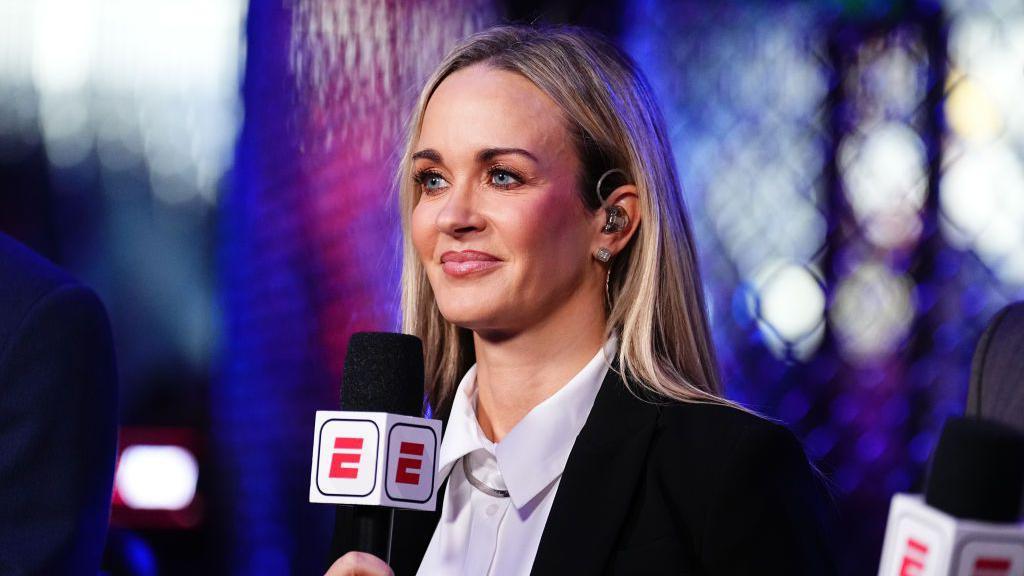
Laura Sanko does not need to think for long when she is asked which fight has been her favourite to commentate on.
At UFC 293 in 2023, she became the first woman in the modern era to cover one of the promotion’s pay-per-view broadcasts.
Advertisement
Former kickboxing champion Kathy Long was the last to do so at UFC 1 in 1993.
Just under 30 years later, Sanko guided fans through American Sean Strickland’s stunning win over Nigeria-born New Zealander Israel Adesanya to win the middleweight title.
“It wasn’t because I was rooting for anyone in particular, but being able to be part of that moment, and the first woman to call a PPV in 30 years, it was and is a big deal,” Sanko tells BBC Sport.
For as long as she can remember, the American has been breaking down barriers for women.
Before her broadcasting career, Sanko started training in MMA in 2006, where she faced barriers in convincing men she belonged in the gym.
Advertisement
With no women being signed to the UFC until 2012 when Ronda Rousey debuted, many did not see MMA as a viable career path.
For seven years, Sanko says she was usually the only woman at her gym.
The 42-year-old pauses before revealing the challenges that brought as she adds: “Probably the toughest challenge was finding the right way to be accepted on a team and go about it the right way, and not make it about being different to them.
“It was about not sticking out, and not making it about being a woman. It was about almost doing whatever I could to prove that didn’t matter.
“Yes I was smaller, yes I was female and yes there were certain things that would be different for me because of that, but it was about showing up every day, working super hard, not complaining and not showing them I was weak.”
Advertisement
Sanko fought seven times before leaving the sport after becoming pregnant.
She turned to broadcasting afterwards, but the obstacles as a woman during her fighting career remain.
‘It’s special, but one day I hope it’s not unique’
Sanko commentated on Tom Aspinall’s heavyweight title bout against Ciryl Gane at UFC 321 last month [Getty Images]
Sanko has held a number of roles during her UFC broadcasting career, working her way up from a reporter to an analyst and commentator.
But she adds: “The challenge was earning the respect of the guys I worked with, not demanding it and not expecting it to happen overnight. I had to prove I belonged there, not because I was a woman.”
Unlike her male commentator peers, which includes former UFC champions Michael Bisping, Daniel Cormier and Dominick Cruz among others, Sanko carries a bigger weight when she is on air.
Advertisement
Citing criticism from fans on social media, she doesn’t just represent the UFC and martial arts, but women as a whole.
“It’s a different standard for the fans. I feel like I have to get it right, and not just for me,” says Sanko.
“I have to get it right because if I suck, then all women suck. That’s just how it is.”
Sanko is a trailblazer and beams at recalling stories of inspiring girls to start jiu-jitsu, and fathers telling her she is an example to their daughters of “what can be possible”.
“On one hand you want to celebrate it and it is special, but on the other I look forward to the day it is not unique, and it’s not news,” she adds.
Advertisement
“As much as I love being part of the history of this process, it’s also part of my goal that one day it’s not a big deal.”
‘It’s not glamorous for a long time but that’s OK’
Despite the challenges, Sanko praises the pioneering equality for women in MMA.
Since Rousey’s UFC debut in 2013, the promotion has consistently provided a platform for women to compete at the highest level and showcase their commercial viability.
Women will sometimes headline fight cards above their male peers, with fighters such as Amanda Nunes being paid more than her male counterparts.
Advertisement
“As much as it really truly is a male-dominated sport, somehow at the same time it is the sport that has the most equality, which is crazy to say both things are true at the same time,” says Sanko.
“To me it comes down to the training room and the respect that’s earned in the training room.
“When Dustin Poirier is on the mat with Amanda Nunes and he sees what she’s doing, you better believe there’s not one bit of him that doesn’t think of her as every bit of a fighter as the guys on the mat. And that’s true of every gym.”
Chicago-born Sanko never expected to be thought of as an inspiration to young girls, but would give two keys bits of advice.
Advertisement
“First of all, even though you’re young and it’s hard to do when you’re young, try and think about long-term success and goals,” she adds.
“The second one is just to do the work. It’s not glamorous for a long time, and that’s OK.”
