“It was like somebody had shot him,” says Simon Fletcher, describing the moment his son Lewis crashed on a tarmac BMX track a year and a half ago. First he heard the bang of the fork snapping, then came the sight of the limp body on the floor. “Even now, just remembering…” he continues, catching his throat as he speaks. “We thought the worst.”
Simon was coaching the pump track session when the incident happened. Lewis had ridden the course in Gravesend plenty of times before, but on this run, three quarters of the way round, his bike collapsed beneath him at 45kph, and he barrelled head first into the ground. Within moments, the emergency services turned up in an ambulance and a fire engine – the latter only needed for the most serious call-outs.
“It was so bad they put him to sleep, into a coma, straightaway at the side of the track,” Simon says. Lewis stayed unconscious for three days afterwards. He didn’t leave the intensive care unit at the hospital for two weeks.
He has no memory of the crash that almost ended his life, the now 18-year-old says, or any of the six months before it. “They found two bleeds [initially],” he says. “I was in a coma for three days, and it didn’t get any better. Then they gave me another brain scan, and I had four bleeds – two more bleeds.”
‘Cycling saved me’
(Image credit: Olly Hassell/SWPix)
It took four months before the teenager could return to school. Judged to be at high risk of having a seizure, he was also “banned” from driving for eight months – “I hated that,” he says.
“The parts [of my brain that I damaged], were [responsible for] language and emotions,” he says. As such, he struggled with his mental health– “I was depressed for a long time” – and began to have troubles with his speech. “I still do now sometimes,” he says. “I had speech and language therapy. It’s things like, if I had a conversation with you, I’d want to say ‘car’ but I’d say ‘bus’, or I’d want to say ‘bike’ and I’d say ‘car’.”
As time passed, Fletcher returned little by little to cycling. He began by turning his legs slowly on the turbo trainer at home in Dartford, riding until the headaches became so sore he had to stop. Come January 2025, though, just four months after the crash, and he was ready to commit himself again to the bike.
“That’s what saved me,” he says. “I was really, really struggling, then I got on a bike, and I felt back to normal. It’s so hard to explain. I didn’t have emotion, I didn’t feel happy, didn’t feel sad, I was just blunt, so blunt. I got on a bike, and I actually started smiling again.”
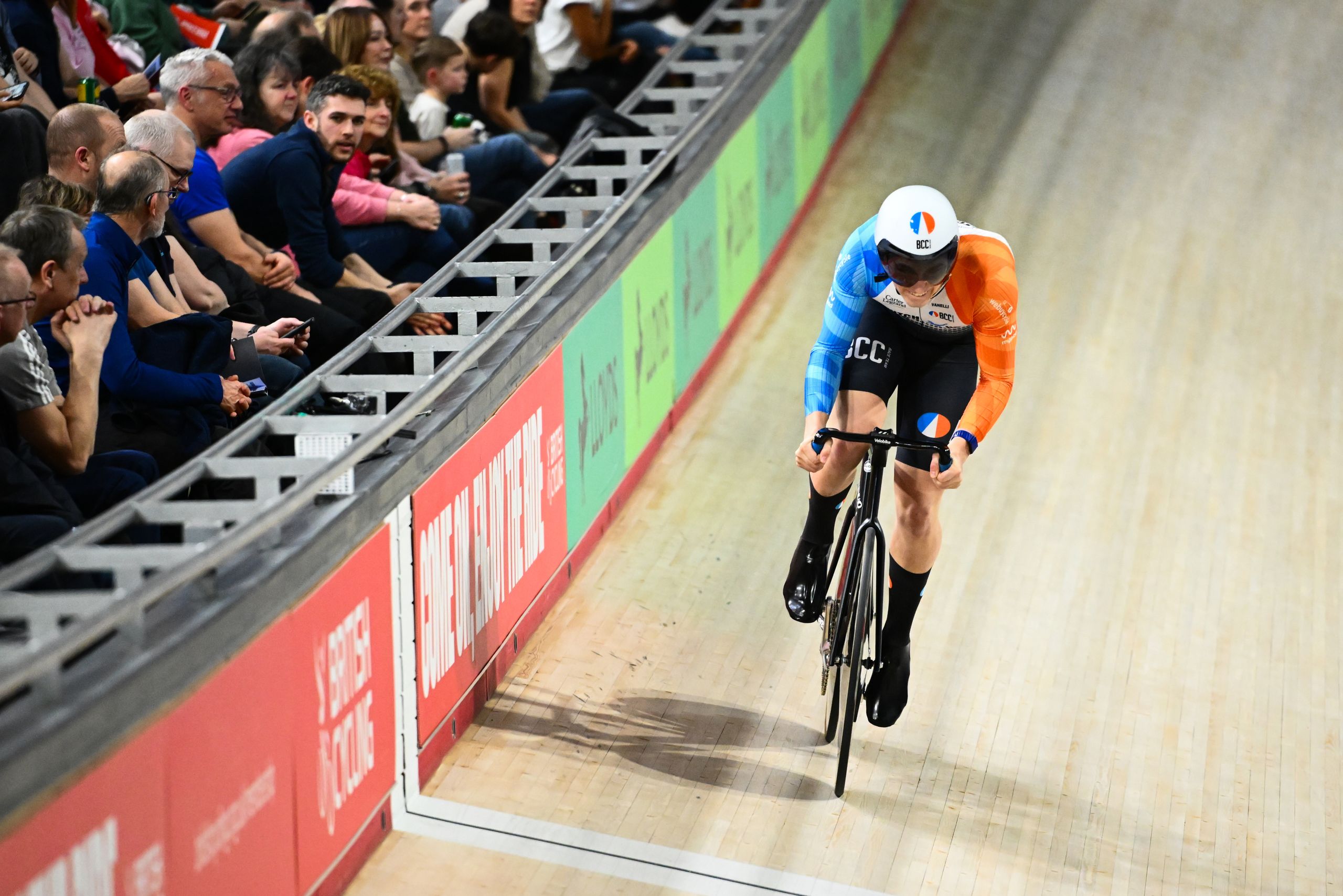
Once the fifth-ranked youth BMXer in the world, this time he turned his talent to the velodrome. “I met [my coach] Chris Pyatt, who took me on. Absolute legend, I love that guy,” he says, pointing across to Pyatt in a black polo shirt. “I’ve worked with him now for seven months, and I’ve gone from an 11.3 [seconds] to a 10.3 [in the 200m flying lap].
“I feel like I lost a year of my life – I don’t know about it, but I’m not going to complain. Where I am now, I’m living my dream, racing against riders who have got a GB top on, and opportunities that I want.”
Fletcher is now on a scholarship at the University of Derby. His A-Levels didn’t go to plan – he dropped a subject, had to relearn the syllabus because of the memory loss, and got a C and an E – but the university understood his case, and offered him a place nonetheless. He’s studying sport therapy and rehabilitation, which he combines with regular training, and one overarching dream.
“I want to be on GB. That’s my goal,” he says. Less than five metres away is the fenced paddock where GB’s men’s sprint squad is warming up. Sir Chris Hoy went from BMX racing to track sprint Olympic champion, I say. Fletcher points out that so too did Dutchman Harrie Lavreysen, the now 20-time world champion. Could that be his destiny, too? “Fingers crossed,” he smiles.
“I nearly died, so I’m lucky I’m still here. In the next three years, if someone says I’m going to die, I want to be happy. I’m not taking anything for granted.”
His dad by his side, Fletcher reaches out his right arm for a high five. “We’re going for the GB squad!” he says excitedly. With his future ahead of him, the crash, and that foggy September evening in Gravesend, suddenly feels a lifetime ago.
Explore More
