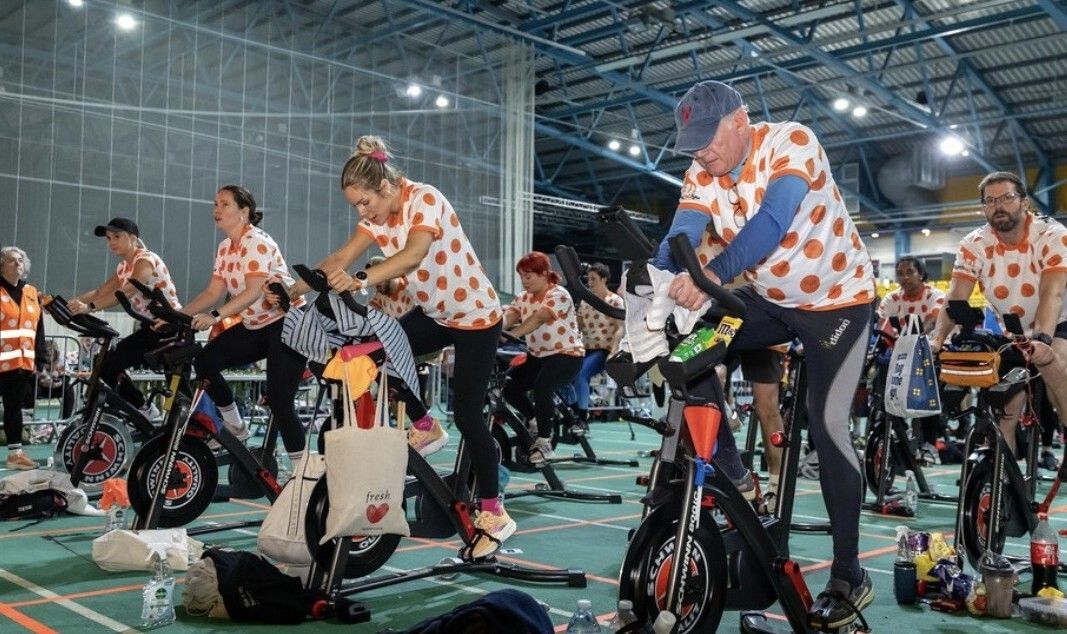
When I told people I was going to ride a spin bike for 24 hours straight, it was met with a lot of raised eyebrows. It’s understandable, once you learn I can’t actually ride a bike. And yet there I was, signing up for Bigmoose’s Project 1 Million, volunteering in a team of five, among hundreds of people, to cycle for an entire day. I was ready to find out just how much a spin bike could take out of someone with zero endurance experience.
Signing up to Project 1 million – in an effort to help raise £1,000,000 to fund mental health therapy – I had envisioned an entirely different experience; sitting in a quiet room, spinning, maybe listening to a podcast. I expected boredom to be a big challenge here. I was very wrong.
The atmosphere was like nothing else I’ve experienced. With the themed music hours, spin instructors, lively hosts and fun performances, there was constantly some sort of distraction from the growing aches and pains.
Ffion Wall is a freelance writer and dedicated spin enthusiast who, for now, can’t ride a bike outdoors.
It was the people involved that really levelled up the experience, whether it was the friends and family of spinners cheering people on, the amazing volunteers filling up water bottles and giving out unlimited sweets or other spinners giving their words of encouragement after their sessions on the bike, this is really what made the event as special as it was.
The one thing I did let myself down on was preparation.
In my defence, I originally signed up for one hour on the bike to begin with. It was only four days prior that I eventually agreed to 24 hours. I was entirely winging it and that was quite obvious.
I did, however, really believe I had outdone myself in the snack department. I turned up with a sandwich bag for every hour. This was great for the first few hours but, by the time I had eaten six bananas and so many handfuls of bland crackers and rice cakes, my plan went out the window. I just wasn’t hungry at all and the very unappetising selection of snacks did not help my case at all.
At around the midnight mark my team ordered pizzas. I knew I needed to keep eating and this sounded like the more appealing approach. Whilst it felt great in the moment, I am convinced that those few pizza slices were the cause of my early morning slump that only the coffee given to me by a lovely stranger at 7.30am could save.

(Image credit: Andy Gale Photography)
Something many people have also questioned me on is my choice of clothing. It was a given that everyone would be wearing the same orange spotty tees that Bigmoose friends always champion, so I didn’t feel I had to have much thought over my outfit. My lack of experience meant I hadn’t even considered the thought of padded cycling shorts. The silver lining of this is that people were impressed all the more but I certainly would not recommend it.
Here are the things I learned…
Inexperience wasn’t a disadvantage
I really had no business signing up to an endurance ride, with barely any skill or knowledge. I only started taking up spin classes two months before the event; this is ultimately what made me realise this was the kind of challenge I needed in my life.
Surprisingly, being a novice had its perks. Without expectations or bad habits to unlearn, I could focus entirely on the essentials: keep pedalling, stay hydrated, and get through each hour.
Somewhere between hours five and ten, I realised I was learning something bigger than just cycling technique; I was building patience, persistence, and the strange pride that comes from doing something you never thought you could.
By the end, I understood that endurance isn’t something you’re simply born with and sometimes, the hardest challenges teach you the most about yourself. For the first time, I felt like I could push through uncertainty and actually surprise myself.
If surviving as a total novice was a victory, enduring the endless spin routines was the real test.
Endurance is built by showing up again
As well as the general spinning, there were spin classes which ran every other hour, all led by my team, Studio Tarw, and I did pretty much every single one.
Some sessions were deceptively easy like the 8am spin, 20 hours in, which somehow felt like a breeze. Others, like the 6am class at hour 18, felt like the bike was winning. At about 4:30am, I began to regret every decision I had made up to that point.
It’s only when people start saying, “It’s OK, you’ve only got 8 hours left”, that you really begin to understand the scale of things.
Endurance isn’t linear. Your legs don’t care how fun a routine may be; they just keep reminding you that they exist. But the variety helped in its own way. Between classes there were interviews, live bands, video tributes, and emotional talks from people that had been helped by Bigmoose, a mental health charity. It was exhausting, emotional, chaotic and exactly the kind of distraction my legs needed to keep pedalling.

(Image credit: Andy Gale Photography)
Purpose changes how suffering feels
Purpose doesn’t make your legs less tired or your hips less sore, but it changes how the struggle feels. I wasn’t just spinning for me; I was spinning for the people whose stories filled the room, for the cause behind the chaos, and for the small sense of pride that comes from doing something you never thought you could.
Seeing how Bigmoose supports mental health, and knowing that my efforts contributed to that, gave every pedal a new weight, one that was meaningful rather than miserable. By the time I made it through, I realised that simply showing up, pedalling through hour after hour, and refusing to quit was a huge personal achievement in itself.
Spin bikes are their own kind of torture
If you’d asked me before this challenge what a spin bike could do to a person, I would have given a vague shrug. Now I know. It’s relentless. Your legs ache in ways you didn’t know were possible, your hips and back stage a constant protest, and the minutes can feel like hours. The physical and mental pain can make you question why you ever sat on one in the first place.
Of course, this is probably true of an ordinary bike too, but I don’t know that feeling.
The fact this feeling of suffering was shared created a powerful camaraderie. Strangers came up to cheer me on, to offer a smile, a word of encouragement or a coffee. The communal struggle turned the torture into something inspiring. Your body might hurt, but your heart swells a little, too.
By the end, I understood that spin bikes are brutal, unforgiving machines. But they’re also the perfect stage for people to show up for each other, and for small acts of encouragement to turn exhaustion into achievement. Pain became pride, struggle became community, and surviving the spin bike felt like a triumph in more ways than one.
A full day on a spin bike is brutal. But so is skipping the chance to do something meaningful. Thanks to Bigmoose, I got to push my limits, cheer on strangers, and feel part of something bigger than myself. Whether on a bike, on your feet, or cheering from afar, the charity lets everyone make an impact and if I had any advice it would be to get involved (and wear padded cycling shorts) because you can do hard things.
And between now and the next Bigmoose event, my next big challenge will be… learning to ride a bike.
Explore More
