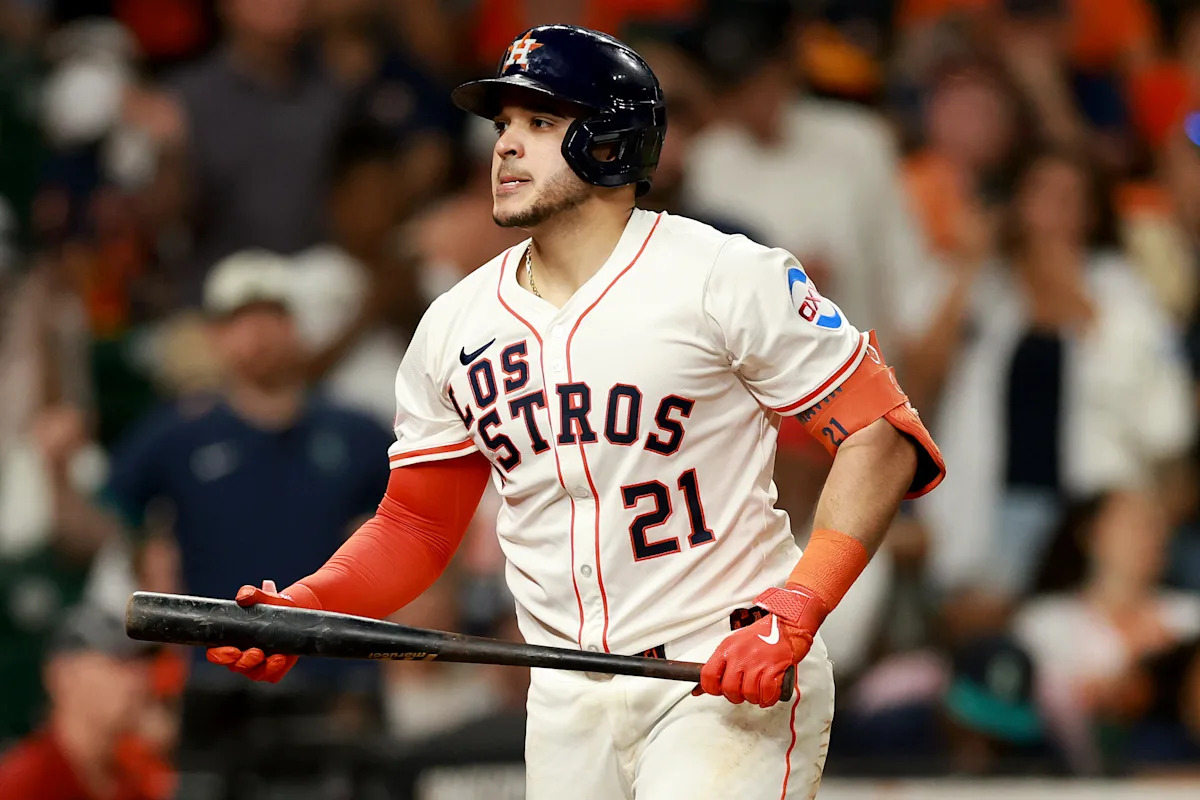
In one of my first editions of the lab, I mentioned something I called “magical thinking.” I think the kids call it wishcasting but I’m not necessarily down on the lingo. The idea behind magical thinking is that the person practicing it thinks of the most positive result from a particular player or situation and assumes that to be not only possible, but likely.
Usually, this does not impact those inside organizations, but it can if the organizations are not mindful of the analytics. We see this more from the general public. There is no greater example than Yainer Diaz. People seem to think he should be a 30 home run guy and maybe even a .300 hitter. Unfortunately, there is not much to base this on in terms of actual performance. What we will do in this series in Spring Training is look at the Astros position by position and determine what is likely to happen based on some key numbers. Before we dive in, I thought we should review those numbers.
Advertisement
-
Chase rate: This is the percentage of balls a player swings at outside of the zone. The league average normally lives between 30 and 32 percent, but we will be looking at three year intervals and we should notice trends more than where a player is in relationship to the league average.
-
Hard hit percentage: This is simply the percentage of balls that a player hits hard. Hard hit balls become hits and extra base hits more often than softer contact. Typically 35 percent is around the league average in this category.
-
BABIP: This is batting average on balls in play. Home runs are obviously excluded since they are not in play. The league average tends to hover around .300 but it will largely depend on hard hit percentages and breakdowns between groundballs, flyballs, and line drives.
-
Contact percentage: This is the percentage of swings that turn into contact. Typically 70-75 percent is around league average.
-
HR/FB percentage: This is the percentage of flyballs that result in home runs. Ten percent is typically around the league average.
Yainer Diaz
|
Chase |
Hardhit |
BABIP |
Contact |
HR/FB |
|
|
2023 |
44.0 |
43.9 |
.292 |
74.6 |
21.9 |
|
2024 |
42.3 |
47.5 |
.338 |
77.6 |
12.5 |
|
2025 |
43.8 |
42.2 |
.277 |
78.1 |
12.7 |
|
Aggregate |
43.4 |
44.5 |
.303 |
76.8 |
15.7 |
Expectations of 30 home run power are based on an unsustainable home run per flyball rate from 2023. He still has more power than most players, but we have to focus on what he does well. Diaz hits the ball more often than most players and he hits it harder than most players. That is what scouts would lovingly call the hit tool. So, if we were to expect any number to go up for Diaz it would probably be batting average. If hard hit ball rates and contact rates remain constant then he could very well hit as high as .280 with the current underlying numbers.
Of course, that brings us to the negative. Diaz probably chases more than any regular in the game. What’s more, that rate seems to be fairly constant over the three years. This is one of the reasons why plate discipline needs to be added as a sixth tool. Diaz can put the bat on the ball even when it is outside the zone, but that contact usually doesn’t result in extra base hits.
The chase rate will be a number I will track throughout the year because it will tell us whether the new hitting coaches can mute some of his aggressive tendencies. Balls in the zone are typically hit more often and hit harder than balls outside the zone. I don’t think Diaz would ever be a good disciplined hitter, but if we could elevate himself to even below average in that category (35-40 percent) then it could lead to more walks and to more pitches for him to hit in the zone.
Advertisement
Cesar Salazar
|
Chase |
Hardhit |
BABIP |
Contact |
HR/FB |
|
|
2023 |
35.7 |
8.3 |
.167 |
72.3 |
0.0 |
|
2024 |
29.4 |
13.6 |
.381 |
77.2 |
0.0 |
|
2025 |
34.6 |
18.2 |
.273 |
80.8 |
0.0 |
|
Aggregate |
32.8 |
13.3 |
.295 |
76.2 |
0.0 |
Remove the soft contact and Salazar is as close as you can get to an average major league hitter. His chase rate is fairly close to average. His BABIP is fairly close to average and his contact rates are fairly close to average. He simply does not hit the ball hard and does not have enough power. The good news is that the hard hit ball rate has steadily climbed in each pass through the big leagues. The bad news is that his next home run will be his first one.
Salazar is there because there is really no one else at this point. Of course, that could change this week or next as rumors are swirling about Christian Vazquez being signed to give the team a veteran option. Of course, that rumor has been circulating for weeks. In case it comes to fruition, we will list his numbers below as a comparison.
Christian Vazquez
|
Chase |
Hardhit |
BABIP |
Contact |
HR/FB |
|
|
2023 |
33.2 |
32.8 |
.279 |
75.5 |
7.2 |
|
2024 |
33.5 |
36.6 |
.257 |
81.7 |
7.5 |
|
2025 |
25.3 |
27.4 |
.214 |
84.6 |
4.1 |
|
Aggregate |
30.7 |
32.3 |
.250 |
80.6 |
6.3 |
One of the offshoots of magical thinking is what we might call “the Jeff Bagwell theory.” As Bagwell is fond of saying, players will produce the numbers that are on the back of the baseball card. The difficulty with this theory is that almost every player goes into rot late in their career. It happened to Bagwell himself in 2004 and 2005. it happened to Craig Biggio in his last couple of seasons. It is rare for a player to finish on top. So, magical thinking would look at the aggregate above and assume Vazquez will get back there. It is certainly possible. Rot is also possible for a catcher in his mid-thirties.
Advertisement
In particular, the hard hit percentage and home runs per flyball rates concern me. It shows a concerning reduction in power that could crater the overall numbers. A return to even the aggregate in hard hit percentage, BABIP, and even home runs per flyball rate make Vazquez a viable backup catcher. Continued rot in those categories do not.
What do you think are reasonable expectations for these players? Are you predicting a return to near all-star performance for Yainer Diaz or do you think we will see more of the same?
