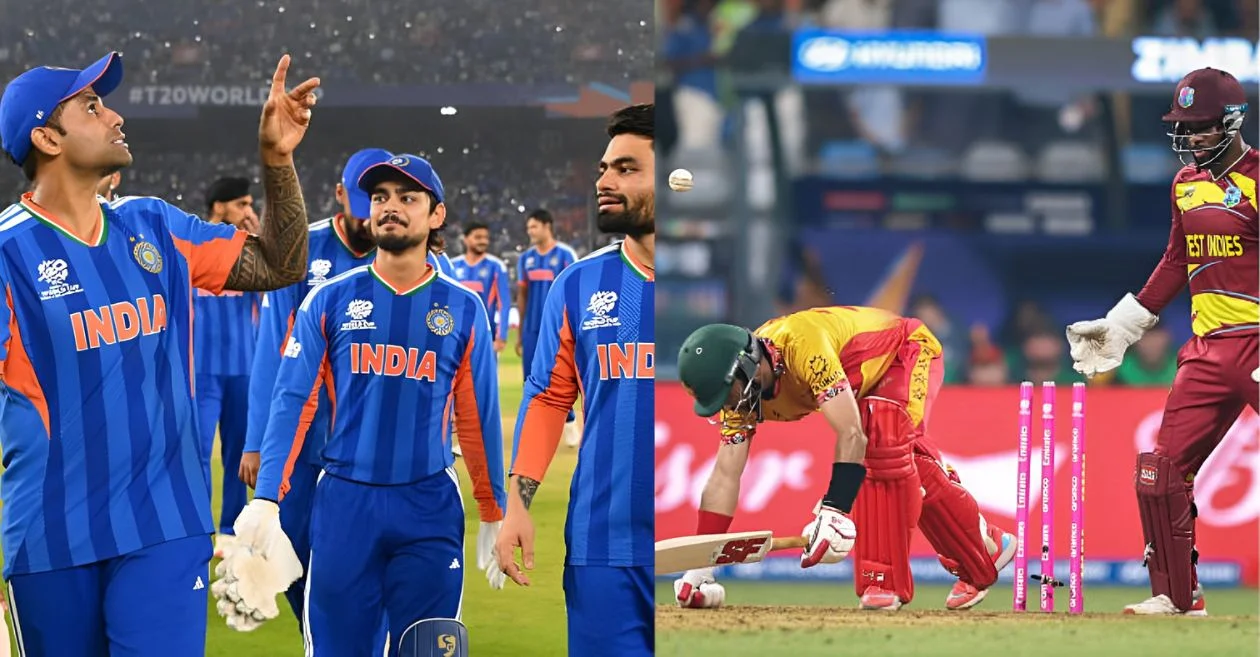
The West Indies’ record-breaking 107-run victory over Zimbabwe in Super 8 stage of T20 World Cup 2026 has essentially turned Group 1 into a statistical minefield for the Indian cricket team. After suffering a heavy 76-run defeat to South Africa, India finds themselves at the bottom of the table with a daunting -3.800 Net Run Rate (NRR), while the Windies have surged to the top with a massive +5.350. For the defending champions, the room for error has completely vanished; they now face two mandatory wins in Chennai and Kolkata to keep their title defense alive.
The Super 8 standings: T20 World Cup 2026
The current Group 1 table reflects a massive divide that India must bridge in just two matches. Because the West Indies and South Africa both secured “blowout” victories in their opening games, they have created a massive NRR buffer that acts as an extra point in their favor. India, sitting at 0 points, is not just trailing in the win column but is effectively 9.15 runs per over behind the West Indies.
This means that simply winning their remaining fixtures may not be enough if the points are tied; the Men in Blue must approach their next two games against Zimbabwe and the West Indies with an ultra-aggressive mindset to systematically dismantle these surpluses and move their own NRR back into the positive territory.
Group Points Table
| Position | Team | Points | Net Run Rate (NRR) |
|---|---|---|---|
| 1 | West Indies | 2 | +5.350 |
| 2 | South Africa | 2 | +3.800 |
| 3 | India | 0 | -3.800 |
| 4 | Zimbabwe | 0 | -5.350 |
What India need to qualify for T20 World Cup 2026 semi-finals after West Indies thrash Zimbabwe?
Scenario 1: The clean sweep and South African assistance
The most straightforward and mathematically safe path for Suryakumar Yadav‘s India is to win both of their remaining matches while hoping South Africa wins their remaining two games as well. If the Proteas defeat the West Indies on February 26 and then beat Zimbabwe on March 1, they would finish as the undisputed group leaders with 6 points. Under these conditions, if India successfully defeats Zimbabwe and the West Indies, they would finish on 4 points, while the Windies and Zimbabwe would be capped at 2 points each. This scenario is the “Gold Standard” for India because it allows them to qualify in the second spot based on points alone, completely removing the hazardous Net Run Rate tie-breaker from the equation.
Scenario 2: The three-way tie and NRR calculations
A much more volatile situation arises if the West Indies defeat South Africa in their upcoming clash. If that result occurs and India goes on to win their next two matches, India, South Africa, and the West Indies would all be tied on 4 points (each with 2 wins and 1 loss). In this deadlock, the semi-finalists would be determined solely by Net Run Rate. To survive this, India would need to win their matches by colossal margins, potentially winning by a combined total of 100+ runs across both games, to leapfrog the NRR of at least one of their rivals. This would require India to not just win, but to effectively “demolish” Zimbabwe in Chennai to set up a final-day shootout in Kolkata.
Scenario 3: The strategic last-mover advantage
India possesses a vital tactical advantage due to the tournament’s scheduling. Their final match against the West Indies at Eden Gardens (March 1) takes place after the South Africa vs. Zimbabwe game has concluded. This sequence provides the Indian team with absolute ‘mathematical clarity’ before they even step onto the field. They will know the exact result needed, down to the specific over or run, to overtake their rivals on the points table or the NRR column. This allows the coaching staff to tailor their strategy, whether it requires a steady chase for a simple win or an all-out blitz to reach a target within a specific timeframe to satisfy NRR requirements.
