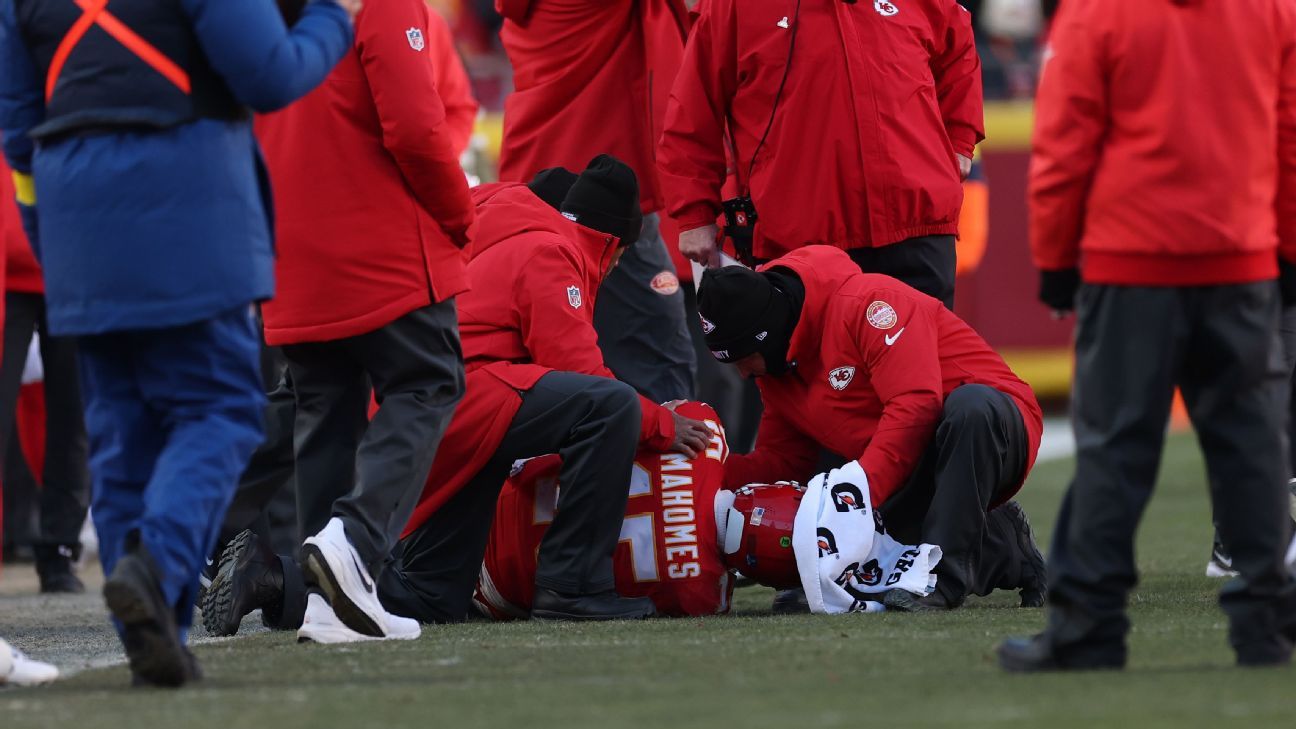
Patrick Mahomes wasted no time in beginning his comeback, undergoing surgery Monday evening in Dallas to repair the ACL he tore one day earlier in Kansas City. It can often be weeks before a player undergoes such a procedure.
It’s the clearest sign that Mahomes is already focused on recovering, if not returning to play, as soon as humanly impossible. The recovery timeline is generally 9-12 months.
“Attack every single day over and over again,” Mahomes promised in a statement. “… I will be back stronger than ever.”
That Mahomes was going to pour everything into being back stronger than ever was never in doubt.
It’s imperative to the Chiefs, however, to make sure that doesn’t become sooner than ever. This shouldn’t be a rush; this should be about getting things right, both for Mahomes and the franchise over the long haul. A Week 16 loss to the Titans, who just last week were contending for the No. 1 pick for a second straight year, reinforces that point. As currently constructed, this team was overly reliant on Mahomes.
Mahomes’ injury during the Chiefs’ Week 15 loss to the Los Angeles Chargers was a brutal, if premature, end to a brutal season by Kansas City standards. After reaching five of the past six Super Bowls (and winning three), the Chiefs are 6-8 and already eliminated from the playoffs.
It was a jarring collapse, yet not entirely unexpected. Empires fall. Always.
What is painful and unfortunate, though, can also be an opportunity — at least if the Chiefs embrace it.
There is now no need to chase a final playoff spot this season in the long-shot hopes that Mahomes can once again conjure some postseason magic. Nor does Kansas City have to pretend this year’s mediocrity was just a one-off hiccup of a season. It doesn’t have to try to duct-tape the roster together and bring back every fading veteran for another title run in 2026.
The Chiefs have a chance to face reality, reexamine everything in the organization and try to reboot for the second part of Mahomes’ career, which might not need to even begin until 2027.
Roster. Staff. Scheme.
Mahomes is 30 years old, comfortably in his prime. He likely has a lot of football left in him.
The Chiefs should view him as something of a rookie again (they patiently sat him to learn and develop back then) and build out in order to best complement his talents going forward.
The similarities with Tom Brady and New England are obvious. Just like Mahomes, Brady, in the first game of the 2008 season, tore an ACL nine years into his career, with three Super Bowls under his belt.
Brady’s injury was more significant in the moment — the Patriots were coming off a 16-0 regular season before losing in the Super Bowl. They were the title favorites. This season, K.C. was headed for some hard decisions no matter what.
Either way, Brady returned and the Patriots continued to evolve around him, setting up a run to five more Super Bowls and three more championships.
Whether Mahomes has the longevity of the otherworldly Brady remains to be seen. He is certainly going to try. The job of general manager Brett Veach and coach Andy Reid is to maximize the next five to 10 seasons.
While this shouldn’t be a full teardown and rebuild, it is the chance for more than just an on-the-fly retooling. How do we want to play? What kind of players can get us there? Do we need fresh voices and concepts on the coaching staff — even if the 67-year-old Reid is in for the foreseeable future?
No need to hurry back to run it back; change was needed.
Kansas City was already facing a salary cap crunch, projected to be about $44 million over budget for next season, per Over the Cap. That’s even with the expected departure of soon-to-be free agent Travis Kelce (and his $19.8 million cap hit this year).
Additional expensive contracts (like right tackle Jawaan Taylor’s $27 million cap hit) need to be moved and the money spent wisely. Others could be packaged to get more draft capital. The good news, after years at the back of the draft, is that the Chiefs could pick as high, if not higher, than they have since 2017, when they selected Mahomes at No. 10.
Finding a running game, including an offensive line that can protect Mahomes, is paramount. A big wide receiver isn’t far behind. This season’s Chiefs were too reliant on Mahomes making plays — perhaps not coincidentally, he was hurt trying to make a pass while scrambling.
The defensive line can’t rely on 32-year-old tackle Chris Jones for much longer, either, especially with his $44.85 million cap hit next season. The Chiefs have done a great job developing cornerbacks, but they may need to do so again as Trent McDuffie nears the end of his rookie deal.
None of this is simple, of course. Everyone wants great players. There are options, though. The injury demands decisions. There is a little less urgency, offering time to concentrate on good long-term picks (the 2025 draft class produced little this year), trading to acquire more assets and clearing the cap with a brief window of austerity.
Mahomes is going to be Mahomes. He’ll continue to be driven and ultra-competitive: first in his rehabilitation, then once he returns.
As long as the Chiefs have him, they are going to be contenders. Taking this rare window — one they never wanted — to rework for that future, not just hold on until the moment he gets back, should now be the priority.
