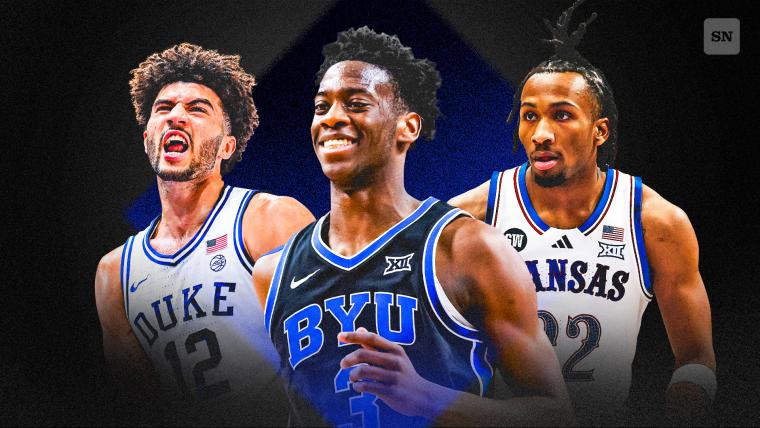
Is this freshman class the greatest in college basketball history? Depends how you keep score originally appeared on The Sporting News. Add The Sporting News as a Preferred Source by clicking here.
They grew up in different parts of this very large country, but the community of elite basketball players is compact enough that the Class of 2025’s potential for excellence quickly was apparent to its members. Duke forward Cameron Boozer was aware long before he became NCAA Division I’s most productive player in his first college season.
Advertisement
“Even when were 8th grade, freshman, sophomore year, everyone talked about our class as a special class,” Boozer told The Sporting News. “They labeled us as a special class. And playing with these guys at USA Basketball, the Hoop Summit, camps, stuff like that – you see how good other guys are. We knew how much talent we had in our class, for sure.”
A.J. Dybantsa, Darryn Peterson, Caleb Wilson, Nate Ament, Kingston Flemings, Mikel Brown, Darius Acuff – these young men have encountered one another for years, as opponents or teammates on the grassroots circuit, in national prep school events, in international competition.
MORE: SN’s latest bracket forecast for March Madness
And they and their classmates have introduced themselves to the world of college basketball in a most audacious manner. Their play has been so extraordinary they’ve generated discussions about where this class ranks among the best in the history of American basketball.
Advertisement
Are they up there with 2007, 1995 – possibly even the standard that has endured nearly half a century, 1979?
In statistician Ken Pomeroy’s analytical look at the national Player of the Year contenders, Boozer’s rating is 53 percent higher than the second performer in line. That’s the most extreme gap between first and second in the 16 seasons Pomeroy has been compiling this data.
On that list, half the players in the top 10 are freshmen, as are three of the nation’s top six scorers.
Five of the 15 players on The Sporting News midseason All-America team were freshmen, including two first-team selections, and that was before Illinois point guard Keaton Wagler emerged as one of the nation’s top players and a likely full-season pick.
Advertisement
On Tankathon’s 2026 NBA mock draft, 13 of the first 16 projected selections are freshmen, and there are 17 total in the first round.
“These kids are built to play the game the way it is today,” retired recruiting analyst Van Coleman told SN. “What makes this class unique is they have the skills of the game today to translate into the next level: to translate from high school into college and then to be integral pieces early on in their careers as pros.”
—
There were all sorts of signs in advance of the 2025-26 college season this could be an exceptional group of freshmen, starting with the achievements of Boozer and his twin brother Cayden at Christopher Columbus High in Westchester, Fla., where they won four consecutive state championships in the highest classification. Together, they also won a Chipotle National Championship and three Nike EYBL at the Peach Jam titles.
Advertisement
When they joined some of the other top prospects for the Nike Hoop Summit, which matches U.S. high schoolers against the same age group from other nations, it became obvious something extraordinary could be happening.
That’s mostly because the Boozers were joined by Dybantsa, Ament, Brown and Acuff, among others, but also because a lot of the youths on the World team were college-bound, as well. Italy’s Dame Sarr is with the Boozers at Duke. Tounde Yessoufou is at Baylor, David Mirkovic at Illinois and Omer Mayer at Purdue.
Last summer, at the FIBA U19 World Cup, Brown, Dybantsa and Peat were three of the top four scorers for the USA Basketball squad that won the gold medal, but among those vanquished along the way were Germany’s Hannes Steinbach (now starring at Washington) and Eric Reibe (a key reserve center with the UConn Huskies).
“This group is the deepest in the last 10 years,” Coleman told TSN. “From the standpoint of having guys who translated to college immediately – because we’ve got all kinds of guys averaging between 15 and 25 points a game. That means you were ready to be a star in college. If you look at that, you say how many times have we had that kind of early success across the board?”
Advertisement
Even with all that, the impact of these freshmen might be greater than expected. Examining the top six teams on the Bracket Matrix, which comprises every available online NCAA bracket projection, 13 of the 36 players who are top-six scorers on those squads are freshmen. That includes the leading scorers for No. 1 seeds Duke (Cameron Boozer) and Arizona (guard Brayden Burries).
And one differentiation between this class and almost any before it: How many ever had a player ranked in the neighborhood of No. 150 become an immediate 18-point scorer on a top-10 team and a projected top-10 NBA pick? That’s the Keaton Wagler story at Illinois.
There are some who have other specific questions about this group, though.
“It’s hard to say this is the greatest group of freshmen ever when they don’t play against seniors,” Turner Sports analyst Chris Webber, the leader of Michigan’s class of ’91 Fab Five, said on a recent studio program. “I had to play against the Christian Laettners … or the juniors that were the Grant Hills or (Jamal) Mashburns.
Advertisement
“I think competition, I think impact, I think culture, I think changing the game – we came in, our culture changed the game. I love what they’re doing. And they’re a great class. But that’s unfair to others to say they’re the greatest freshman class.”
Which is fine.
Because we’re not saying that.
Because some of us were around for 1979.
—-
Take a deeper look at some of basketball history’s other great classes:
2007 Parade and McDonald’s High School All-Americans
NBA Champions: Kevin Love, DeAndre Jordan
NBA All-Stars: Love, James Harden, Derrick Rose, Blake Griffin, Jordan
NCAA Champions: Kyle Singler, Nolan Smith, Cole Aldrich
Advertisement
Final Four: Love, Rose, Corey Fisher, Corey Stokes, Durrell Summers
All-Americans: James Anderson, Michael Beasley, Smith, Griffin, Love
There probably never was a recruiting class that got the hype that was accorded the Class of 2007, because they came along when the grassroots circuit was at the peak of national coverage.
When I first attended the Sonny Vaccaro’s ABCD Camp in Indianapolis in 1991, when he still was affiliated with Nike, there were not even a dozen reporters joining the college coaches who scouted Rasheed Wallace, Corliss Williamson and Tony Delk. The Indianapolis Star covered it because the event was right there. Dick “Hoops” Weiss of the New York Daily News’ traveled from his home in the Philadelphia area. Not many more.
Advertisement
By 2007, with the explosion of team-specific sites on the Scout and Rivals networks, with national websites from Sporting News, CBS, ESPN and Sports Illustrated, there were nearly as many writers as in Las Vegas for the Big Time tournament as players to watch.
O.J. Mayo became an impactful college player in his one season at Southern California, and Michael Beasley became a first-team All-American at Kansas State, but the players who had the most enduring success received slightly less attention: point guard Derrick Rose, who led Memphis to the Final Four and became an NBA MVP, and Kevin Love, who got to that 2008 Final Four with UCLA and later won an NBA title with the Cleveland Cavaliers.
1995 Parade and McDonald’s High School All-Americans
Hall of Fame: Kevin Garnett, Vince Carter, Paul Pierce, Chauncey Billups
Advertisement
NBA Champions: Garnett, Billups, Pierce
NBA All-Stars: Garnett, Carter, Pierce, Billups, Jamison, Shareef Abdur-Rahim, Stephon Marbury
NCAA Champions: Ron Mercer, Wayne Turner, Ricky Moore
Final Four: Carter, Jamison, Tyrone Washington
All-Americans: Mercer, Jamison, Carter, Billups, Courtney Alexander
We never got to see what Kevin Garnett might have done as a collegian.
Maybe it was for the best.
With his astonishing intensity added to his absurd dynamism and developing skill, the rest of college basketball might have crumbled with one KG trip through March Madness. Even without him, this class delivered so much as collegians and went on to concentrated greatness in the NBA.
Advertisement
That’s the one thing this group did not possess that the greatest of classes did: depth. The 10 best players built phenomenal careers that led to the very pinnacle of the sport, but some of the highest-rated prospects accomplished little.
Big man Taymon Domzalski went to Duke and started only 27 games in four years. Gary Bell went to Notre Dame and played only 27 games in two seasons. There were some all-conference players on the top of that class’ recruiting charts, but nearly as many flat-out busts.
1979 Parade and McDonald’s High School All-Americans
Hall of Fame: Isiah Thomas, Dominique Wilkins, James Worthy, Ralph Sampson
Advertisement
NBA Champions: Thomas, Worthy, John Paxson, Byron Scott, Cliff Levingston, Rodney McCray
NBA All-Stars: Thomas, Worthy, Wilkins, Sampson, Dale Ellis, Terry Cummings
NCAA Champions: Thomas, Worthy, McCray, Dereck Whittenburg, Sidney Lowe
Final Four: Sampson, Sam Bowie, Howard Carter, Terry Fair, Rob Williams, Michael Holton, Darren Daye, Rod Foster
All-Americans: Bowie, Sampson, Cummings, Thomas, Worthy, Paxson, Ellis, Steve Stipanovich, Sidney Green, Quintin Dailey
“I don’t know there’s ever been a group better,” retired Florida State coach Leonard Hamilton told SN. “All those guys in one class. That was just phenomenal.”
Advertisement
Hamilton was an assistant coach at Kentucky under Joe B. Hall when he convinced Bowie, Dirk Minniefield, Charles Hurt and Derek Hord to join the Wildcats. It was considered one of the great recruiting classes in history. Their scheduled four seasons included 96 victories, four NCAA Tournament appearances and an Elite Eight appearance in 1983, but injuries to Bowie prevented them from reaching the Final Four together. Bowie made it the following year as a redshirt senior.
Another reason that UK team didn’t reach the pinnacle: The competition was brutal, courtesy of their classmates across the nation. Indiana won it in 1981 with Thomas as the singular star. Worthy kept freshman Michael Jordan somewhat in the background when North Carolina won it a year later.
Vaccaro, who later went on to become a pivotal figure in the endorsement careers of Jordan and Kobe Bryant, staged the first national high school all-star game in Pittsburgh in 1965. For 14 years, the Roundball Classic was the U.S. All-Stars against the Pennsylvania All-Stars, and the state even won a couple, including in 1977.
As the 1979 event approached, however, Vaccaro worried that the Pennsylvania team would not be strong enough to even compete against the massive glut of talent that existed in that year’s senior class. So he expanded the occasion to two nights and spread the U.S. talent to three different teams.
Advertisement
“I was never going to do a game if the Roundball wasn’t a classic,” Vaccaro told SN. “When you go to ’79, and you talk about Rod Foster, Tony Bruin, Quintin Dailey, Rodney McCray, Sidney Green and Thurl Bailey – that’s on one team, the East. It’s an amazing team. I knew it would be a problem if it wouldn’t be competitive and the crowds stopped coming.
“By then, I was Mr. Nike. I had access to every kid in America. It was not hard filling out the other rosters … I don’t know how anything could have been any better, with the Hall of Famers that played.”
—-

AJ Dybantsa
Scott Sewell/USA TODAY Network
It’s very early to judge the Class of 2025 against groups that contain future NBA All-Stars and Hall of Famers. But there are some ways in which this group is making its own sort of history.
Advertisement
In the time of the ’79 class, freshmen were welcome to contribute to title runs — Jordan in 1982, McCray in 1980 — but few were recognized individually. Only three players between 1973 and 2002 were named All-America, but there have been 33 since 2003, an average of slightly more than one per year. We could have five or more this season alone.
If he continues at his current pace (23 points, 10 rebounds, 58 percent shooting) and Duke continues to rank among the nation’s top teams (22-2, 11-1 in the ACC entering Saturday’s home game against 10-1 Clemson), Boozer likely will become the third Blue Devils freshman since 2019 to become consensus national Player of the Year.
He almost certainly will be joined on the All-America first team by Dybantsa, and it’s not out of the question for Flemings, Wagler or Caleb Wilson to join him or be selected for the adjacent second and third teams.
If Peterson had been healthy for the full season, instead of missing 11 of the team’s 24 games – and extended portions of many in which he did appear – he almost certainly would be All-American, as well, given the astounding talent he’s displayed.
Advertisement
Given his expertise on the subject, we asked Boozer which of his great classmates across the nation he would choose to join him on the Duke roster, if given the opportunity.
“Um, yeah, you know: Cayden Boozer, Dame Sarr, Nik Khamenia. We’ve got the best freshmen at Duke,” Boozer said, showing an impressive degree of maturity for a freshman. “I love my guys. I’d never trade them for anyone.”
