If you were to stand in the middle of Derbyshire, you’d be the farthest you could get from the sea in the UK – about 100km or 62 miles. In such places it’s possible to forget you live on an island. But the sea surrounds us and, taking into account our 6,289 scattered islands, we have about 31,000km (19,300 miles) of coastline.
Along that epic shore lie regions as diverse in culture as they are in land formations, ecologies and dialects. From the remote, weather-beaten north of Scotland to the azure seascapes of Cornwall, Britain is ringed by one of the longest, most varied coastlines in Europe.
Meg Elliot is a staff writer at Cycling Weekly and producer of the BBC podcast Heart and Stone.
This year, three cyclists set out to ride the perimeter of Britain – a journey of more than 4,000 miles – all propelled by a different, personal mission. Chris Hall rode the island’s rugged coastline, including some of the islands, to raise money for men’s mental health, while Bernard Bunting tackled the ride for the National Brain Appeal. But we’ll begin with the highest-profile coastline ride of the year – a new outright record.
THE RECORD-BREAKER MOLLY WEAVER

This summer, Molly Weaver completed a full lap of the British coast in the fastest time ever recorded by a supported cyclist, 21 days 10 hours and 48 minutes. In doing so, she smashed Nick Sanders’s 1984 record by 17 hours. “I can’t believe I’ve actually done it; I need to keep on reminding myself,” Weaver laughed in disbelief, speaking to me by phone a few days after finishing the ride.
Her journey began on London’s Tower Bridge, its iconic blue steel framing her first push south, curling down towards Canterbury and along England’s southernmost outposts. Weaver set off armed with a custom-built Orbea OMR carbon bike, and a five-strong rotating support crew that included her girlfriend, dad and brother.
The only rules for Weaver’s route – beyond smashing her predecessor’s time – were to pass all 118 of Britain’s coastal waypoints to cover a minimum distance of 7,730km (4,803 miles).

Distance cycled: 7,730km (4,803 miles)
Time taken: 21 days, 11 hours
Total elevation: 70,000m (approx)
Punctures: 0
Gels: 362
Bottles of isotonic hydration: 126
Bottles of Coke Zero: 42
Energy gummies: 432
Bottles of whey protein: 42
World record: 1
Weaver is no stranger to endurance challenges. She represented GB on the roads, finished second in the 2015 national TT champs, and now competes as an ultra rider. In 2022, she set the Fastest Known Time in the Lakeland 200.
“You have to have a certain drive that I think is innate,” Weaver said of the task in front of her. “I told myself, I’m going for the record. I don’t care about anything else.” The 31-year-old tackled the ride dressed in the blue of her challenge jersey with marbled sea-foam graphics criss-crossing her chest – a reminder of the Royal National Lifeboat Institution (RNLI), for which she was raising money.
Weaver looped around Cornwall’s coast, powered on pot noodles, Shreddies and Soreen banana loaf supplied by the support vehicle at four- to six-hour intervals, before journeying north through Wales and across the Scottish border.
“I had horrendous weather for the whole of Scotland, especially on the west coast. We were in the eye of a storm the entire time,” she said. “It is weird seeing the whole of the country and noticing how quickly everything changes. You cross the border and feel the instant change.”

The record-seeking rider didn’t have time to dwell on the weather’s unwelcome discomfort and pushed into the heart of the storm, and on to John o’ Groats. She spent three weeks on the road, tackling the changing elements, chamois soaked through from six hours of constant torrential rain, averaging four hours of sleep per night.
“Dot-watchers would line the road,” Weaver recalled. “After hours on my own, suddenly there were people cheering me on… Strangers who had come out in the torrential rain, holding up signs, ringing cowbells, and believing that I could achieve this thing, and it made me believe it too.”
Road closures and diversions added to the chaos. On her homeward stretch towards London, Weaver’s route was curtailed in the Isle of Dogs, forcing her to loop up around the outskirts of London. But on 7 July she arrived – weather-beaten, exhausted, but ecstatic – back on Tower Bridge, having beaten the record by some 17 hours, and having raised £10,000 for the RNLI.
“Some of the best moments were, after it had rained all day, when the sun came out, and the sunset would be amazing, the view incredible,” she said.
THE MEN’S HEALTH CAMPAIGNER CHRIS HALL

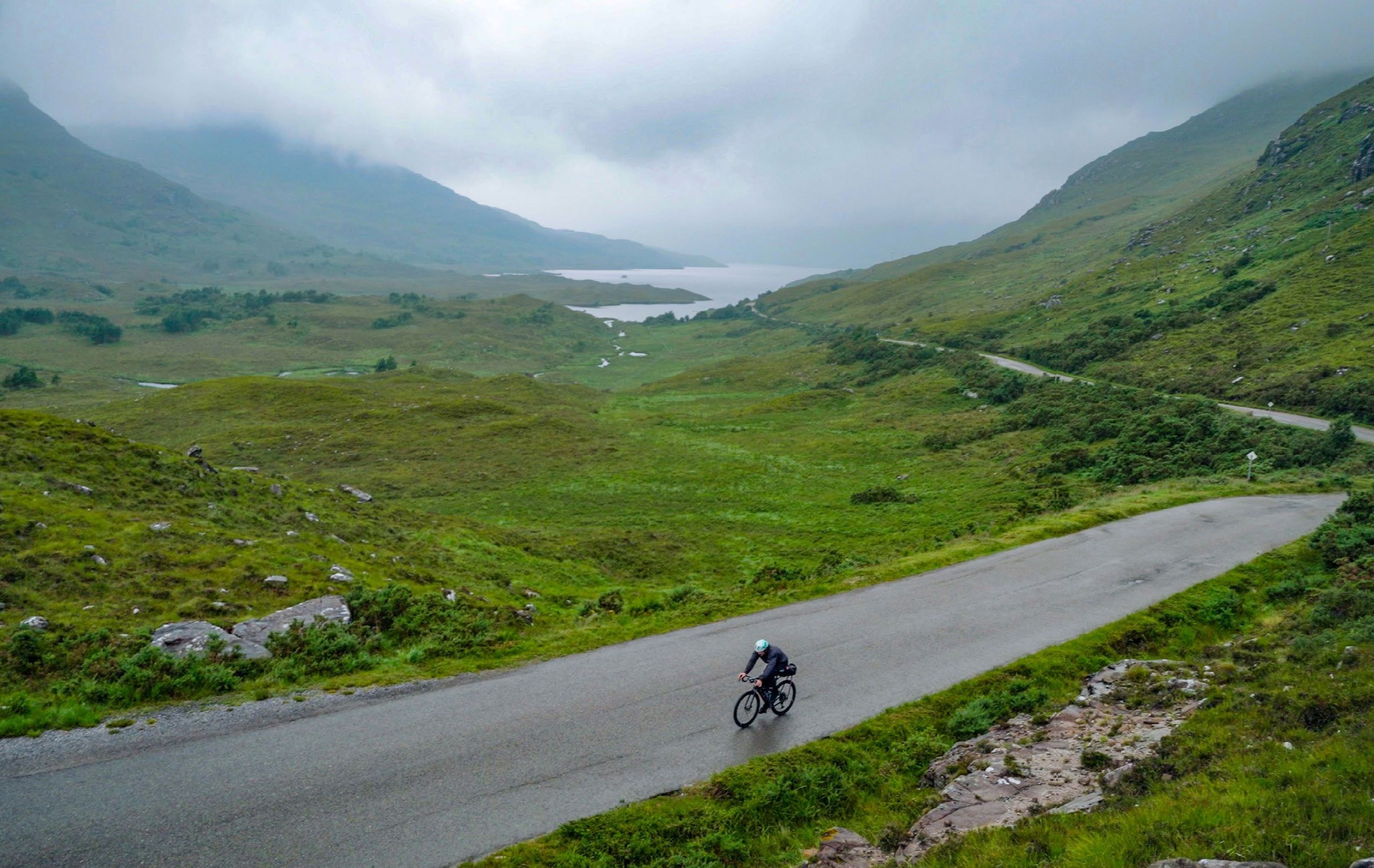
“Bikepacking the perimeter of Britain anticlockwise as a fundraiser for Movember was, to be frank, brutally beautiful,” Chris Hall said, two months after finishing his self-supported perimeter ride of Britain. The 35-year-old was thinking back to northern Scotland, drenched in the same relentless wet weather that Weaver had struggled through a few weeks earlier. Unlike Weaver, Hall battled the elements alone, soloing climbs in Scotland, and suffering through long slogs down wet A-roads, with countless chargers and toothbrushes accidentally left behind along the way.
Despite starting in July, it rained on 21 of the 30 days he spent riding round Britain. “I guess it’s to be expected in British summer time,” he joked.

Distance cycled: 6,500km (4,039 miles)
Time taken: 30 days
Total elevation: 54,925m
Days of rain: 21
Punctures: 6
Pairs of tyres: 3
Chain: 1
Sets of brake pads: 3
Hall set out on this challenge to raise money for the Movember charity, after he sought their help during his own mental health struggles years ago. His planning for the round-Britain ride was a four-year task, culminating this summer. Hall’s isolation was occasionally broken as cyclists joined him along the way.
“More important than the riding were the conversations I had on the route about mental health,” he said. “Generally, men are really bad at looking people in the eyes – it’s apparently something guys can really struggle with.”
Hall has learnt the importance of being open and talking. In the UK, suicide is the leading cause of death among men aged 20-34, and his journey across the UK wasn’t only a challenge of endurance but one that sought to create space to talk and to share.
In Cornwall, he caught a ferry with local cyclist Jonny Stephenson, and in Kings Lynn he was joined by the local cycling club who promote open chats on their weekly ride-outs, encouraging riders to share their worries, fears and joys. Our own tech editor, Andy Carr joined Hall on his roll around Norfolk.
“I found when you ride next to each other, conversation drifts in all kinds of ways and directions,” said Hall, “you might start riding with an absolute stranger, and at the end of the day, they’re someone you’ve become firm friends with.”
Hall finished his challenge in central London on 14 August, having covered around 250km (155 miles) a day over 30 days.
THE DEMENTIA-DEFIER BERNARD BUNTING

Distance cycled: 6,851km (4,257 miles)
Time taken: 47 days
Total elevation climbed: 57,000m
Equivalent Everests: 8
Punctures: 14 (approx)
Sets of brake pads: 3
Money raised: £37,000
It was a sunny spring day when Bernard Bunting set off on his ‘slow way’ around round Britain’s coastline to follow a zigzagging route that took in Brighton beach, Anthony Gormley’s bronze sculptures on Crosby Beach in Liverpool and many other attractions.
Bunting is an affable 67-year-old with big eyes and a wide smile that easily cracks open into a laugh. A lifelong cyclist and former soldier, in his younger days he toured widely in Scotland (“miserable… it poured… the tent leaked”) and France. After leaving the army in 1982, he returned to his racing roots, competing in crit races on the weekends with his club the London Dynamo. But three years ago, at the age of 64, Bunting was diagnosed with Young Onset Alzheimers, a condition affecting about 70,000 people in the UK.
He was determined to carry on, to keep making the most of life. Apart from intermittent confusion and the occasional forgotten conversation, his fitness is unaffected. Bunting wanted the coastline challenge “to prove to people that I can still go and do stuff – probably a lot more than most people,” he laughed.

Just like Hall, Bunting’s journey around Britain was enlivened by interactions with supportive strangers. Noticing the Alzheimer’s charity logo emblazoned on his back, lorries tooted and cars waved in support. Every day at around 11 o’clock, he would stop for coffee and strike up conversations. “The number of people who put a tenner in my hand or gave me a pat on the back was really encouraging,” he said.
Powered by porridge and energy bars, Bunting wove through Britain, catching up with a friend in North Wales, his sister in Scotland, and getting temporarily lost in Southampton. Having done limited preparation, Bunting sometimes ended his day with nowhere to stay – and his wife Caroline had to frantically set about emailing friends around the country. “50% of the journey was catered for by kind friends,” said Bunting.
He finished the last leg of his journey just as Weaver was setting off. The pair almost crossed paths on Bunting’s last day of riding, in Clacton. “I looked at the tracker on my phone and, hey presto, she was within 300 metres of me. I shouted, ‘Molly, Molly, Molly! Go! Go! Go!’.” Bunting had set off on 18 May, four weeks before Weaver. “I have great fun telling everyone that she caught up with me and overtook me,” he laughs.
Bunting has raised more than £37,000 for the Rare Dementia Support Centre. You can donate here:
COASTAL QUESTS BY SEA
As Bunting, Hall and Weaver rode their winding routes round Britain’s coastline, others were tackling it by sea. In July, Polish Olympian Sebastian Szubski became the fastest person to circumnavigate Britain by kayak, in a time of 37 days and six hours. To break the 40-day record, Szubski had to learn to paddle on the sea in a surf ski – the longest type of kayak – within seven months, and how to navigate some of the world’s most dangerous tidal races, while proceeding at record-breaking speed.
Meanwhile, 26-year old Jazz Turner became the first woman, and first disabled sailor, to circumnavigate the UK and Ireland on her boat named ‘FEAR’ (‘Forget Everything and Rise’). The sailor lives with Ehlers Danlos Syndrome, a genetic condition affecting connective tissue, and was told in December 2023 that she had six months to live. Two years later, Turner completed her record-breaking, 2,070 mile trip in 28 days and one hour. She has raised over £58,000 for Newhaven and Seaford Sailability, a charity she founded with her parents to provide adaptive equipment for sailors with additional needs.
