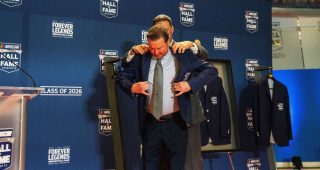
Through all the ups and downs of his career, Kurt Busch will receive his highest award Friday night as he will be inducted into the NASCAR Hall of Fame as a member of the Class of 2026.
The journey was anything but smooth for Busch, the 2004 NASCAR Cup Series champion and 43-time winner across NASCAR’s three national series. He’ll tell you as much.
Advertisement
But the bumps along the way all make the buildup to Friday night’s induction ceremony (8 p.m. ET, The NASCAR Channel) so much sweeter.
HALL OF FAME: How to watch Friday’s ceremonies
Busch learned of his election to the Hall of Fame alongside Harry Gant and Ray Hendrick back in May. In the months since, the Las Vegas native has been reflective of every moment that led him to eternal stock-car racing glory.
“It’s been an amazing journey,” Busch told NASCAR.com in a Thursday teleconference. “And all the trips down memory lane, talking with a crew chief, just asking them to help verify one of the stories, that way I can get it into the speech. And by the time you ask one question, it’s like an hour just went by with every one of them. And just all the different stats that the statistician guys were helping me put together, it’s like, wow. We really got a lot done with a lot of different teams.”
Advertisement
The list of teams Busch raced with in Cup is long — from Roush Racing (before it was known as RFK) to Penske Racing (before it was known as Team Penske) to Phoenix Racing, Furniture Row Racing, Stewart-Haas Racing and 23XI Racing. The list of highlights with each of those programs glows with success: a Cup title; wins in 19 different seasons; a 2017 Daytona 500 triumph; a NASCAR All-Star Race victory in 2010, followed by a Coca-Cola 600 triumph one week later.
But frustration often got the better of Busch in the first stanza of his career, made public by frantic radio communications and unflattering media relations, to put it kindly. Now 47, Busch overcame adversity in his career that most people — drivers or otherwise — may not have been able to leave in the past.
Some of that tumult stemmed from his meteoric rise to the elite of stock-car racing. The first race of Busch’s life came in 1994. By September 2000, he was strapping into a Cup car to race against Dale Earnhardt, Jeff Gordon and NASCAR’s best in September 2000.
“It was that fast,” Busch said. “That’s why I wasn’t ready for the big time to be a professional and to understand all the responsibilities with it. … I was drinking through a fire hose at times.”
In this 2004 photo, Kurt Busch celebrates his NASCAR Cup Series championship sprayed in champagne.
Today, he doesn’t shy away from the ugly moments; instead, he credits the work ethic instilled by his parents and the resiliency he’s gleaned from them for helping him hurdle those less-than-sparkling times in the midst of the extraordinary.
Advertisement
“Of course, it gets down to people — the people that you surround yourself with, and the people that help you make decisions,” Busch said. “But then age kicks in, and you start to figure things out. And again, there was the truth behind a lot of the different stories. And I raced with the truth, knowing what my version of the story is, whether it’s a team departure or a media moment or whatever it was. I knew where I sat with them and the people in the garage, the people in our sport, people with a hard card; it felt like they were always on my side. And so that gave me that motivation to keep digging.”
Busch credits former teammate and NASCAR Hall of Famer Mark Martin and Furniture Row Racing owner Barney Visser for their guidance through the tough times, particularly when Busch joined Furniture Row in 2013 after a year with the underfunded Phoenix Racing program.
What became evident at each of Busch’s stops, though, was how much better he made each team.
NASCAR ON YOUTUBE: Busch breaks down his best moments
The last stop of his career came at 23XI, where Busch piloted the No. 45 Toyota as teammates with Bubba Wallace. Wallace had never had a teammate at the Cup level before. But the bond and memories established in their time together still resonate with Wallace years later.
Advertisement
“He’s always, even to this day, still sending motivational stuff to look at and understand how to navigate through certain race weekends,” Wallace told NASCAR.com Tuesday. “I think looking at things from a bigger picture and maybe a different perspective is Kurt’s philosophy, and just kind of looking at it from all angles and not just one side.”
Busch’s efforts to be a team player were intentional, returning the favor of teammates he had at his first stop with Jack Roush’s team.
“The second half of my career and being a little bit older and more experienced, usually at that time, my teammates were getting younger,” Busch said. “And so it was cool because that’s what Mark Martin and Jeff Burton did for me when I was first starting out at Roush. And so you feel that moment of giving back and helping, and if you can make them better, they’re going to make you better.”
Those days driving the No. 97 Ford gave Busch plenty of lessons because of the caliber of drivers he raced with, from Martin and Burton to 2003 Cup champion Matt Kenseth, Hall of Famer Carl Edwards and 19-time Cup winner Greg Biffle.
Advertisement
“This is how life was at Roush with five championship-eligible guys, right?” Busch said. “I mean, that group, they’re all Hall of Famers. And I looked at it, and I said, ‘You know, we’ve got to work together six days out of the week.’ But I know I can beat these guys on the seventh day. Might not beat all of them on the same week, but I know I can beat them most of the time. And so that’s the mentality that I put in my head, and then used that later in my career with teammates.”

Kurt Busch and Harry Gant pose with their NASCAR Hall of Fame jackets.
The end of Busch’s career was ultimately beyond his control. Just eight weeks after earning 23XI Racing’s first victory at Kansas Speedway, a crash during qualifying at Pocono Raceway in June 2022 brought Busch’s career to a halt. His No. 45 car backed into the retaining SAFER barrier exiting Turn 3 before ricocheting his right-front fender against the SAFER barrier and sliding to a stop. The first sign that something was wrong, though, was that Busch had no recollection of the right-front contact.
Busch was held out of the event with concussion-like symptoms. And despite months of rehabilitation, Busch never raced in the Cup Series again, announcing his departure from full-time racing in October 2022 at Las Vegas Motor Speedway, his home track.
Advertisement
“I made a mistake and spun the car,” Busch said. “And when I backed into the fence, and then the right front supposedly hit, I don’t remember that. It was a different hit, and it took me to a tough place. And to go through rehab and to be cleared and to then close out with the announcement that I won’t be full-time racing anymore, that was a key moment.”
Busch has “definitely” made peace with how things ended, he said. His connections to 23XI remain strong as ever, and his eye is on the future of the Busch’s legacy in racing: Brexton Busch, his nephew and Kyle Busch’s son.
“To be able to go to 23XI, to go to the track and have a hard card and just go into their hauler, make a sandwich, jump into a meeting and listen in, yeah, that’s still that on the table,” Busch said. “But for me, it’s just been fun now to take a step back and enjoy it more from the bird’s eye view, and then rooting on my little nephew Brexton. Brexton Busch is definitely the next greatest thing happening.”
From a championship to crown-jewel victories, memories of interactions with Dale Earnhardt to moments with Michael Jordan, Busch has seen it all in his 25 years as a member of the NASCAR community. On Friday, his place within that community will forever be cemented with an induction into the NASCAR Hall of Fame, his legacy enshrined and surrounded by the sport’s heroes.
Advertisement
“My story, I believe, is this blue-collar kid who had a dream,” Busch said. “And it was pushed into all these uncharted territories with not having an agent or not having a family that was at this top level, or having to know anybody really. …
“And I think at the end of the day, what I found that I wanted to be for our race fans was someone that they could depend on for a top-10 finish or a win every single week. No matter if we’re in New England, Florida, Texas, the desert southwest. I wanted fans to know that I was racing hard every lap.”
Turns out, that was a Hall-of-Fame approach.
