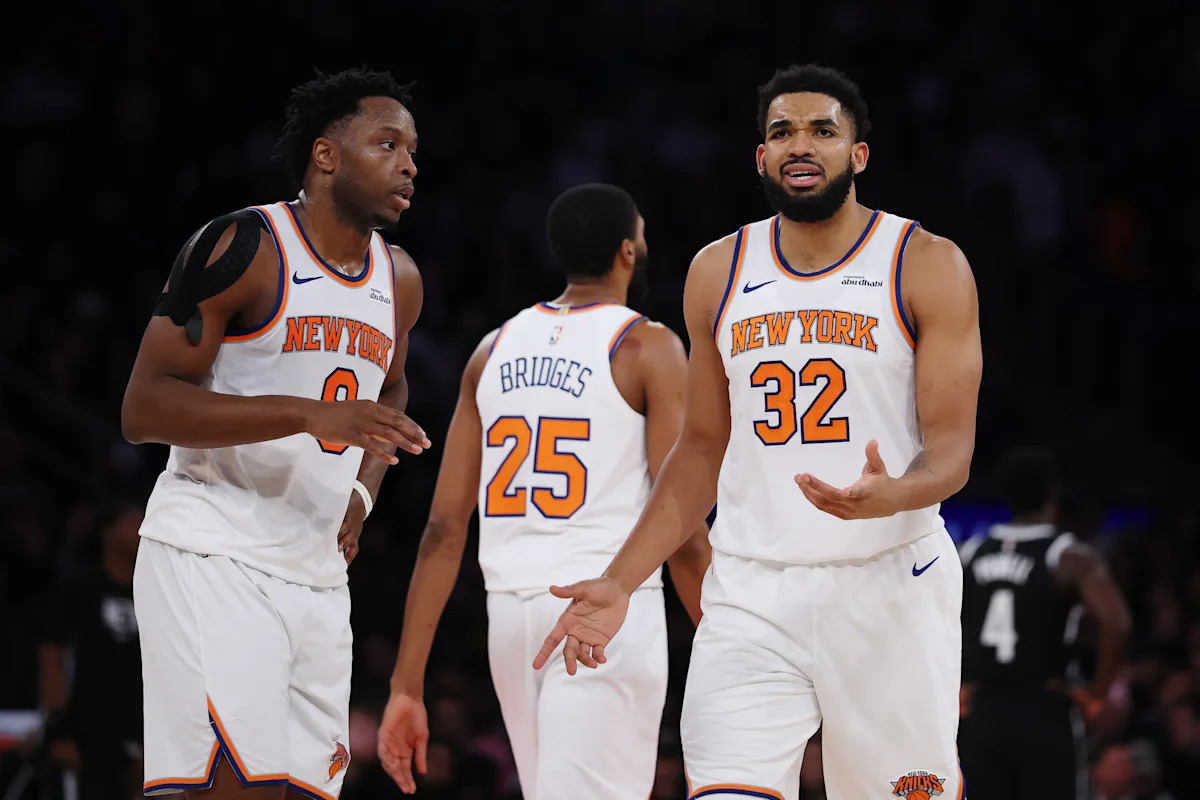
The New York Knicks are the No. 3 seed in the Eastern Conference, which wouldn’t feel all that disappointing had we not just seen the Knicks winning the NBA Cup and knocking on the door of the Detroit Pistons a month ago. The question now is, which version of the Knicks is real?
Coach Mike Brown was brought in to deliver a stronger process to a preexisting identity. A lot of the early talk surrounded the Knicks’ offense. More tempo, more pace, and more empowerment throughout the roster would elevate New York on an end of the floor that tended to get stagnant. That came with an understanding that the defense may not remain at the level it was under Tom Thibodeau, but there was enough of a base to sustain success on that end. A little slippage defensively with a competitive mindset mixed with better offensive flow would be the package to elevate the Knicks.
Advertisement
[Subscribe to Yahoo Sports NBA on YouTube]
According to NBA.com, the Knicks are No. 3 in offensive rating (119.1) and No. 17 in defensive rating (115). But here’s the key: In November, the Knicks were No. 2 in offensive rating (122.8) and No. 10 in defensive rating (112.3); in December, the Knicks were No. 2 in offensive rating (123.2) and No. 21 in defensive rating (118); and during their recent 2-9 stretch, opponents averaged 117.4 points per game (25th in the league during that time).
Is this a team that can’t defend, or a team that can’t afford to not defend?
New York’s defensive state of mind
When the Knicks are humming on defense, it’s the effort that jumps off the screen. Is this a perfect defensive unit? Absolutely not. But when they have the mindset to work on that end of the floor, they can usually live with the results. Active ball pressure. Physicality off-ball. Scrambling and recovering. Switches anticipating the next step in the defensive process. A unit defending on a string, working to find a way to get a stop and get out in transition.
If the Knicks’ defense is able to give that type of effort, then what is the issue?
Advertisement
Consistency and connection.
In the two clips below, a simple backscreen exposes what happens to the Knicks’ defense when they are not connected. Devin Booker sets a backscreen for Jordan Goodwin, which puts Jalen Brunson in action, but that’s not the only issue. While Mikal Bridges is working to get to Booker’s body, Mitchell Robinson is outside of the paint, no switch takes place and it’s an easy layup. Against Brooklyn, the Knicks are able to navigate a dribble handoff, but a backscreen does them in again. Michael Porter Jr. screens, Josh Hart sees it and takes the cut. Unfortunately, OG Anunoby is working to fight over and that separation opens a look for MPJ for 3. The Knicks’ activity on defense requires connection or it can work against them.
When the Knicks’ defense is working well, you can see them working to get bodies on cutters and working to navigate screens.
Advertisement
A key is the timing of their rotations; the earlier they show help, the better chance they have to recover and reset.
Notice in the first clip when Porter gets a handoff and Robinson engages, Anunoby is already in the paint to take away the roll. Deuce McBride and Anunoby both work to close out and the Knicks do well. Against Phoenix, when a pindown for Booker turns into pick-and-roll, you see no bodies in the paint from the Knicks. There’s a free lane to finish and a reminder of what happens when the Knicks are not tied together.
As important as it is for a defense to be early and show help, the rotations behind that are just as key. The idea is to help the helper, and work to ensure the defense can help and recover. There is a reason why the top defensive teams consistently give multiple efforts.
Advertisement
Can the Knicks depend on Karl-Anthony Towns?
Part of the reason it’s so important for the Knicks to have a strong base defensively is because of the inevitable fact that teams are going to put Karl-Anthony Towns and Brunson in action.
I’m a believer in Towns on the defensive end from a coaching perspective because, at the end of the day, you just have to land in the “do your job” territory. With the right defensive personnel around him, if he executes his portion, the Knicks can likely survive. The question that has popped up this season is which scheme works for him that the Knicks can depend on?
In general, the Knicks have been able to live with Towns working toward the level of the screen, being active and trusting the rotations behind it. But his activity in this coverage has regressed this season, which puts even more pressure on the rotations behind the defense to cover things up. So if that scheme is no longer at the top of the playbook, where do you pivot?
Advertisement
The optimal setting for Towns in New York has been for him to be in drop coverage in pick-and-roll.
As the season has progressed, the Knicks have worked to keep side pick-and-rolls on that same side (a little ironic considering Thibs was just there), but the challenge remains the same. In an ideal setting, defenders are able to navigate the screen and recover while Towns can remain in the paint and contain the roller. The issue becomes the positioning if they can’t get back in front and aren’t ready to protect the rim. What’s intriguing in the last clip is that even when the Knicks went double-big, Towns was still in a drop. There is an ability to give those multiple efforts, contain and recover, but it has to be a constant for the Knicks.
The other key is how many other schemes can be trusted?
Advertisement
The Knicks have continued to mix in late switches with KAT when he is dropped back. If the primary defender gets hit with a screen, Towns will take the ball-handler and the Knicks’ defense resets. Containing those drives becomes key in those moments, but the more flexibility the Knicks have the better. Late switches are one thing, but how much do you want Towns to outright switch?
It’s not an automatic for the Knicks, but it’s something to keep an eye on as we get closer to the playoffs. It’s more likely to be seen when he is in a double-big lineup with Robinson. The key is for KAT to switch, contain the drive and then be ready to defend on the weakside. Show help, close out, recover back. When Towns gives multiple efforts, you can live with the results.
What about Jalen Brunson?
It’s important to have your base set and your Towns coverages set because you also have to be prepared for teams to attack Brunson.
Advertisement
Teams are going to put Brunson in action by a) forcing him to navigate screens and b) using whoever he is defending as a screener to try to force a mismatch.
Against Phoenix in the clip below, he works to fight over a screen and is immediately put in action. He does a good job of showing early and recovering, McBride helps him on the roll, and he returns the favor by being in position to take a charge on a drive.
The problem comes when some of the Knicks’ defensive issues bleed into the things offenses want to attack.
In the clips below you can see how a small breakdown can create an issue for the Knicks. Against Phoenix, Brunson is calling for the switch against Booker. McBride fights over the top which opens a pop for a 3. Against Dallas, Brunson is going show-and-recover, only Hart goes with the roll, which opens a lane for Naji Marshall to drive.
Every defense has something an offense wants to attack; the thing is you have to be clean and consistent in how you handle it.
Advertisement
A good sign for the Knicks is they have been self-aware, understanding they have to have the right mindset on the defensive end if they want to hit their goals. Ultimately, if they want to contend, the defense is going to have to hit a certain level. There is a chance that having a playoff game plan and focusing on one team helps them, but they have to build their base and versatility on their way there.
