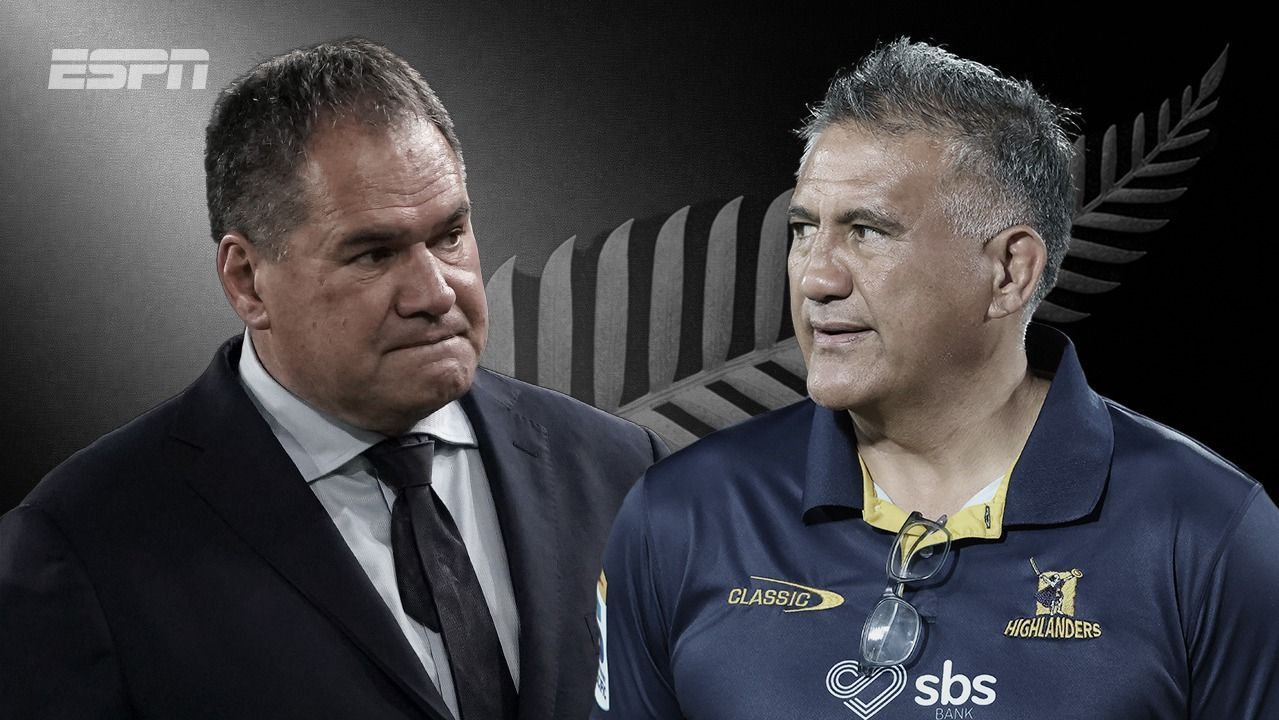
Dave Rennie or Jamie Joseph. Jamie Joseph or Dave Rennie.
Everyone in New Zealand has their theories, their supposed inside scoops. The reality, though, is that the wait to appoint the next All Blacks head coach will linger until mid-March.
In an ideal world Joe Schmidt, Vern Cotter and, perhaps, others who satisfy the criteria of having coached another international nation would contest Scott Robertson’s former post.
As it has transpired, Rennie and Joseph are the only two genuine contenders. Warren Gatland and any other suggestions are nothing but a mirage.
In the coming weeks, New Zealand Rugby’s panel comprising former All Blacks hookers Dane Coles, Keven Mealamu, chairman David Kirk, high performance expert Don Tricker and interim chief executive Steve Lancaster will ultimately determine the appointment.
Lancaster and Coles spent time with the Highlanders in Dunedin last week and will travel to Japan to visit Rennie’s Kobe Steelers next week as part of the due diligence process before formal interviews are conducted with the full appointment panel.
But, for now, let’s play kingmaker and assess Rennie and Joseph.
Who has the edge and why?
Joseph sparked a flurry of speculation that he had sealed his appointment after guiding the Highlanders to their round one Super Rugby Pacific upset against the Crusaders in Dunedin last week.
While one win doesn’t hurt his chances, it certainly doesn’t carry unilateral rubber stamp approval.
Joseph’s appeal dates well before Super Rugby’s opening weekend, with his extensive coaching experience stretching from Wellington to the Highlanders, whom he guided to their sole Super Rugby title in 2015, to New Zealand Māori and Japan.
Two years ago, Joseph contested the All Blacks job when Robertson was appointed. He has since led the All Blacks XV on their unbeaten northern tour against Uruguay, England A and the Barbarians last November to suggest he is firmly next in line.
Joseph’s case is significantly hurt, though, by his former right hand man Tony Brown’s commitment to the Springboks through to the 2027 World Cup.
ALL BLACKS BRUTAL FEEDBACK THAT SEALED ROBERTSON’S FATE
Most rugby observers recognise Brown’s now world-renowned attacking creativity but his softer, personable approach is also the perfect foil for Joseph’s uncompromising, authoritative personality.
The All Blacks, particularly their forward pack, could benefit from Joseph’s old school direct presence but so, too, is NZ Rugby aware of the string of assistant coaches, including Kendrick Lynn (now Pumas attack coach), Tom Donnelly (Wallabies lineout), Dave Dillon and Riki Flutey, who have departed the Highlanders ranks in recent times.
Some players also struggle with Joseph’s heavy, physical trainings.
The Highlanders have long struggled to consistently compete with other New Zealand franchises for recruitment and talent which adds context to Joseph’s 49.15% win rate (58 of 118 matches) with the southerners.
While Joseph’s Highlanders started this season on a memorable note, last year finished with three wins, 11 losses and the wooden spoon.
At Test level Joseph guided Japan to their first World Cup quarterfinal appearance in 2019 after topping their pool with notable wins against Ireland and Scotland.
After that success, Joseph’s 45% win rate (23 victories from 51 attempts) with Japan stems from victories against tier two nations – Uruguay, South Korea, Hong Kong, Georgia, Romania, Tonga, Russia, USA, Samoa, Portugal and Chile.
Rennie, in my view, is the standout candidate.
From Wellington to Manawatū, the Chiefs, Glasgow, the Wallabies and Kobe in Japan, Rennie’s impact is clear.
He delivered Wellington their first provincial title in 14 years and led the New Zealand under 20s to three unbeaten World Cups – winning 15 straight matches – but it was at the Chiefs he left an indelible mark.
Assuming charge in 2012, alongside the influential Wayne Smith, Rennie immediately rebuilt the Chiefs squad that finished 11th and 10th the previous two years under Ian Foster, recruiting Aaron Cruden, Ben Tameifuna, Brodie Retallick and Sonny Bill Williams along the way.
While those were headline figures, Rennie trawled through data to prioritise his Chiefs squad on workers and character.
After the Chiefs, where Rennie finished with a 66.7% win rate (71 from 106 matches), second only to Clayton McMillan, he led Glasgow to No. 1 in Pro 14 in his two seasons at the helm.
Rennie endured a difficult time with the Wallabies, finishing with a 38.2% win record after his tenure was brutally cut short by former Rugby Australia chairman Hamish McLennan in his desperation to hire Eddie Jones, but those figures don’t tell the full story.
Under Rennie the Wallabies defeated Rassie Erasmus’ Springboks in three of four Tests. And despite their struggles for results, many senior Wallabies publicly voiced their frustration with Rennie’s ousting to indicate strong support among their playing group.
The Wallabies would have been a much more united, prepared squad than the dysfunctional version Jones led to crash out of the 2023 World Cup pool stages for the first time in history.
Rennie is his own man and, therefore, experienced fractures with NZ Rugby hierarchy, partly because he stayed true to the Chiefs and didn’t always fall in line with requested All Blacks rests.
He has always been highly regarded, though. Speaking at the Wairarapa Bush rugby sports award function, Sir Graham Henry bemoaned NZ Rugby letting Rennie go to the Wallabies, stating he should have been All Blacks coach instead of Ian Foster.
A change of management at NZ Rugby, with a new chief executive, chair and board, since Rennie’s time at the Chiefs, should also ensure no grievances linger.
On the field for all the hoopla surrounding the Highlanders first round win, Rennie’s Kobe Steelers toppled Todd Blackadder’s Toshiba Brave Lupus in Japan Rugby League One last weekend to continue their rise on his watch.
Joseph started the favourite and his presence in New Zealand may hand him the inside running but as a noted man manager with a track record of success, Rennie’s credentials should shine through in the process to appoint the next All Blacks coach.
