NIKE STAFFERS SAT around a conference room table inside the company’s Oregon headquarters in late 2002 examining a space-age material.
Black and tubelike, Tech Flex had commonly been found inside cars and airplanes. Its grip expanded and contracted whatever was placed inside it.
Staffers saw it as a possible foundation for the next frontier of a basketball sneaker, one that wouldn’t feature laces.
Gentry Humphrey, a Nike executive tasked with marketing the shoe, looked at its braided sleeving. “It kind of looks like a snake,” he thought to himself. Others thought the same.
At home late that night, Humphrey searched the internet for more information about “the most badass black snake there is.”
The search didn’t take long. The top result: black mamba.
The snake was described as lightning fast, agile and feared — the same qualities of the star NBA guard for whom they were designing the shoe.
Humphrey, who had worked at Nike since 1994, quickly prepared a presentation that featured the snake as the centerpiece of a new sneaker campaign. Alongside photos of the snake were videos of the NBA star attacking the basket.
Soon after, Humphrey showed the presentation to his colleagues. The synergy between the material, the black mamba and the NBA star felt natural, alluring.
“Everybody was in on it,” he told ESPN.
From there, it was time to create a global campaign featuring the black mamba, and present it to the player who would ultimately represent it.
That player was Michael Jordan.
TODAY, THE BLACK mamba is synonymous with Kobe Bryant, the late Los Angeles Lakers legend.
Countless posters, murals and commercials champion the intensity of his “Mamba Mentality.” Bryant founded an academy that bore its name. Mamba Day is Aug. 24 — 8/24 — a nod to the two jersey numbers he wore during his 20-year career with the Lakers.
Nearly 10 years ago, after scoring 60 points in his final game on April 13, 2016, Bryant addressed the crowd at Staples Center, declaring “Mamba out!” — his final words as a Laker before placing the microphone on the court.
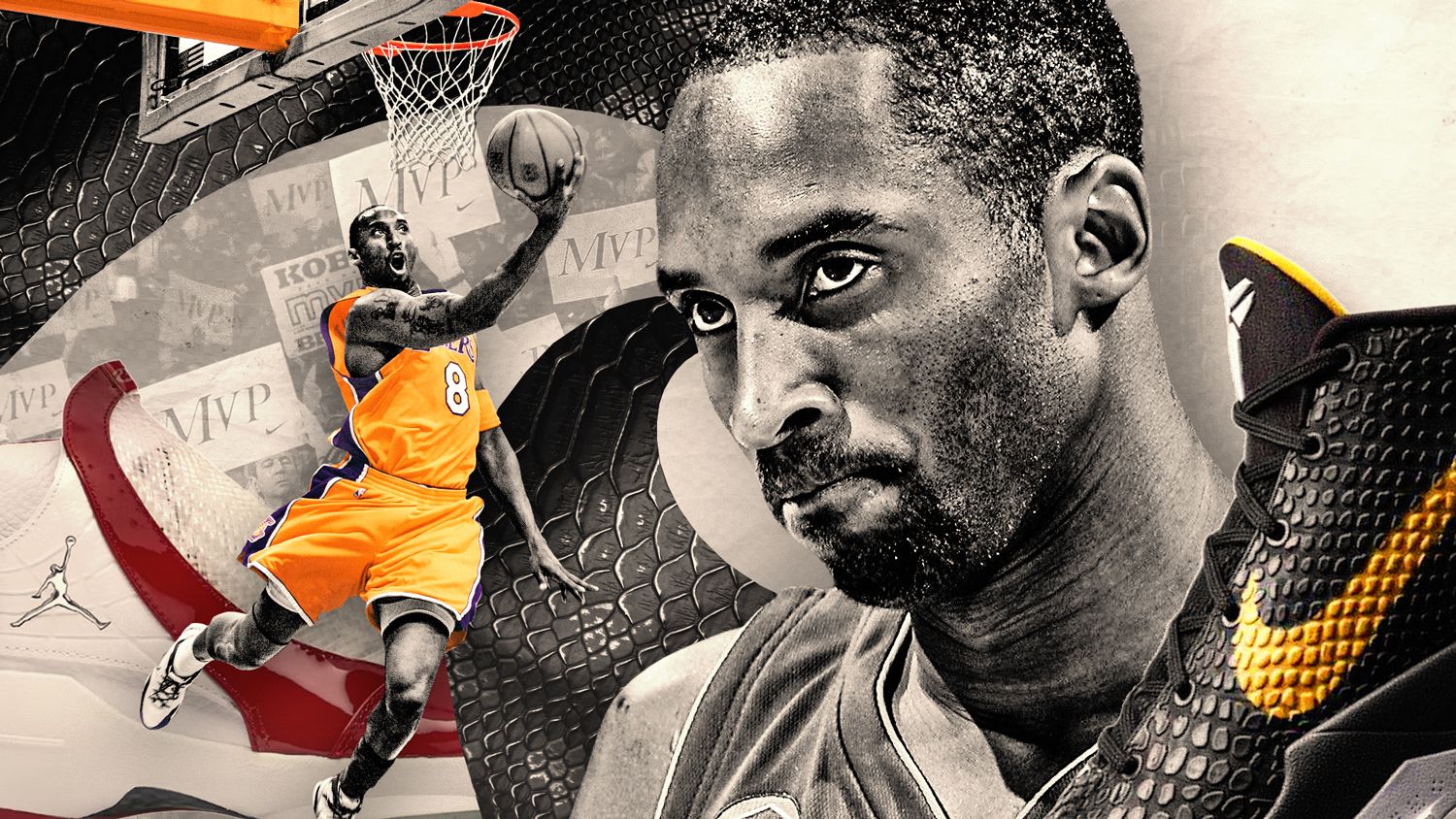
As part of his signature sneaker line, Nike has released several shoes featuring Mamba-related elements, including textured snakeskin patterns.
How a shoe and persona designed for Jordan became Bryant’s instead reveals an alternate reality — one of the most remarkable untold stories in the history of sports marketing, advertising and apparel.
The first Air Jordans were released in 1985. The 40-year-old signature shoe line netted nearly $7.3 billion in sales for the fiscal year ending in May 2025, and the annual launch of each one involves an army of staff — and, most importantly, input from Jordan himself.
For the first 18 versions of the Air Jordans, initial design ideas had come from Jordan, who would provide feedback on sketches and prototypes until the shoe met his expectations.
It wasn’t unusual for ideas outside of sports to influence the shoes. The Jordan 5 took inspiration from an American WWII fighter plane, the 6 from a German sports car, the 7 from West African tribal art, the 12 from the Japanese flag, the 14 from a Ferrari sports car, the 15 from a X-15 fighter plane, the 17 from jazz and an Aston Martin.
For the 18s, which were released in 2003, Jordan told Tate Kuerbis, the shoe’s designer, that he saw a beautiful, Italian-crafted leather driving shoe, one typically used in Formula 1 races. “And he was like, ‘Hey, can you make a basketball shoe look like one piece of leather that is inspired by this driving shoe?'”
Eventually, samples of the 18 were created for him to try on.
“When he puts it on, that’s really when it becomes the Air Jordan,” Kuerbis said. “And he’s signing off like, this is good to go to market.”
“MJ’s vision led the way,” Kuerbis continued.
The 19s represented the first time the initial concept would come from the design team instead.
For years, Jordan had carried the nickname “The Black Cat,” among players. Humphrey and others at Nike believed, however, that the way Jordan attacked on the court better mirrored the speed and agility of a snake — and now they had a material to represent it.
That concept was something of a “white whale” for the industry — the laceless shoe. There had never been a performance basketball shoe without laces, but the Tech Flex material now made that possible, Humphrey and Kuerbis said.
Now all they needed to do was sell Jordan on their idea.
EXCITEMENT GREW AFTER Humphrey’s presentation for a black mamba campaign for the Air Jordan 19s.
Soon after, Kuerbis began working on sketches and prototypes.
He recalled bringing them to see Jordan during an off-day when the Wizards were in Miami to play the Heat.
In the locker room, Jordan, who was then wearing the just-launched 18s, examined the shoe. Those who worked with him say he was always careful, inquisitive, protective of the brand — and, most of all, competitive. He wanted his shoes to be the best.
He asked if the Tech Flex material stretched over time. Would it still provide the necessary support during a game? He suggested that it might be good to have some laces under the braided sleeving. In all, Kuerbis said, Jordan was “excited and curious and onboard.”
Humphrey and Kuerbis pushed forward. They recalled a meeting with Jordan in the spring of 2003, as his NBA career was winding down, in an office in downtown Chicago, with a handful of Nike officials in attendance.
It was there that Humphrey said he first explained the black mamba campaign concept to Jordan.
By then, Humphrey said the idea had already been shared internally with advertising and marketing officials at Jordan Brand, and they had launched on how to present it to a global audience.
But as soon as Humphrey began to walk Jordan through the black mamba concept, he knew there was a major problem.
“You could just tell from the very beginning,” Humphrey said, “he was uncomfortable.”
IN THE SPRING of 2003, after receiving the black mamba brief from the Jordan Brand team, Tina Davis of the Wieden+Kennedy advertising firm gathered her team in New York.
Nike had used Wieden+Kennedy since 1982, and Dan Wieden — one of its founders — had coined Nike’s famous “Just Do It” slogan. The firm was also behind the Air Jordan commercials that featured Spike Lee as “Mars Blackmon” in the late 1980s and early 1990s.
Typically, Wieden+Kennedy would receive a brief, then take the core of an idea and try to express it visually in the most ambitious way across a variety of platforms: commercials, print advertisements, billboards, posters.
Justin Barocas, then a Wieden+Kennedy media director, said they wanted to create visuals for the black mamba campaign that had “stopping power.”
They first tried to find a live black mamba snake, typically found in sub-Saharan Africa, in the hopes of placing it in a cage with the shoe for a photoshoot.
“Then we learned that they’re illegal in the United States,” Davis recalled. “You can’t even bring them into the country.”
They used a different black snake, one that was so large, said Charles Hall, then a Wieden+Kennedy associate creative director, “that you wouldn’t have wanted it loose in the room.”
Inside the New York office, they stitched photos together to digitally recreate a version of the black mamba slithering around the shoe, rearing its head, and the team prepared for the targeted spring 2004 launch of the Air Jordan 19.
The next step was for Jordan to visit the Nike campus to see the campaign for himself.
IN LATE 2003, Jackie Thomas stood in an empty conference room on the Nike campus, her back to the door, going over the notes of a presentation she was about to deliver.
She heard a deep voice behind her.
“You must be Jackie.”
She turned around.
“You must be MJ,” she said, extending her hand to the man himself, the namesake of the empire who had his own reserved parking space on the campus.
Thomas was Jordan Brand’s new director of marketing, a position she assumed in August 2003 that tasked her with overseeing marketing for all Jordan products, with a focus on increased innovation.
“We had a very robust retro business,” she told ESPN. “And there was concern — rightfully so — that the brand was leaning very heavily on the retro market, and we did not want to kill the golden goose.”
The goal was to preserve the integrity of a retro product but also move it into the future. The 19, she said, was a key part of that effort, and Wieden+Kennedy had already created the ads for the launch. The entire campaign was in place.
It was now her job to explain it to Jordan.
Thomas had spent weeks prepping, planning, researching. Marketing, apparel, footwear and advertising staffers soon packed the room. Thomas’ mission was to describe every aspect of the launch.
Across the next hour, she dissected each element; the portion that mentioned the black mamba snake lasted about 15 minutes.
While she talked, Jordan seemed enthusiastic, and when the presentation ended, Thomas felt relieved and excited — like she’d hit a home run.
The next day, Thomas said, she received a call from Larry Miller, the president of Jordan Brand.
“Why don’t you come down to my office?” he asked. “I’ve got to talk to you about something.”
Still riding high, she didn’t think anything of the call. She bounded down the hall.
“What’s up, boss?” she asked.
“Hey, good job in there yesterday,” Miller said. “MJ really liked the meeting. The product looked great, but you’ve got a problem.
“MJ doesn’t like snakes.”
THOMAS WAS PERPLEXED. No one had told her Jordan didn’t like snakes. At no point during the meeting did Jordan convey such an impression.
“Well, I wasn’t involved in product creation,” she told Miller, “and you guys all knew that the snake was a large part of the story around the product design. And I think this campaign is really good.”
Miller shrugged.
“Here’s MJ’s number,” he told her. “Give him a call. Sell him on it.”
She took a breath, steeled herself and dialed.
It was late in the week, a Thursday, she said.
No answer. She called again later that day — again, no answer. She called twice the next day. She left voicemails.
The weekend arrived, and Thomas paced through her Oregon home.
Thomas gathered her team and crunched the numbers. On Sunday, she called Jordan again and left a detailed voicemail.
The launch was just months away, and plans were in place, she explained — advertisements, marketing. There was no way they could suddenly tell retailers, for instance, that they had no visuals, no in-store point-of-sale material.
The sales team had already placed ads to be published. There had been countless meetings, countless checkpoints, and they all had the green light. Hitting pause, she said, could translate to millions of dollars in losses.
A couple hours later, Jordan called her back. He said he understood.
“I’m OK on this one particular occasion to allow you to run the ad,” he told her, “but you need to reconcept before the next colorway drops.”
She thanked him, appreciative of the compromise.
After the call, she sent him a box of Davidoff Millennium cigars and a thank-you note.
On March 14, 2004, the same month the $165 shoe launched, a two-page black mamba Air Jordan 19 advertisement appeared in ESPN The Magazine, part of a print-focused run that Thomas said included other national magazines. It carried the tagline “Only Greatness Equals Greatness.”
Then, the campaign quickly pivoted.
Commercials featured additional colorways. One with Carmelo Anthony, another with Gary Payton, another with Jason Kidd. Legendary Georgetown coach John Thompson provided the voiceovers.
None referenced the black mamba.
LOOKING BACK, THOSE involved on the shoe admit surprise that the black mamba campaign advanced as far as it did, given Jordan’s disdain for snakes. “We couldn’t believe that when we found out,” Hall said.
But Jordan Brand and Wieden+Kennedy officials at that time all point to the same reason why: Jordan’s fear of snakes was one of his closest-held secrets.
Nike officials had known about his other fear, which he had revealed in a 1992 interview with Playboy. “Everybody’s got a phobia for something,” Jordan told the magazine. “I do not mess with water.”
He explained that it stemmed from watching a friend drown as a child.
But author Mark Vancil, who worked with Jordan on the 1993 book “Rare Air,” explained in a 2024 podcast with Jordan’s former teammate Stacey King the depth of Jordan’s phobia.
“He was terrified,” Vancil said. “If you watched TV with him and a snake came on, he’d change the channel. And [Jordan] goes, ‘If you write that, somebody’s going to get killed because somebody’s going to throw a snake one day.'”
In August 2023, Jordan’s son Marcus revealed on his “Separation Anxiety” podcast that he and his older brother Jeffrey once pranked their dad by throwing fake snakes on his bed.
“We were grounded,” Marcus said. “I think he was caught off guard, and he realized they weren’t real after a while. He was running ’round the house trying to find out who pranked him.”
Barocas and others said they weren’t surprised that Jordan kept his fear of snakes from Nike officials.
“If you know anything about him, he was the ultimate competitor,” he said. “He was a trash talker. He got inside your head. He used any competitive advantage that he had. If he had a legitimate fear of snakes, then you wouldn’t want that out.”
On April 16, 2003, a year before the release of the Jordan 19s, Jordan played his final game, a 107-87 Wizards loss to the 76ers in Philadelphia.
Exactly one year later, in a twist of cosmic fate, a new film directed by Quentin Tarantino was released: “Kill Bill Vol. 2.”
The film featured a group of assassins known as The Deadly Viper Assassination Squad.
In one scene, a member of the group named Elle Driver (played by Daryl Hannah) uses a black mamba snake to attack a fellow assassin named Budd (played by Michael Madsen).
As Budd writhes on the ground with the snake’s venom flowing through his body, Elle delivers a monologue:
“Budd — I’d like to introduce my friend, The Black Mamba. Black Mamba — this is Budd.”
Elle says that she looked up the black mamba online.
“Fascinating creature, the Black Mamba. Listen to this.”
She began to read:
… In Africa, the saying goes, in the bush, an elephant can kill you. A leopard can kill you. And a Black Mamba can kill you. But only with the mamba, and this has been true in Africa since the dawn of time, is death sure. Hence its handle:
Death Incarnate.
Bryant would later say, in a 2018 interview with the Washington Post, that he saw the movie one night at home, when he couldn’t sleep. It was past 2 a.m. The scene had captured his imagination.
“The length, the snake, the bite, the strike, the temperament,” he told the Post, “‘Let me look this s— up.’
“I looked it up — yeah, that’s me. That’s me!'”
IN JUNE 2003, four months after Jordan’s black mamba ad appeared and three months after “Kill Bill Vol. 2“ was released, Bryant signed with Nike after his contract with Adidas expired.
That same month, he also visited Colorado for a knee procedure. He stayed at The Lodge and Spa at Cordillera. There, a 19-year-old woman worked at the front desk. She would later tell authorities that Bryant raped her in his room.
One month later, in July 2003, Bryant, then 24, was charged with felony sexual assault against her. That same day, Bryant held a news conference, admitting to adultery but insisting the encounter was consensual. In September 2004, the charge was dismissed. Six months later, a civil lawsuit was settled out of court.
The incident marked a dividing line in his life and career. During the ensuing 2003-04 NBA season, Bryant flew back and forth between Colorado, where courtroom proceedings were held, and Los Angeles, where he played with the Lakers. Bryant would later say, in the 2015 documentary “Kobe Bryant’s Muse” that he took on the black mamba persona during this time.
“In 2003, I went from a person that was at the top of his game, that had everything coming, to a year later, having absolutely no idea where life is going or if you’re going to even be part of life as we all know it,” Bryant said in the documentary, of which he was an executive producer.
“I hear everything that the crowd is saying. I hear it. So it’s like this place that was my refuge is now being bombarded with all kinds of things that they would say. I had to separate myself, because going through that time, it felt like there was so many things coming at once and it was just becoming very, very confusing. I had to organize things.
“So, I created the black mamba.”
The first mainstream mention of Bryant’s association with the black mamba appeared in an ESPN The Magazine feature by Ric Bucher that ran in the Nov. 7, 2005 issue:
Granted, there is a dark side that Bryant still embraces. He’s known in his inner circle as Mamba, which, he is happy to explain, is a kind of snake that can grow to 13 feet and is the world’s quickest, and one of the most venomous, serpents.
He put that persona on display in August, as motivation for a select group of LA high school players and coaches. The group was provided all-black gear and shuttled over in an all-black bus at 5 a.m. to watch Bryant in a three-hour solo workout. “The mamba can strike with 99% accuracy at maximum speed, in rapid succession,” Bryant explains.
The first image of Bryant with the snake did not appear until the summer of 2006.
In the months prior, Ryan Jones, then the editor-in-chief of SLAM Magazine, said the team at SLAM knew that Bryant had been calling himself “mamba” and pitched him on the idea of appearing on the cover of the magazine holding a snake.
Bryant agreed. He arrived at a SoHo studio in New York City during an off-game night. SLAM had hired a snake wrangler and had a couple nonvenomous black snakes at the ready.
“Once the handler showed him what to do, he was super comfortable with it,” Jones recalled. “He was holding it near his face. He was all-in.”
The cover appeared in May 2006, with Bryant holding the snake.
The headline: “Kobe COLD BLOODED.”
ERIC AVAR HELPED design several of Bryant’s shoes. He said that the origins of Bryant’s black mamba campaign can be traced back to the Nike Zoom III, which was released in 2007.
“The early notion about the black mamba was all about being lightning quick, deadly — and that was just his style and his game,” Avar told former ESPN staff writer Nick DePaula. “Kobe has always been creative and imaginative, so he would look at things from a functional and practical standpoint for his game, but the story, expression and imagination were always so big.
“He really thought about his game, how he approached the game, and he was always leaning into that. Looking at metaphors was always really big. It was really the lightning-fast, deadly aspect of the black mamba that resonated with him and his style. That’s where that started from.”
The shoe itself doesn’t feature any obvious ties to the snake, but those would soon emerge.
In late December 2008, Nike released a limited-edition Nike Zoom Kobe IV “Venom” signature sneaker. Then, in December 2010, Nike released the Zoom Kobe VI, which featured a snakeskin texture.
A Nike release stated, “The shoe is inspired by Kobe’s on-court alter ego, ‘The Black Mamba,’ and features a design inspired by the fearsome snake.”
In February 2011, in conjunction with the NBA All-Star Weekend in Los Angeles, Nike released “The Black Mamba” — a short film starring Bryant.
By then Bryant had become synonymous with the snake, and some Nike insiders smirked when they saw the campaign take off.
“For me, what was shocking was when Nike came out with it — ‘Ah, Kobe and the black mamba!'” Humphrey said. “I was like, ‘This shit is old! You serious?'”
Bryant idolized Jordan and patterned his game after him, studying Jordan relentlessly, his VHS tapes, how he walked, even how he chewed gum. It’s unclear, though, whether he knew about Jordan’s black mamba campaign.
Multiple people close to him say he did not.
Before becoming the general manager and vice president of basketball operations for the Dallas Mavericks, Nico Harrison worked at Nike for 19 years. He supervised Nike’s basketball brand managers and worked closely with Bryant since the Lakers guard signed with Nike in 2003.
Of the Air Jordan 19 campaign, Harrison told ESPN, “I remember the snakes. I remember the [Tech Flex] technology. And I don’t remember the ad.”
He said no one from Nike or Jordan Brand had ever mentioned it or the campaign to him or, to his knowledge, to Bryant.
Another source who worked closely with Bryant for many years said Bryant had no knowledge of the black mamba connection to Jordan.
Years later, when Thomas became the head of global brand marketing of basketball for Nike, she worked with Bryant and Jordan. She doesn’t recall talking with Bryant about the Air Jordan 19 — or the black mamba campaign around it.
Harrison, among others, pointed out that it’s not surprising that Bryant was likely unaware of Jordan’s campaign because there had long been a strict separation between Jordan Brand and the rest of Nike. That separation stemmed from Jordan himself.
“When Jordan Brand became its own thing, [Jordan] became extremely protective of the style and the design,” Barocas said. “Everybody wanted to keep it as separate from Nike as they could because there was a fear — whether or not it was real, or at least the potential — that those original designs would somehow make their way into Nike.”
Harrison also noted that if Bryant had known about Jordan’s black mamba campaign, then Bryant likely wouldn’t have wanted to pursue his own. “If he did know about it, I think it might give him pause,” Harrison said.
Davis made the point that when Jordan’s campaign was over, “I probably had [the Air Jordan black mamba campaign] in my filing cabinet in my office for forever. And we just moved on. She added that it wasn’t as if it could’ve been used for any other campaign, including Bryant’s.
“If a client decides to kill an idea, the idea is dead,” she said.
“From a product or inspiration standpoint, they were never talked about together,” Avar told DePaula. “They were separate thoughts and ideas.”
It’s unclear what Jordan thinks about the name and campaign: A representative for Jordan declined an interview request on his behalf.
On Nike’s campus, a photo of the black mamba advertisement for the Air Jordan 19 can be found in the company’s archives library on mutlilayered wood plank display boards.
A nearby placard says of the shoe: “Inspired by the black mamba snake, the lightest, most flexible and most breathable Air Jordan to date included Tech Flex [industrial braided sleeving] on the upper, and a lightweight, flexible and breathable overwrap. It also has double-stacked, full-length Zoom Air units. It was a product of a team of designers, a first for an Air Jordan shoe.”
Today, the black mamba campaign for Bryant carries on.
In January 2025, Nike announced that it would honor Bryant by designating 2025 — the Year of the Snake in the Chinese zodiac — as the Year of the Mamba.
There would be a new collection released, featuring new shoes, T-shirts, fleece crews and pants and a satinlike jacket.
The Kobe 5 Protro “Year of Mamba” shoe, the centerpiece of the collection, came in multiple colorways, including purple and red.
On both versions of the shoe, a snake wraps around Nike’s swoosh logo.

