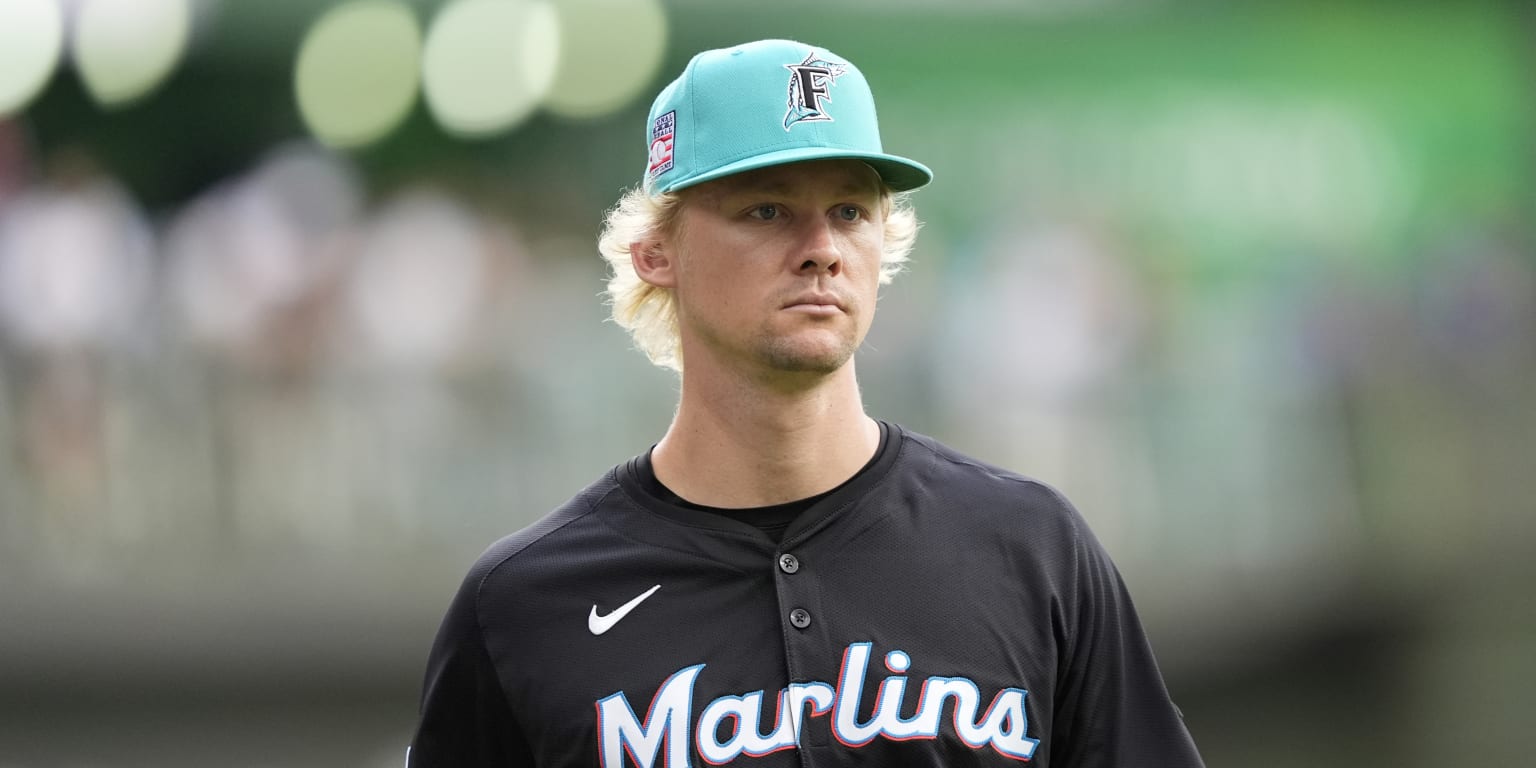
The fact discussions have been had should come as no surprise. I highlighted Stowers as a possible candidate in the offseason’s first newsletter. At president of baseball operations Peter Bendix’s end-of-season presser, he said, “We’re always going to have those conversations. We have a bunch of really good young players” in relation to making extensions a priority this offseason.
Here are things to consider when determining whether a Stowers extension makes sense for the Marlins:
Is the sample size too small?
Once a second-round pick, Stowers had yet to establish himself as a big leaguer before 2025. Baltimore had shuttled Stowers back and forth between Triple-A and the Majors before shipping him to Miami in the Trevor Rogers trade of July 2024.
With no Minor League options remaining, Stowers entered this past Spring Training with a career 69 OPS+ and -1.0 bWAR in his first 117 Major League games from 2022-24. There was no guarantee of making the Opening Day roster, especially after he struggled in Grapefruit League play (.175 average, 7-for-40).
Unfortunately for Stowers, his season was cut short at 117 games – matching his career total to begin the year – due to a left oblique strain. At the time of his injury, Stowers (149 OPS+) ranked among the NL leaders in multiple categories. With a full season under his belt, he would have received at least down-ballot NL MVP votes.
Players with less experience and success have received extensions, so that shouldn’t work against Stowers. The Marlins’ philosophy includes believing in the process and that results will follow, and the introspective Stowers is a poster boy for that.
What is his current contract situation?
Stowers, who made $740,000 in 2025, will not become arbitration-eligible until next offseason. His salary will jump into the millions, especially if he once again produces in 2026. Stowers cannot become a free agent until after the 2029 season.
This means that Miami has four more seasons of control. During this period of time, Stowers will be in his age-28-31 seasons, so the expected prime of his career.
Is there a comparison for Stowers’ situation?
The report mentions Stowers’ representation seeking a deal around $100 million, similar to Pirates All-Star outfielder Bryan Reynolds. The Marlins sought around $50 million.
Of players entering their age-28 season, only eight position players in recent memory received extensions of at least five years: Mookie Betts (12 years, $365 million), Will Smith (10 years, $140 million), Francisco Lindor (10 years, $341 million), Reynolds (eight years, $106.75 million), Byron Buxton (seven years, $100 million), Christian Yelich (seven years, $188.5 million), Sean Murphy (six years, $73 million) and Cal Raleigh (six years, $105 million).
Reynolds is the closest comp to Stowers, and even then, there is much that differs between them. At the time of Reynolds’ extension in 2023, he had 16.1 bWAR and 638 games on his resume from 2019-23.
How would this affect the Marlins financially?
Everyone on the 40-man roster is under club control for multiple seasons, so the payroll is low as a result.
Ace Sandy Alcantara has the team’s largest contract ($11.2 million) for 2026, followed by the seven arbitration-eligible players who will see bumps. Avisaíl García, who hasn’t played for the team since April 27, 2024, is finally off the books. And since Yankees outfielder Giancarlo Stanton opted in after the 2020 season, the Marlins will retain $10 million each year from 2026-28.
What kind of message would it send?
The Marlins have signed players to extensions just 15 times in franchise history.
The Marlins signing Stowers to an extension would show the other organizations, players and fans alike that they are serious about keeping talent if the price is right.
