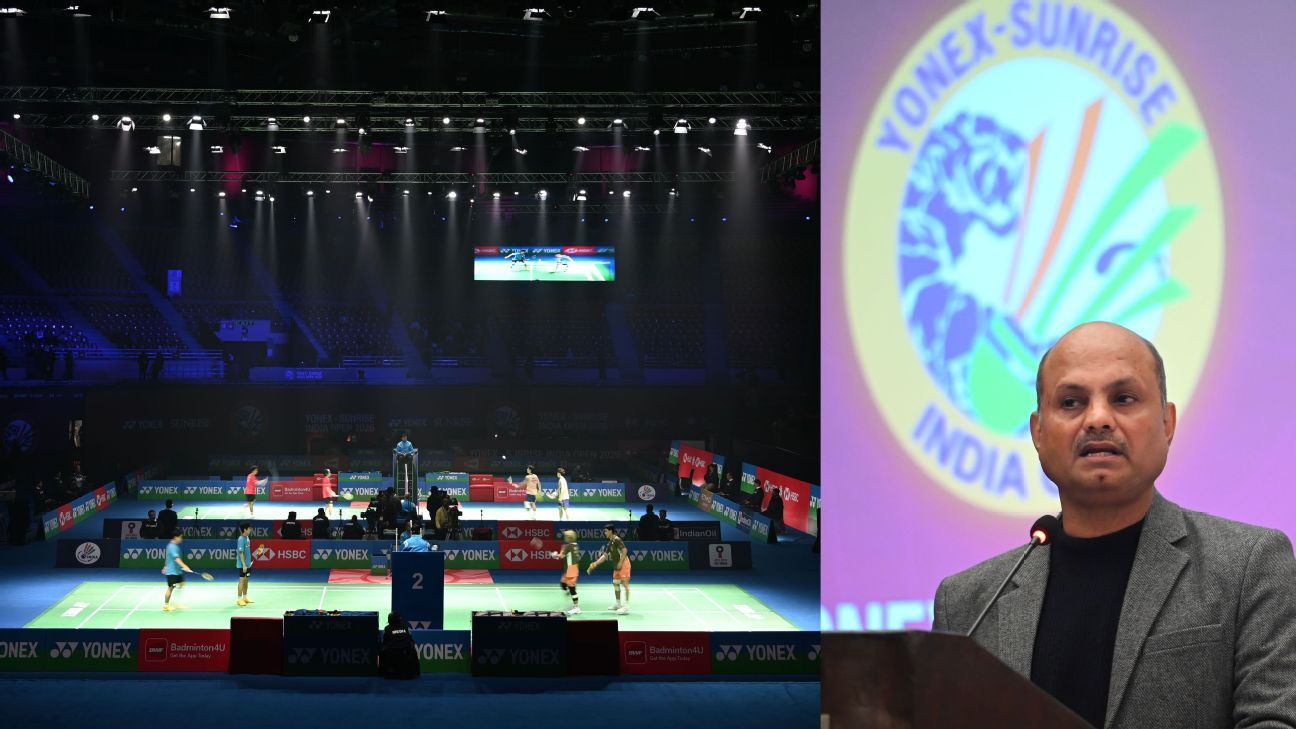
The India Open is in the news, and it isn’t in a way, or a scale, that’s been seen before.
For those unfamiliar, the BWF India Open Super 750 is one of the highest-level badminton events, which India has hosted annually since 2008. It’s a big event in a sport where India have been prominent medalists at the Olympic Games and the World Championships but its coverage is usually confined to the sports pages.
This time, however, it’s front-page stuff – and not for good reasons. Put mildly, the event – at the Indira Gandhi Arena in New Delhi – has been a shambles. The lighting has been atrocious; pigeon and pigeon-poop issues; a monkey was spotted hanging out in the bleachers; dirty toilets and other facilities. And then there’s the Delhi air pollution, with superhigh AQI levels that pose a bigger threat to athletes.
The players have been vocal. Anders Antonsen, the world no. 3 men’s player, refused to travel for the tournament and accepted a $5000 fine rather than endanger his health. Former world champion Loh Kean Yew (one of the favourites for the title) asked journalists how they were managing to breathe properly — he said he was staying indoors as much as possible, always masking up, and still felt everyone’s stamina was down two levels.
Mia Blichfeldt, world no. 20, has been most vociferous in her complaints of the conditions. “I had mentally prepared myself for “the worst” once again, but the conditions surrounding us are simply unacceptable and highly unprofessional,” she wrote on her Instagram handle on Friday. “…Everyone is stressed and frustrated by the conditions we are being met with at a World Tour Super 750 event. At first, you try to laugh it off, but in the end, it is neither funny nor fair to the players or anyone participating in this event.” She also then said something that drove to the heart of the issue: “Sadly, under the current circumstances, I find it very difficult to see how a World Championship could be held here.”
#WATCH | Delhi | On allegations of poor conditions at the venue of the ongoing 2026 India Open Badminton Tournament, Sanjay Mishra, General Secretary, Badminton Association of India, says,” This event is a test event for us before the BWF World Championships. Everyone has… pic.twitter.com/EUJOsarMO5
– ANI (@ANI) January 14, 2026
The official response has been predictable. Downplaying the concerns or dismissing them outright, and turning it back on the players. The secretary of the Badminton Association of India, the organisers, said Blichfeldt’s comments were made in the context of her personal health sensitivities and said that Antonsen can’t comment from Denmark. “There is no place for politics in this sport. It is wrong to support those who criticise our nation from abroad.”
Therein lies the problem. On the one hand, India aspires to be at the top table of international sport, to host the biggest sporting events culminating to host the 2036 Olympics. On the other, the officials who run Indian sport, and will presumably steer the ship to that Olympic goal, have not revealed themselves as capable of doing so – and are certainly incapable of handling criticism, even when the issues are documented. When you host a top-level tournament, intense scrutiny – of everything and at every level – comes with the territory. Just ask Qatar, whose construction and labour issues were repeatedly highlighted, in microscopic detail, when they decided to bid for the FIFA World Cup and right up to kickoff in 2022.
Everything you do gets magnified, every issue that pops up gets spoken about. If you want to host a badminton world championship, be prepared for badminton players to speak up about genuine issues that concern them. If you want to host an Olympic Games, be prepared for every such complaint from every such sport to be analysed and discussed. And dismissing legitimate concerns simply doesn’t work.
This isn’t cricket, where India’s financial clout allows it to call the shots. This is global sport in the true sense, with powers above that you are accountable to, athletes involved who don’t depend entirely on you for their survival. It will take some getting used to.
The good news is that the kind of issues faced by athletes in India are easily fixed. Even Delhi’s notorious pollution; after all, there are ten years to go for 2036. But it needs sports administrators across the nation to rewire their thinking, their way of functioning to do something utterly radical: put the athletes first.
For that is the only way this scrutiny is passed. If Delhi’s AQI is a problem, choose your venues more carefully, plan your schedule better. Ensure animal control is in place at sporting venues, temperature and wind-draft control are sorted, the lighting is appropriate. Over the years, observers of Indian sport have seen how little these things have mattered.
We don’t even need to go too far back: just last fortnight, the Boxing National Championships were delayed for hours because they’d not put in only two boxing rings. You know, the thing boxers enter to box in. On the last day, many teams had been kicked out a day before they were supposed to leave and some of those stranded in the brutal cold of a Noida winter night had finals to compete in the next day. This isn’t the best advertisement of the nation’s aptitude to handle the greatest sporting event of them all. Any issue around the nationals can be quickly and quietly hushed up but the India Open fiasco underlines the fact that international athletes are under no obligation to toe the line.
Now, it’s not like the men in charge are not aware of all this. Earlier this month, a truncated Indian Super League (football) season was pushed through after intervention by the union sports minister. None of the issues that had caused the delay in start (lack of commercial sponsor and broadcast partner, financial woes, ownership arrangement) had been resolved, but the message from the ministry was essentially – ‘don’t send a wrong message internationally.’ An Indian Express report suggested that the minister had warned the clubs that any FIFA sanction or warning could affect India’s Olympic Games bid. Since a global entity of the stature of FIFA was involved, since they had the ear of the International Olympic Committee, the lack of a domestic football league suddenly became a matter that couldn’t simply be brushed under the carpet.
And that’s what India will learn in 2026, and beyond. There is no space underneath the carpet. So, for Indian sport, this entire PR disaster throws up both a chance, and a warning. A chance to finally do right by their raison d’etre (the athletes), and a warning that if they don’t sort their act out, there will be ramifications that they simply cannot control.
