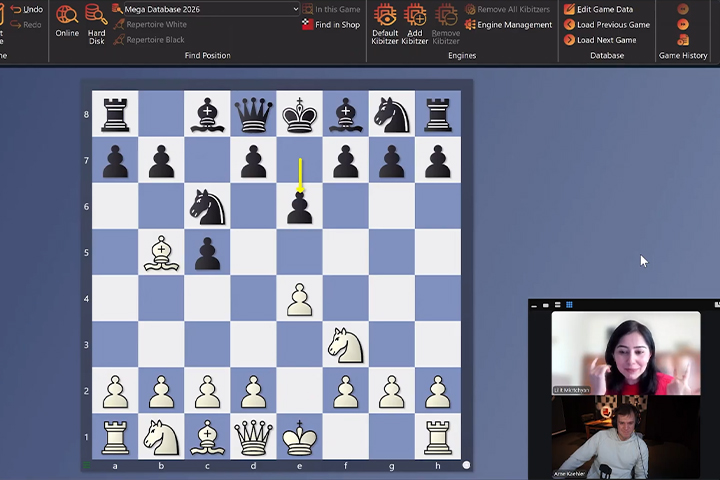
Arne reunites with WIM Lilit Mkrtchian after almost three years to revive their popular training format – this time using ChessBase 26 – and asks her to show three of her favourite games of 2025 while explaining her full preparation process.
For episode 1, Lilit chooses a game from round 5 of the Tegernsee Open (Germany) against 70-year-old Klaus Jürgens, which she found inspiring both for the tournament atmosphere and for how strong and consistent his opening repertoire was.
She demonstrates how she researches an opponent in the Mega Database, identifies their habitual setups (Sicilian vs 1.e4, Dutch/Leningrad vs 1.d4), and then uses that predictability to steer the game into a prepared Rossolimo line with a “trap” where the common move …Ng6 is actually an engine-confirmed mistake!
The key instructional moment is her move-order: after provoking …h5 she plays e5 with the point that later tactics (Qe4 and Bf4 ideas) punish Black’s king safety and pawn structure—details that are almost impossible to find over the board without prior analysis.
She also reviews critical practical decisions in the middlegame and endgame (admitting a couple of inaccuracies that gave counterplay), but shows how she converts the advantage step-by-step into a winning knight ending, and closes by praising how impressive it was that her veteran opponent still set active traps before eventually resigning.
- 0:52 – Why this game: matters Lilit introduces the chosen game from her recent German tournament and explains why the opponent and setting made it special.
- 4:03 – Real tournament preparation in ChessBase Step-by-step: opponent scouting in the Mega Database: filtering games, identifying opening habits, and spotting long-term patterns.
- 14:44 – The critical Rossolimo mistake: …Ng6? The key Rossolimo moment where a “natural” and popular move turns out to be an engine-confirmed mistake, and why over-the-board intuition fails here.
- 28:44 – Advantage conversion & practical decisions: Transition from opening success into the endgame, including Lilit’s honest discussion of inaccuracies, psychology, and how she still converts the win.
EXPAND YOUR CHESS HORIZONS
Data, plans, practice – the new Opening Report In ChessBase there are always attempts to show the typical plans of an opening variation. In the age of engines, chess is much more concrete than previously thought. But amateurs in particular love openings with clear plans, see the London System. In ChessBase ’26, three functions deal with the display of plans. The new opening report examines which piece moves or pawn advances are significant for each important variation. In the reference search you can now see on the board where the pieces usually go. If you start the new Monte Carlo analysis, the board also shows the most common figure paths.
