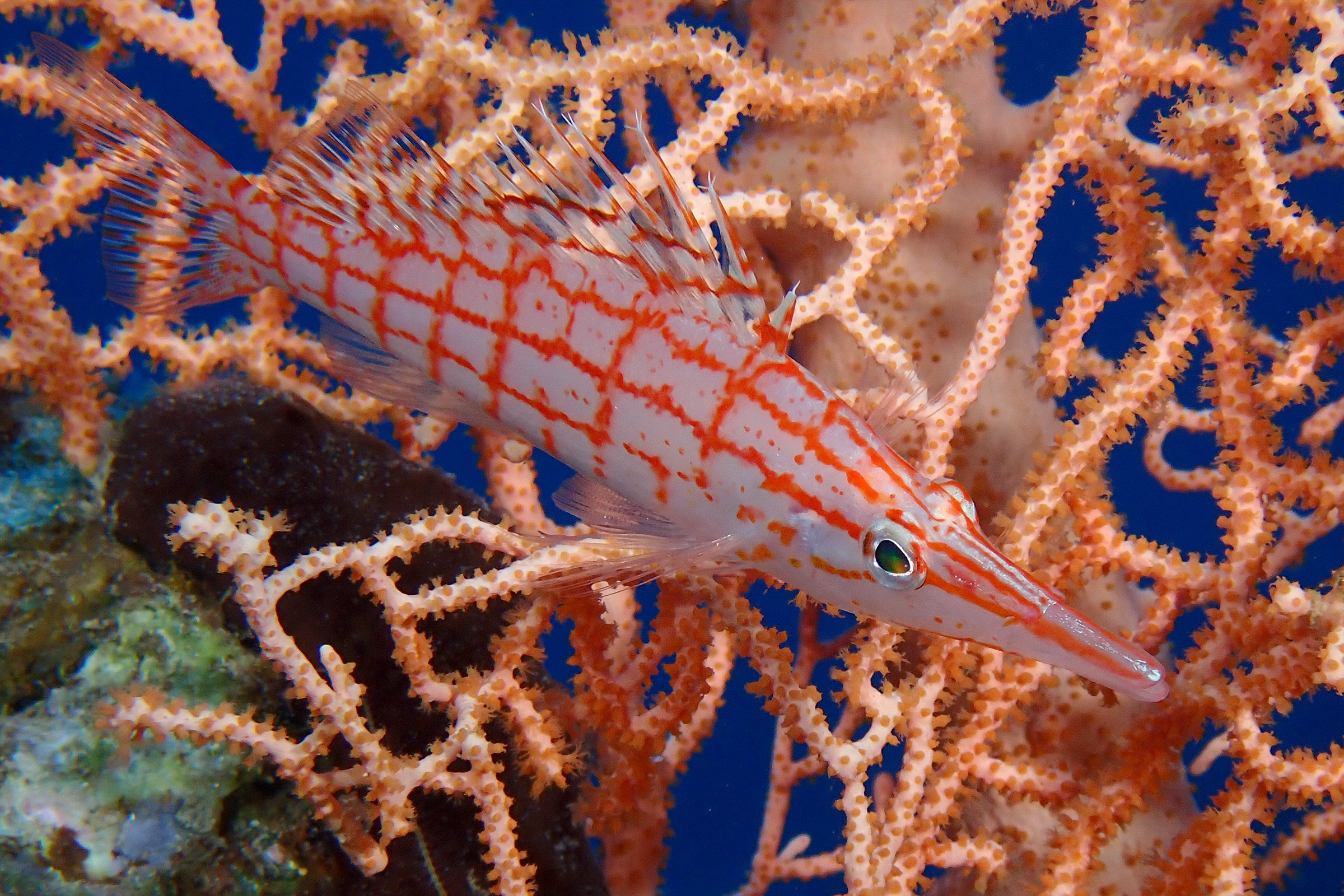
The Little Dragon of the Sea
The Dragon Seamoth (Eurypegasus draconis) is an extraordinary creature.
The Dragon Seamoth is also known as the Little Dragonfish. Jill Studholme
A Walking Fish?
Unlike most fish, the dragon seamoth moves in a rather peculiar way – it walks. Using its fan-like pectoral fins, it slowly creeps across the seafloor, only occasionally using its large pectorals to ‘fly’.
A Suit of Armour
It’s body is encased in a hard armour. With its rough texture and colour, it looks like it’s covered in fragments of shells or sand, making it incredibly difficult to spot.
Another remarkable feature of the dragon seamoth is its ability to shed its skin in one piece every one to five days. This keeps it clean, removing algae and small invertebrates that accumulate on this slow-moving fish. This process also helps with camouflage by allowing it to regenerate new skin with colour changes.

The seamoth uses its long snout to hoover up small crustaceans and other tiny animals. Jill Studholme
Monogamous Pair Bonds
The seamoth is not only intriguing in appearance but also in behaviour. Unlike many fish species, it practices monogamous pair bonding, meaning that once it finds a mate they stay together. This social structure likely evolved to ensure reproductive success in these low-density populations; just one pair is found per 325-477 sq m of suitable habitat. The same pair mate repeatedly, but show neither parental care nor site fidelity.
Single animals take a long time to find a partner, as sother seamoths are faithful to their partners and live at low densities.
You can tell males and females apart as when disturbed males flash a blue-white margin on their pectoral fins, possibly as a warning signal.
Deep and Shallow
The dragon seamoth has been seen as shallow as 3 m, but they are more commonly found in deeper water (37 to over 90 m).
A Hidden Gem of the Ocean
The rarely-seen dragonfish seamoth remains elusive. But the next time you find yourself diving in the warm waters of the Indo-Pacific, on seagrass beds or sandy bottoms, keep an eye on the seafloor – you might just spot a tiny dragon on a slow march across the sand.
References
Herold & Clark. Monogamy, spawning and skin-shedding of the sea moth, Eurypegasus draconis (Pisces: Pegasidae). Environ Biol Fish 37, 219-236 (1993).
Nadir M. Al Abri1 et al. The short dragonfish Eurypegasus draconis (Linnaeus, 1766) in the Sea of Oman. Bulletin of Fish Biology Volume 20 04.07.2021 1-6
Marivic G. Pajaro et al. Biology, fishery and trade of sea moths (Pisces: Pegasidae) in the central Philippines. Oryx. 2004;38(4):432-438.
Amanda C. J. Vincent. Trade in pegasid fishes (sea moths), primarily for traditional Chinese medicine. Oryx. 1997;31(3):199-208. doi:10.1046/j.1365-3008.1997.d01-12.x
