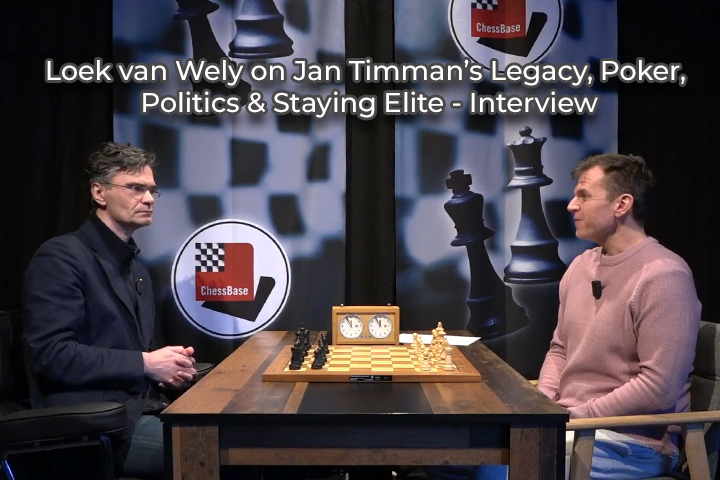
On a bittersweet day — February 19th, 2026, one day before Jan Timman passed away, Dutch Grandmaster Loek van Wely sat down at ChessBase headquarters in Hamburg for an in-depth conversation about his life in and beyond chess.
Remembering Jan Timman
Van Wely opened the interview with fond memories of the late Jan Timman. Their story began at the 1992 Manila Olympiad, where a young Van Wely and Jereon Piket were still “very green,” while Timman, the experienced team leader, showed them the ropes, both on and off the board. The two shared a fierce rivalry for over a decade. Van Wely admitted that his early trash-talking actually motivated Timman to play even better.
Their last encounter over the board came at a four-player round-robin in Leiden alongside Jan Smeets, where Timman got his revenge with a back-rank mate. Van Wely took it in stride: after years of dominating their head-to-head, he felt it was only fair.
Travelling together for club matches also forged lasting memories, including a memorable car ride to Dresden, with Timman attempting to pour white wine at 180 km/h on the Autobahn before Van Wely had to slam the brakes for traffic.
What Made Van Wely Great
Asked what separated him from his Dutch contemporaries, Van Wely pointed to a combination of natural talent, relentless work ethic, and sheer ambition. He amassed a library of over a thousand chess books, not opening manuals, but works on endgames and positional understanding that he considers essential for a sustainable chess career. He also credits the post-game analysis sessions with Soviet-era opponents in the late 1980s and early 1990s as a major influence on his development.
His 25 consecutive appearances at the Wijk aan Zee tournament (1992–2017) are a testament to that dedication. But by 2017, with a rating of 2695, he sensed the fire was fading, and a disastrous 3.5/13 result confirmed it was time to step back from the super-tournament circuit.
Having recently attended Wijk aan Zee 2026 as a coach, Van Wely offered a sharp assessment of today’s young elite. Players like Vincent Keymer, he observed, sometimes lack a “stop button”. They push relentlessly, which can be both a strength and a vulnerability. For an experienced campaigner like Van Wely, this is actually an opportunity: patience and experience can punish over-ambition, much like waiting for an unforced error in tennis.
Van Wely has been coaching Max Warmerdam for approximately eight years and Eline Roebers for about a year and a half. He was candid about the challenges. While praising Warmerdam’s work ethic, he noted a stubbornness that sometimes prevents the young GM from fully absorbing his coach’s approach. As for Roebers, who won European Blitz gold and World Blitz bronze, Van Wely was characteristically honest: he can’t yet see his coaching fingerprint in her play, and wishes she would integrate more of his style, particularly for the demanding classical format.
Tired of spending hours and hours on the boring theory of your favourite opening? Then here is your solution, play an Anti-Sicilian with 3.Bb5 against 2…d6 or 2…Nc6, and 3.d3 against 2…e6. In 60 minutes you will get a crash course in how to avoid mainstream theory and in understanding the ideas of this Anti-Sicilian setup. After these 60 minutes you should be able to survive the Sicilian for a long time, without being bothered by new developments found by engine x supported by an x-core machine. Now that it finally comes down to understanding, let’s play chess!
The Unlikely Politician
Van Wely’s entry into Dutch politics reads like a chess blitz game. A friend offered him a spot on a new party’s election list in 2017. He asked for time to think. The answer: “You have one hour.” He said yes. When the party surged in the 2019 Senate elections, Van Wely suddenly found himself in the Dutch Senate, a role he compared more to poker than chess, given the bluffing, hidden agendas, and pattern recognition required.
He even co-founded his own local political party and expects to double their seats in the upcoming March 2026 elections, though he admits he no longer has time for active involvement. His current role? Party treasurer. As he put it: “When you control the money, you’re in charge.”
Fitness as a Chess Weapon
Three years ago, Van Wely committed seriously to physical fitness, taking up CrossFit and Hyrox events. He sees this as a decisive edge over peers from his generation, players like Adams, Gelfand, and Chucky Ivanchuk, who were once rated above him but have since dropped off.
Van Wely believes his superior physical condition is the key difference. A recent Bundesliga win against the young Russian GM Alexey Sarana illustrated the point: his opponent pushed aggressively, expecting to grind Van Wely down, but the Dutchman’s stamina allowed him to absorb the pressure and strike back decisively.
In 60 minutes you will get a crash course how to play such a complicated opening like the Sicilian Najdorf by the hands of GM van Wely who knows by experience how the dangers look like! The contents:
• Video 1, 2, 3: how to survive versus whites most aggressive approach: 6. Bc4, 6. Be3 and 6 Bg5
• Video 4: how to deal with the latest fashion in the Najdorf 6. h3 and last but not least
• Video 5: how to play vs the more classical set ups 6. Be2 and 6. g3
The Road to the 2026 Olympiad
Van Wely’s primary goal for 2026 is clear: the Chess Olympiad. If selected, it will be his 15th appearance for the Dutch national team. The Netherlands have won two European team gold medals but never an Olympiad medal, a gap Van Wely is determined to close. With Giri and Van Foreest in the squad, he believes a medal is possible, despite fierce competition from India, the USA, and Uzbekistan.
His preparation roadmap includes open tournaments in Thailand (alongside Nigel Short) and Corsica, the French league, and the Dutch national championship, a steady, step-by-step climb toward peak form by summer. And after that? Van Wely isn’t looking beyond the Olympiad. “Let’s see after the medal what will happen then.”
As for opponents who might write him off? “I love it when people underestimate you, and you can still fire back.”
