Abdusattorov’s deep preparation
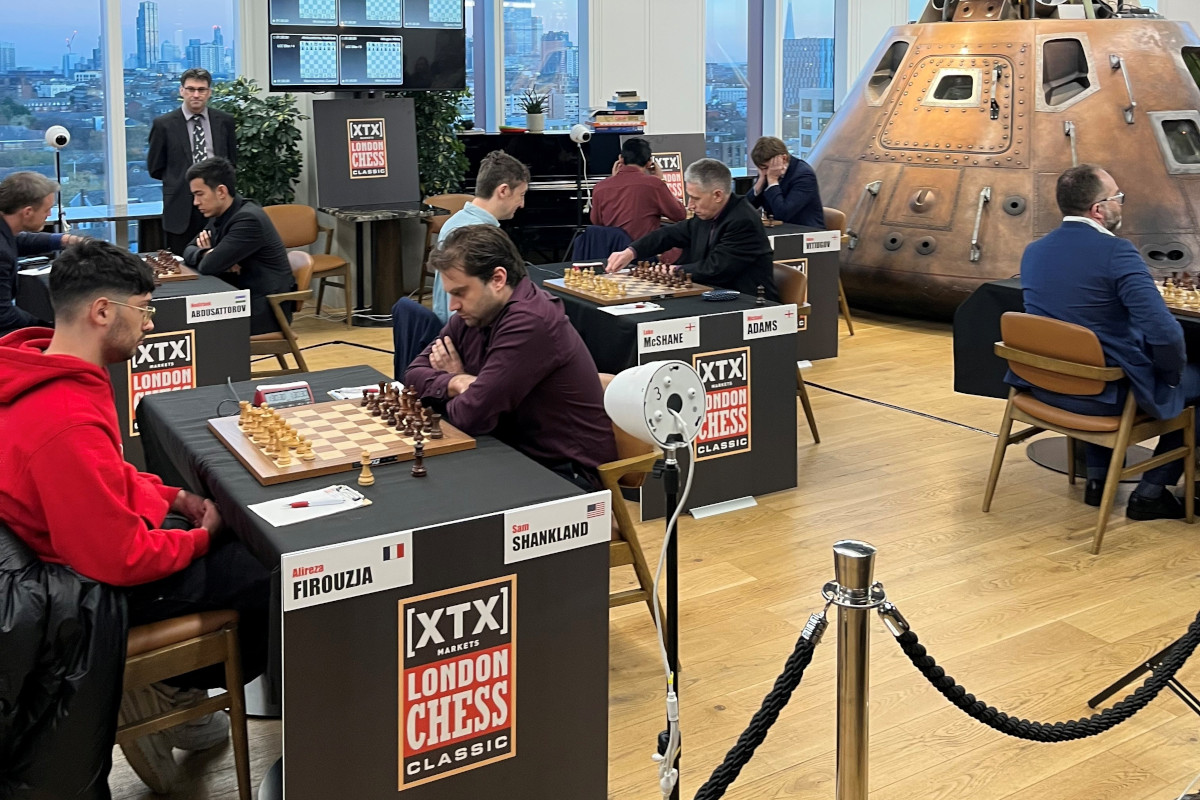
Round two of the London Chess Classic offered a change of pace after the fully drawn opening day. In round one, all five games had ended peacefully, with Alireza Firouzja notably missing winning chances against Sam Shankland. On Tuesday, however, three players – Firouzja, Nodirbek Abdusattorov and Nikolas Theodorou – collected full points to become co-leaders at the tournament, which is taking place at Arsenal Football Club’s stadium.
Round 2 results
I’ll be at the London Chess Classic today, Friday, and Monday if anyone wants to come and say hi! 👋 One of my favourite events, where I’ve faced so many strong opponents and had so many fun experiences over the years ♟️🇬🇧 pic.twitter.com/wFdshugbhg
— David Howell (@DavidHowellGM) November 27, 2025
Remarkable commentary was provided by GMs David Howell and Daniel King on Thursday
The most eye-catching performance of the round came from Abdusattorov, who defeated Abhimanyu Mishra in a highly theoretical variation of the Ruy Lopez. With the white pieces, the Uzbek GM astonished commentators and spectators by playing more than 30 moves of prepared analysis at blitz-like speed.
The line Abdusattorov had prepared led to an endgame which he already knew to be favourable for White. The practical effect of this deep preparation was dramatic: by the time he played 34.Ke3, he still had 1 hour and 28 minutes on his clock (players begin the game with an hour and a half), while Mishra was down to 6 minutes.
Facing a difficult endgame with little time remaining, the young US representative soon faltered. Abdusattorov converted his advantage without difficulty, winning in 49 moves and finishing with 1 hour and 43 minutes after the additional 30 minutes were added at move 40 – a striking illustration of how far elite players’ home analysis can sometimes extend.
Picture this: you’ve outplayed your opponent move by move, you’re clearly better – and then the endgame slips into a draw, simply because you lacked the crucial theoretical knowledge. That is exactly where this course comes in. Without solid endgame skills, there’s no way forward. Rook endgames are most essential: they occur more often than any other type of endgame, and often make the difference between victory and half a point. If you master them, you’ll confidently convert your advantages into wins!
Free video sample: Introduction
Free video sample: Bodycheck
Although Abdusattorov’s win was the longest game in terms of moves, the other decisive results arrived later in the day, given how quickly the Uzbek star had completed his victory.
Firouzja defeated Luke McShane in 33 moves from the black side of a Najdorf Sicilian. The French representative later pointed out that he did not expect to obtain more than equality from the opening, and that his chance arose only after McShane’s blunder with 21.Qxe5
According to Firouzja, this was less a miscalculation than the Englishman simply “forgetting” that he had not yet captured on d5 with 21.Bxd5. Once the mistake appeared on the board, Firouzja demonstrated his well-known tactical sharpness, breaking through convincingly and forcing resignation in a position where checkmate could no longer be prevented.
Glorious sacrifices, unexpected tactics and checkmating attacks. The King’s Gambit is one of the oldest and most romantic openings in the game of chess. This DVD contains all you need to know to tackle your opponent.
The last game of the day to finish saw Nikolas Theodorou score a notable win over defending champion Gawain Maroroa Jones. The players entered a Queen’s Pawn Opening featuring an early 3…a6 – the line sometimes dubbed the Magnus Queen’s Gambit. Theodorou followed known games until move 13, at which point it was Maroroa Jones who diverged with the questionable 13…g4.
Both the commentary team and Theodorou himself later described the move as overly committal. From that moment, the Greek GM gradually tightened his grip on the position. He produced several well-judged moves, including 15.b4 and the timely 21.e4, to make full use of his structural and strategic trumps.
Black’s position deteriorated rapidly, and Theodorou finished the game with a sequence of accurate tactical shots. Maroroa Jones, acknowledging his opponent’s play, allowed the Greek player to deliver checkmate on the board.
Standings after round 2
All games
EXPAND YOUR CHESS HORIZONS
Data, plans, practice – the new Opening Report In ChessBase there are always attempts to show the typical plans of an opening variation. In the age of engines, chess is much more concrete than previously thought. But amateurs in particular love openings with clear plans, see the London System. In ChessBase ’26, three functions deal with the display of plans. The new opening report examines which piece moves or pawn advances are significant for each important variation. In the reference search you can now see on the board where the pieces usually go. If you start the new Monte Carlo analysis, the board also shows the most common figure paths.
