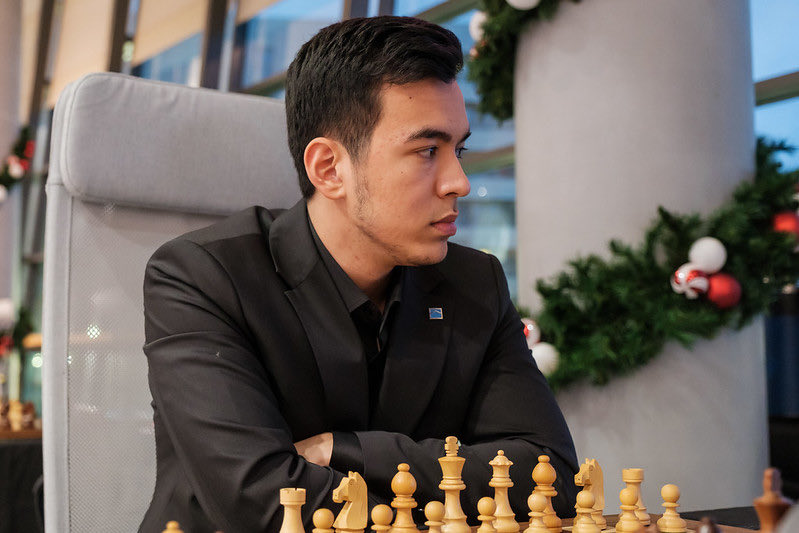
Abdusattorov grabs third win in a row
Round four of the London Chess Classic, played on Saturday, brought a third consecutive win for Nodirbek Abdusattorov, allowing the Uzbek grandmaster to keep sole first place in the invitational tournament. His victory over Michael Adams, achieved with the black pieces, took him to 3½/4 and kept his lead to half a point over Alireza Firouzja, who also collected a full point in his game against Pavel Eljanov.
The third decisive result came from Luke McShane’s win over Gawain Maroroa Jones. The remaining encounters were drawn. Sam Shankland was unable to break through against Abhimanyu Mishra, whose defensive work was consistently solid, while Nikolas Theodorou and Nikita Vitiugov also split the point after a balanced struggle.
Round 4 results
Abdusattorov’s performance has been the main storyline of the event so far. The Uzbek grandmaster has shown excellent form in London, demonstrating deep opening knowledge, strong middlegame handling and reliable endgame play.
His win against Adams – their first-ever classical encounter – turned decisively on move 28, at a moment when the English grandmaster was already down to 8 minutes on his clock. Abdusattorov later noted his satisfaction with the game, which marked his second victory with the black pieces in the tournament.
In round three, the sole leader had defeated Nikita Vitiugov with black after converting an endgame with rook and five pawns against rook, knight and three pawns.
Picture this: you’ve outplayed your opponent move by move, you’re clearly better – and then the endgame slips into a draw, simply because you lacked the crucial theoretical knowledge. That is exactly where this course comes in. Without solid endgame skills, there’s no way forward. Rook endgames are most essential: they occur more often than any other type of endgame, and often make the difference between victory and half a point. If you master them, you’ll confidently convert your advantages into wins!
Free video sample: Introduction
Free video sample: Bodycheck
Firouzja’s game against Eljanov evolved into a test of rook-endgame technique. Both players reached move 40 with little remaining time, and for the rest of the encounter their clocks were effectively running on increments alone.
The balance shifted after Eljanov chose the passive 59…b6, allowing Firouzja to convert. Speaking on the broadcast, Firouzja described the final phase as “a miracle”, explaining that although he had earlier believed he was pressing for an advantage, he had completely overlooked Eljanov’s defensive chances and had to rebuild his winning chances from scratch.
He later let a winning line slip at one moment, but Eljanov did not manage to make use of the reprieve, and the French grandmaster eventually secured the point.
Alireza Firouzja | Photo: Official website
The third decisive result came from Luke McShane’s win over Gawain Maroroa Jones. The latter, who won the event last year, again opted for ambitious play with black and initially achieved a promising position. However, he was unable to calculate accurately in a critical sequence in the middlegame, and his position collapsed rapidly as McShane launched a direct attack on the king.
The loss leaves Maroroa Jones at the bottom of the standings after suffering a second defeat that, given the position he had obtained earlier in the game, might have been avoidable.
Standings after round 4
All games
EXPAND YOUR CHESS HORIZONS
Data, plans, practice – the new Opening Report In ChessBase there are always attempts to show the typical plans of an opening variation. In the age of engines, chess is much more concrete than previously thought. But amateurs in particular love openings with clear plans, see the London System. In ChessBase ’26, three functions deal with the display of plans. The new opening report examines which piece moves or pawn advances are significant for each important variation. In the reference search you can now see on the board where the pieces usually go. If you start the new Monte Carlo analysis, the board also shows the most common figure paths.
