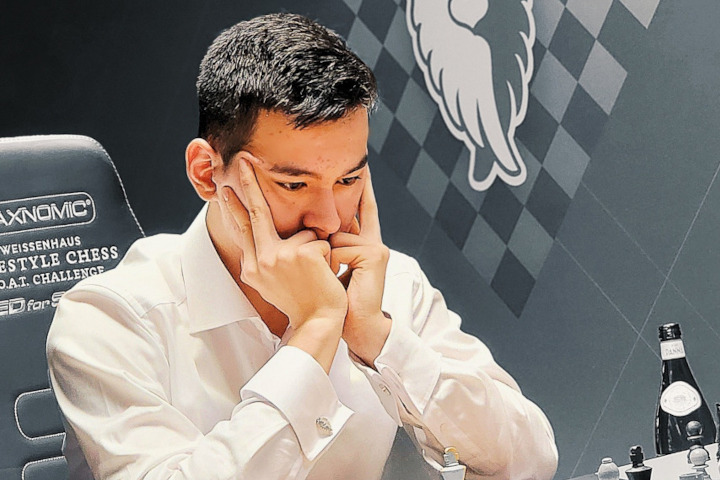
A two-point lead with two rounds to go
Round seven of the London Chess Classic, held at Emirates Stadium, produced a single decisive result, one that was enough for Nodirbek Abdusattorov to secure at least a share of first place with two rounds still to play. The 21-year-old continued his remarkable run by scoring his sixth consecutive victory, this time defeating Luke McShane with the white pieces in a tense Ruy Lopez. Abdusattorov eventually prevailed in a hard-fought strategic battle, extending his lead to two points over Alireza Firouzja, who remains in clear second place.
The tournament situation is now heavily tilted in the Uzbek grandmaster’s favour. With only two rounds remaining, Firouzja would need to win both his remaining games – first against Abdusattorov and then against Nikolas Theodorou – while also relying on Pavel Eljanov to defeat Abdusattorov in the final round in order to catch him. Although possible in theory, such a sequence is highly improbable. Nonetheless, the upcoming Firouzja v. Abdusattorov clash remains compelling for spectators, given the sharp and combative style both players typically bring to their games.
Abdusattorov’s tournament performance rating has now reached an extraordinary 3066 – he has gained 19.8 Elo points so far and has risen to 12th place on the live rating list.
Players will have a rest day on Wednesday before returning to the board for the final two rounds, with Abdusattorov now the overwhelming favourite to claim the title.
Round 7 results
Abdusattorov 1-0 McShane
Analysis by GM Karsten Müller
Picture this: you’ve outplayed your opponent move by move, you’re clearly better – and then the endgame slips into a draw, simply because you lacked the crucial theoretical knowledge. That is exactly where this course comes in. Without solid endgame skills, there’s no way forward. Rook endgames are most essential: they occur more often than any other type of endgame, and often make the difference between victory and half a point. If you master them, you’ll confidently convert your advantages into wins!
Free video sample: Introduction
Free video sample: Bodycheck
Among the drawn games, Firouzja attempted to create complications in a Sicilian Defence while handling the black pieces against Nikita Vitiugov. His efforts to imbalance the position did not yield genuine winning prospects, and the game was eventually drawn after 40 moves. The result effectively leaves Firouzja with only a slim mathematical chance of catching the leader, though his readiness to take risks remains evident.
Nikolas Theodorou and Sam Shankland agreed to the quickest draw of the day, concluding their game after just 11 moves. Abhimanyu Mishra and Pavel Eljanov also split the point, agreeing a draw on move 31 – the minimum move requirement having just been met – in an endgame featuring knight and six pawns against rook and four pawns.
The most dynamic draw of the round came from Gawain Maroroa Jones’ game against Michael Adams. The defending champion launched a direct attacking attempt against Adams’ king and obtained promising chances, but he failed to identify the correct tactical continuation to convert his advantage. The game, rich in ideas, ended in a draw after 39 moves.
Maroroa Jones ½-½ Adams
The King’s Indian Defence is one of the most dynamic openings in chess – and Pirc structures share much of the same DNA. With colours reversed (the King’s Indian Attack), these setups can be just as powerful. What may look modest at first often transforms into highly complex middlegames, where timing, precision, and a deep feel for dynamics make all the difference.
Free video sample: Introduction
Free video sample: Misplaced Pieces
Standings after round 7
All games
EXPAND YOUR CHESS HORIZONS
Data, plans, practice – the new Opening Report In ChessBase there are always attempts to show the typical plans of an opening variation. In the age of engines, chess is much more concrete than previously thought. But amateurs in particular love openings with clear plans, see the London System. In ChessBase ’26, three functions deal with the display of plans. The new opening report examines which piece moves or pawn advances are significant for each important variation. In the reference search you can now see on the board where the pieces usually go. If you start the new Monte Carlo analysis, the board also shows the most common figure paths.
