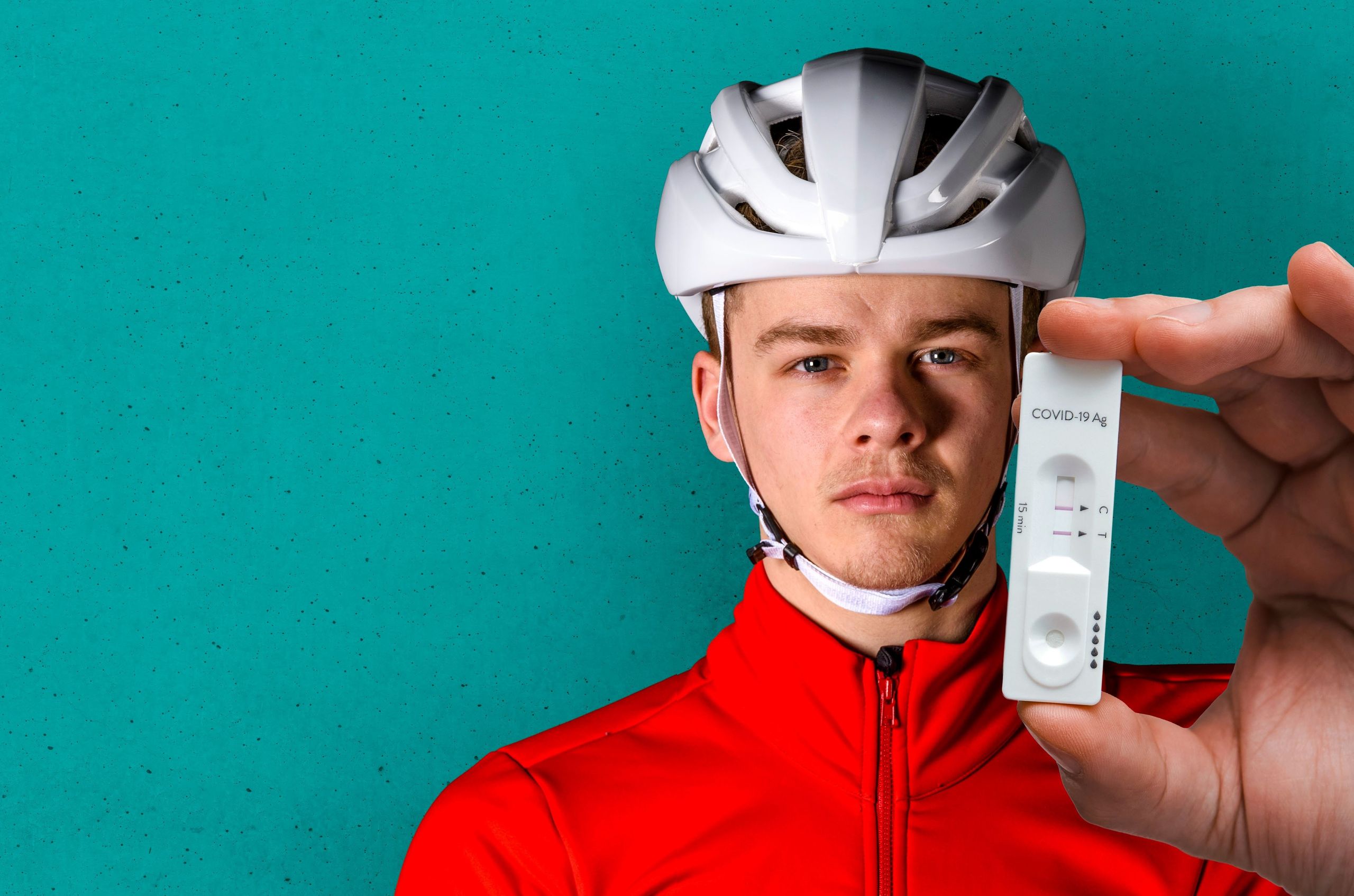
It’s nearly six years since that cold January morning when I wandered downstairs, glanced up from the headlines and murmured to my mum, “This could be really quite bad, couldn’t it?” Over the next two years, my naive worry was more than borne out. With lockdowns, masks and social distancing, Covid-19 turned the world on its head; most of us ended up catching the virus, and a significant minority, me included, are still feeling the effects – on our cycling and on our lives.
Come spring 2022, I thought I’d dodged the worst of it. I was into my second year racing for Zappi Racing Team – a traditional yet brilliant setup for those aiming to turn pro via U23 Italian racing and UCI events. My ambition was to start the Baby Giro (now called the Giro Next Gen). In truth, I wasn’t good enough to make it to the next level. Competing in the best races an under-23 can do, I was receiving a royal head-kicking every time. But training hundreds of kilometres a week and attempting to follow the pace of Juan Ayuso, Michel Hessman or Mason Hollyman, to name a few, does wonders for one’s fitness, even if it is rather painful. But then it happened: I caught Covid-19.
At first the symptoms seemed really mild. That said, my ego took a hit when my resting heart rate, usually a boast-worthy 47bpm, rose to around 80bpm for a few days, while a moderate fever left me shivering in the Italian spring. There was no dramatic cough, no bed rest – it was, at worst, a minor setback. Or so I thought as I strove to do the sensible thing: two weeks off, before easing back with endurance rides. Which is where my real problems began.
Training volume that was once mere background noise now left me with swollen glands and a tiredness I can only describe as like disembarking an overnight long-haul flight. Much of the following three months were spent with my eyes shut, sleeping 12 hours a night, sometimes more. I was living in a fishbowl of foggy, jet-laggy fatigue. When I did manage a ride, I encountered the strangest symptom of all, one that still holds me back today. I call it my ‘rev limiter’. I was OK at tempo, but the moment I nudged above it – anything approaching Zone 4 – my chest tightened, my heart rate spiked and for 15 minutes refused to subside, and I tasted a metallic tang in my mouth, like bleeding gums after a sprint. It wasn’t lactic. It was like driving a Lamborghini around a city centre: craving 6,000rpm but pinned at 2,000rpm. Racing my bike had become a pipe dream.
The racing chapter closes
I’d love to tell you I handled this like a grown-up and paced my recovery. In reality, I did what most athletes do when the body bounces cheques it used to cash with ease: I argued with it. I tried to nudge, then negotiate, then out-stubborn biology. I cycled round the NHS getting blood tests (all normal, bar low potassium), took time out from racing, cut down riding, cut it out entirely, and discovered that pride is a surprisingly heavy thing to carry when you’re already crawling.
Three years on from the worst of it, the racing chapter is now closed. The rev-limiter hangover from Covid-19 means I still couldn’t race if I wanted to. This isn’t a tragedy, nor a misery memoir about how Long Covid stopped me winning the Tour. I have had time to reflect, reframe the importance of cycling in my life – for fun, not a livelihood – but nonetheless I’m eager to understand what Long Covid is and its consequences on my health and that of thousands of cyclists like me.
What exactly is Long Covid?
Dr Ben Sinclair, founder of Dr Finlay’s Private Practice (drfinlays.co.uk), developed one of the UK’s first private Long Covid clinics, in part because he had experienced the condition himself. The first thing I wanted clarity on was, quite simply, what is Long Covid? “In essence, Long Covid is post-viral symptoms lasting longer than 12 weeks,” he explained, “though the definition isn’t clear-cut. There is no agreed diagnostic criteria, but essentially this is a long-lasting condition after a suspected or confirmed viral Covid infection. The common effects are fatigue, brain fog, and post-exertion malaise, among others.” Research suggests that around 10-15% of people who catch Covid-19 go on to develop long-lasting symptoms. Though the risk increases with severity of the initial infection, even mild or asymptomatic cases may lead to Long Covid. A Nature Medicine review estimated that more than 400 million people have been affected since the pandemic, with an economic hit of almost $1 trillion a year.
In terms of the causes, scientists have identified possible mechanisms including blood-vessel damage and micro-clotting, persistent viral fragments, immune system dysregulation and nervous system disruption – but there is no reliable test or means of diagnosis. For cyclists, me included, this lack of certainty presents myriad difficulties. One thing I do know is this: if you find yourself struck down with Long Covid, a form of post-viral fatigue, you absolutely must listen to your body. For those of us whose athletic progress often relies on us ignoring our body’s cries for mercy, that can be very challenging.
Falling foul of the virus forced Joe into a career rethink
(Image credit: Photos: Richard Butcher, Daniel Gould)
“10-15% OF COVID CASES DEVELOP INTO LONGER-LASTING SYMPTOMS”
Sinclair’s story closely mirrors my own: months of excessive sleep, followed by a slow climb back. Having worked with countless Long Covid patients, he is almost uniquely well informed. “We’re looking for the silver bullet. We haven’t found it yet, but we have found particular things that can help.” Those “particular things” are not flashy therapies or cutting-edge medicine, but fundamentals of good health. Sinclair advises on ways to repair the gut biome (post-viral shifts can deplete protective bacteria), boosting vitamin D back into the healthy range, and balancing nervous-system stress. None of which is very exciting – but Sinclair insists that it works.
As for my strange ‘revlimiter’ chest symptoms, science offers some clues but can’t yet fully explain it. “We think that in some people, the virus persists, or byproducts from it cause inflammation of blood vessels and possibly microclotting,” says Sinclair, “meaning you have miniature blood clots flying around your system. Research has demonstrated that this is part of the problem.”
Endurance wipe-out
Another cyclist who has been affected by Long Covid is the 2016 Trans Continental Race winner Emily Chappell. “I got Covid in the summer of 2022 while leading the Le Loop,” she says – the annual ride that traces the Tour de France route ahead of the pros. “Every day one or two riders dropped out with Covid. Eventually I woke up with symptoms. I didn’t test positive, but it was 90% certain.” The timing – and the pressure – couldn’t have been worse. “It was my job. I felt I needed to be there. So I carried on riding 200km a day over mountains. In hindsight, it was a really bad idea.”
Afterwards came exhaustion, breathlessness and confusion. “At first you just think, ‘bad day, try again tomorrow.’ But I wasn’t bouncing back. I’d always thought the solution to feeling tired was to get on the bike – and suddenly that just made things worse.” Progress was halting; recovery nonlinear. “I’d improve, then relapse. The symptoms, tiredness and breathlessness, are identical to being unfit, so you feel guilty and try harder. The athlete’s mentality – don’t give up, push through – is completely wrong for this.”

Chappell has learnt that Long Covid needs long recovery
(Image credit: Future)
A Long Covid clinic helped Chappell reframe things. “The biggest shift has been psychological. I’ve had to accept that sometimes trying hard makes me worse. That’s been huge – rewriting a lifetime’s approach.” There are still ups and downs, but she’s cautiously hopeful. “I do a little exercise every day, no big binges. I’m optimistic I’m on a gradual upward slope. But I’ve had to learn patience. And grief. And that slowing down doesn’t mean giving up – it just means living differently.”
Chappell regrets that she ignored her initial symptoms and tried to power on through. Sinclair admits to making similar mistakes. “I fell into this trap myself trying to go back to exercise far too soon, far too intensely every time. But I learned the lessons because it laid me up in bed for days afterwards. So we have this post-exertional malaise which occurs if we are not up to the task.” Listening to Chappell’s and Sinclair’s stories, I winced – I’ve been that idiot too. If you’re used to stacking 30-hour weeks, it’s hard to accept that a dog walk and a trip to the post office is your new Alpe d’Huez.
“I HAVE MANAGED TO REDISCOVER MY LOVE OF A SIMPLE BIKE RIDE”
So what should we have done to minimise the risks? “Firstly, never train with a fever,” says Sinclair. “I use heart rate as a barometer in terms of training safety, and I’d recommend not pushing your heart rate above about 130bpm while you’re still feeling fatigued.” He urges athletes to follow the ‘graduated return to play’ protocol after any viral infection (see box). I wish I’d been more cautious three years ago. The body takes time to react, and in the meantime you can do quite a lot of damage, as I found out. “Restorative deep sleep is another one of the most important things we can do as well,” adds Sinclair.
From blokey bravado to real-world reckoning
Like a typical 21-year-old bloke, I was somewhat allergic to early nights. I wanted to believe that I could burn the candle at both ends. But the day I stopped treating sleep like an optional upgrade, everything else got 20%, maybe even 30% easier. I also cut my alcohol intake to almost nil. And then there’s the head-stuff – the bit we don’t always talk about. I wish I could say I was zen about scaling down my riding. In reality, I had the classic athlete interior monologue – “don’t be a wuss, suck it up, it’s not that bad” – but this bravado proved costly, triggering multiple setbacks.
Though the Long Covid learning curve has been brutal, this is also where my story takes a brighter turn. Stripping away the ego – the data, the race calendar, the constant comparisons – has let me rediscover the simple pleasure of riding my bike. These days I take it steady, choose different goals, and rarely leave home without planning a coffee stop and a hefty slice of cake. It’s not the life I imagined, but it’s a good one. Covid forced me to rethink what riding meant to me, and in a strange way, I’m very thankful. It has taught me to respect my body and to value the good days rather than chase the perfect ones. If you’re going through long Covid, be patient and kind with yourself, even when every instinct urges you to keep pushing.

Dial back the intensity and recalibrate
(Image credit: Future)
RETURNING TO PLAY: TAKE IT SLOWLY
If you’ve had Covid-19 and are returning to cycling, follow this step-wise ‘return to play’ protocol.
Rest and symptom-free baseline
Wait at least 10 days from symptom onset and be seven days symptom-free before beginning structured activity, as follows.
Stage 1: Light aerobic – no higher for at least 10 days
15-30min of easy cycling (<50% of maximal HR) on flat terrain. Monitor for undue fatigue, chest pain, palpitations. If clear after 24-48hr, move on.
Stage 2: Moderate aerobic – no higher for at least two days
30-60min at 50-70% HRmax, some hills allowed. Avoid competition or high-intensity efforts. Monitor closely.
Stage 3: Heavy aerobic – no higher for at least two days
45–60 min, including hills and moderate efforts (70–80% HRmax), plus bike-handling drills. Still no sprints or maximal efforts.
Stage 4: Ease back into normal training – no higher for at least two days
Full training sessions, including interval work up to 85% HRmax. Introduce race simulation if symptom-free for 48-72hr.
Stage 5: Return to competition – day 17 at the earliest
Full training and racing resume only if all preceding stages passed without symptoms.
Key rule: if symptoms (fatigue, breathlessness, chest tightness) recur within 24-48 hours, step back one stage and rest. Progress only when stable. Listen to your body – this is not the time for ego.
This feature was originally published in the 13 November 2025 print edition of Cycling Weekly magazine – available to buy on the newsstand every Thursday (UK only) while digital versions are available on Apple News and Readly. Subscriptions through Magazine’s Direct.
