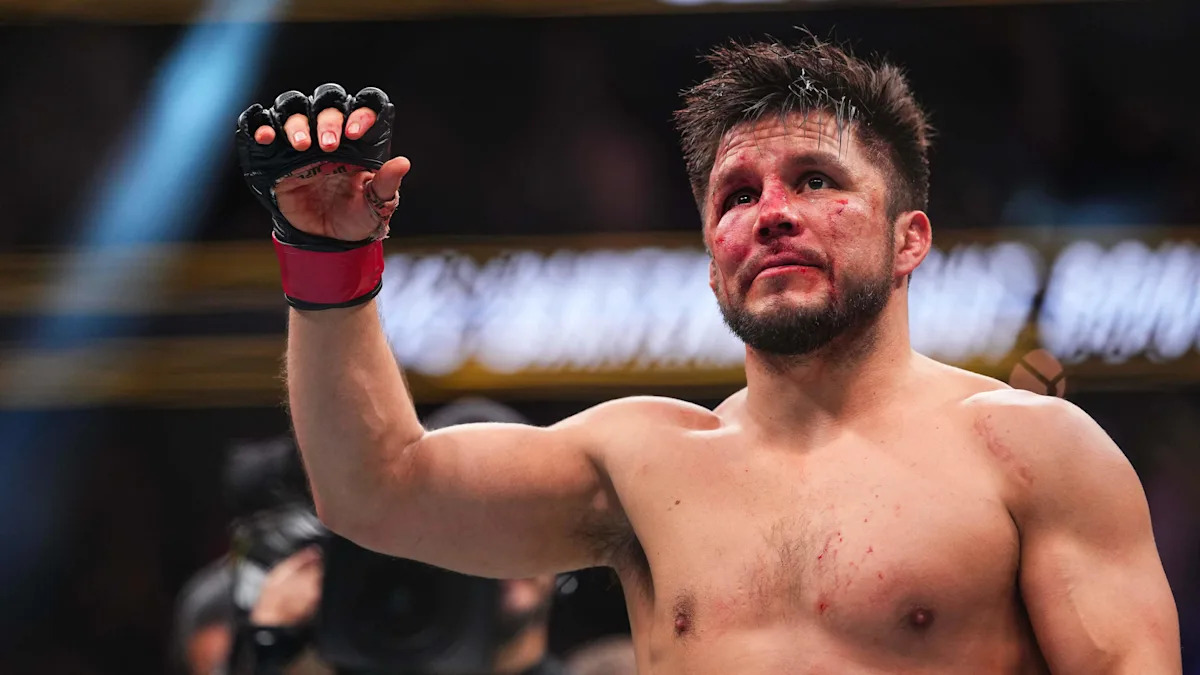
In retrospect, maybe Henry Cejudo shouldn’t have retired in the middle of his historic run. Among other things, he’d hoped to capitalize on his status as a two-division champion, and after beating Dominick Cruz, thought he might create a little public leverage. Didn’t work. The UFC didn’t appreciate it, and many fans muttered good riddance as he walked away. In those intervening years between 2020 and 2023 — which came off more as a furlough more than a retirement — the field caught up. Cejudo went 0-3 leading into Saturday night at UFC 323, in what felt like a conspicuously quiet walk out to pasture.
Saturday night was a hell of a time to show the heart he did.
Advertisement
Seeing him stand in there against Payton Talbott for three rounds was perhaps the greatest sign-off we’ve seen, especially from such a polarizing yet highly accomplished figure. There was no “King of Cringe” in Vegas. There was a man who’d been largely looked over in what was his swan song, who all but smuggled his legacy into the Octagon against the times. The flyweight and bantamweight titles he held all belonged to somebody else, and those very fighters were appearing on the very same card. The public sentiment favored the young, far more dynamic Talbott, who is a star on the rise.
Vegas favored Talbott, too.
And why not? Did Cejudo not look uninspired in losing to Song Yadong back in February? If anything, that performance felt like he was spinning his wheels. Losing decisions to Aljamain Sterling and Merab Dvalishvili were signs of a natural decline for a guy in his late-30s, but up in Seattle he just didn’t come off as all that interested. Maybe the expectations for his fight with Talbott dipped because of it. Maybe it felt like Cejudo was merely hanging on for the sake of hanging on.
But what we got at UFC 323, two months shy of his 39th birthday, was more than the last of the orange embers still glowing against the cold, it was a kind of last stand. A reminder, maybe intended for himself as much as the public, of who he was. It was the summoning of all available reserves to leave the game on a better note than he did the first time. He couldn’t match the speed of Talbott, and he got popped early with a right hand. Talbott had the range to snipe him from the outside, and Cejudo — giving up more than six inches in reach — took it on the chin. He understood it was inevitable. So he fired leg kicks to keep the cannoneer at bay, and he moved forward as steadily as he could.
Advertisement
We didn’t know it yet, but the show of heart was in progress. When he tried a single-leg, his Olympic teammate Daniel Cormier, from Beijing in 2008, gave a nod of approval. If you’re going out, make sure people remember the singlet that ultimately brought you here. Besides, if Raoni Barcelos could plant Talbott in the canvas, as he did back in January, surely Cejudo could too. Cejudo heard all of this. He wanted to use the wrestling, to make the fight as easy as he could, but 11 years is a hell of a gap between competitors.
And the 38-year-old body just isn’t built for such dogged pursuit. There wasn’t any humiliation to be found when Talbott did the unthinkable by taking Cejudo down, either. Cejudo rode it out with a father’s resignation. He couldn’t be surprised by anything. And when Talbott got “greedy” in seeking a submission in the second, Cejudo scrambled to a more familiar spot on top. That’s when the show of heart became more evident. Here he was, now leading the dance.
The moment, of course, was fleeting.
Henry Cejudo retires as a two-division UFC champion and the man most responsible for saving from the flyweight division from extinction.
(Cooper Neill via Getty Images)
It was as the blood streaked down after a head kick and a barrage of shots, both to the face and the body, that the music began to play in earnest. He would not be able to withstand the tide, and he knew it. Yet he fired the shots back as he held his quiet line of belief, which was always his best trait. Cejudo believed in himself when he took out the king’s table of Demetrious Johnson, T.J. Dillashaw and Cruz, and in the final chapter, where every champion goes to die, that never left him. It was in the swollen orbital that disfigured his face. It was in the dignities being so defiantly restored, and in the welts on his body, from the heavy shots being absorbed. The lashes of the younger marksmen, in cruel view for everyone to see.
Advertisement
After the fight, he would ask Dana White, who was seated cageside, for the $50,000 bonus, which is where it all landed him. Still hoping to make a few more bucks in a sport where the exit signs lead back to everything ordinary.
Before he’d go there, though, he fought. With under a minute left, he took a knee flush in the face in the clinch, followed by a battery of big shots from Talbott, who had made his mark in the biggest fight of his career to date. In what was the final act in the sport he once ruled, Cejudo gave over to his instincts. He grabbed the single leg and clung to it, as if not wanting to let any of it go. He lifted the leg in the air and held onto it the way a boy hangs onto the leg of his mother who is about to go away.
The clock wound down.
In those closing moments, you could forgive everything. Joshua Van, who would win the flyweight title within an hour of Cejudo spilling his last blood, wouldn’t likely be in the spot he was without Cejudo. Alexandre Pantoja, Brandon Moreno, Tatsuro Taira too. There wouldn’t likely be a flyweight division if he didn’t come along — no place for Kyoji Horiguchi to come back to. There wouldn’t have been the standard for champions conquering two divisions.
There wouldn’t have been a young Payton Talbott trying to make the leap by taking the juice. Cejudo couldn’t complete the takedown off that final single leg, but it was moving to watch him try.
