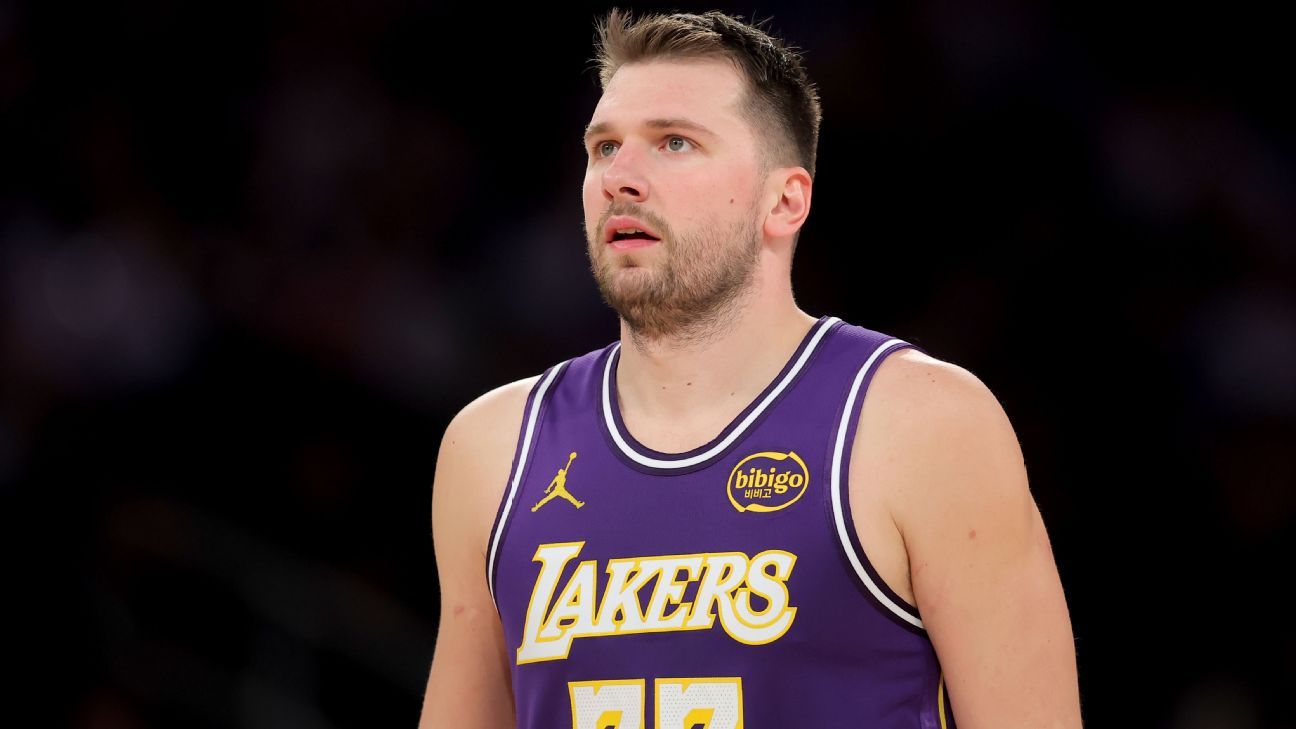
One year ago Tuesday, Luka Doncic played his first game with the Los Angeles Lakers, debuting nine days after ESPN’s Shams Charania broke the shocking news that the Dallas Mavericks had traded their franchise player to L.A.
With the Lakers still digging out from ill-advised moves after winning the 2020 NBA championship and adding Doncic, the trade has yet to shift the balance of power in the Western Conference.
The Lakers’ 32-20 record is virtually the same as this time last year, when they were 32-19 after winning in Doncic’s debut.
But adding an MVP candidate in his prime — and, equally important, having him agree to a three-year contract extension last summer that has Doncic under contract through at least 2027-28 — has already made a dramatic difference in how the Lakers do business. A team that had run through the Klutch Sports-represented duo of Anthony Davis and LeBron James is now built around Doncic’s timeline.
Let’s revisit the first 365 days Doncic has spent playing for the Lakers — and preview what lies ahead as they try to return to championship contention.

Leaner Luka’s production
Predictably, Doncic’s debut performance was forgettable. Returning from an absence of longer than a month due to a calf strain, he missed six of seven 3-pointers in a victory over the lottery-bound Utah Jazz, finishing with 14 points on 5-of-14 shooting. It took four games, with the All-Star break in between, for Doncic to score 20 points as a Laker.
After shaking off the rust, Doncic averaged 28.2 points and 7.5 assists on 44% shooting in 28 games for the Lakers last season. That level of performance, historic for nearly all players, was merely pedestrian for him. Both his shooting and playmaking were Doncic’s lowest marks since his rookie campaign.
In the wake of the injury-marred campaign, with the added motivation of responding to anonymous criticism of his conditioning and commitment from sources in the Dallas front office, Doncic transformed his physique last summer.
It’s impossible to say exactly how much that change has factored into Doncic playing 42 of the Lakers’ first 50 games with no absence longer than three games before suffering a hamstring injury Thursday against the Philadelphia 76ers. However, he has certainly proved more durable than Davis, who managed just 29 regular-season games with the Mavericks before being traded to the Washington Wizards last week.
So far, Doncic’s improved conditioning hasn’t translated into notably better performance than his Dallas peak, suggesting those conditioning woes might have been overstated.
Doncic’s 32.8 points per game this season are virtually identical to his last two full campaigns with the Mavericks, albeit in slightly fewer minutes. (Doncic’s usage rate is 38% this season.) Perhaps the most notable change is Doncic leading the league in free throws made (8.5) and attempted (10.9) per game, surpassing his career-high average of 10.5 foul shots in 2022-23.
Of course, Doncic didn’t really need to improve his production, having finished third in MVP voting in his final full season with Dallas. During Doncic’s first 365 days with the Lakers, only reigning MVP Shai Gilgeous-Alexander of the Oklahoma City Thunder has produced more regular-season wins above replacement by my WARP metric than Doncic’s 14.1.
Switching to Doncic’s timeline
The most intriguing move the Lakers made since adding Doncic was one that was ultimately nixed. Days after the Doncic deal, the Lakers agreed to send Dalton Knecht, a first-round pick and another swap to the Charlotte Hornets for center Mark Williams, a 23-year-old lob threat who would have been an ideal pick-and-roll partner for Doncic.
Although the Lakers subsequently rescinded the trade due to concerns over Williams’ physical condition, the move represented the first indication that they were prioritizing winning during Doncic’s prime rather than building the best team possible in the twilight of James’ career.
That became clearer in June when the Lakers allowed James to play out the option year of his most recent extension rather than signing him to a new, long-term contract. James’ agent, Rich Paul, told Charania then that James wanted to compete for a championship and would be monitoring the team’s moves.
The Lakers’ additions last summer fit the same philosophy as the Williams deal: They replaced veteran 3-and-D wing Dorian Finney-Smith, 32, with Jake LaRavia, who turned 24 in November, and filled their void at center after trading Davis by acquiring Doncic’s fellow 2018 draft pick Deandre Ayton.
Since undoing the Williams deal, the Lakers have yet to use their remaining first-round picks in a trade.
The result is a team unlikely to make a deep playoff run this season. The Lakers are fifth in the West with the Houston Rockets and the Minnesota Timberwolves but have the conference’s eighth-best point differential. The Lakers rank sixth in odds to win the West at DraftKings. Simulations based on ESPN’s Basketball Power Index have L.A. winning a playoff series just 25% of the time, making another first-round exit the overwhelmingly likely outcome.
The Lakers are looking ahead to the summer as the time to change their fortunes.
Crucial decisions ahead
As good as Doncic is, acquiring him didn’t solve the Lakers’ biggest problem: a lack of role players capable of supporting their stars. It is something they’ve failed to address for years. In fact, the Doncic trade exacerbated the issue by sending out the best 3-and-D player the Lakers had developed since the 2020 title run in guard Max Christie.
The Lakers are hoping to try again this summer. After exchanging one expiring contract (Gabe Vincent) for another (Luke Kennard) in their lone in-season trade, the Lakers have just three other players besides Doncic under guaranteed contract for 2026-27: Knecht, LaRavia and reserve forward Jarred Vanderbilt.
If the Lakers let James walk and see Ayton and veteran guard Marcus Smart exercise player options, L.A. would have more than $50 million in cap space to build around a core of Doncic and unrestricted free agent Austin Reaves. Reaves’ $21 million cap hold will surely be far less than he makes this summer, meaning the Lakers can spend that space then go over the cap to re-sign him.
Beyond that, by waiting until the offseason to trade first-round picks, the Lakers will be able to offer up to three first-rounders as opposed to the one they previously had available. They can trade their 2026 first-round pick as soon as it’s made in addition to ones in 2031 and 2033.
The way the Mavericks built a Finals team around Doncic and Kyrie Irving should be a model for the Lakers.
Between missing the playoffs in 2023 and winning the West a year later, Dallas drafted a rim-running center in Dereck Lively II and acquired another via trade in Daniel Gafford. The Mavericks also found two defensive-minded forwards in Derrick Jones Jr. (free agency) and P.J. Washington (trade) who also provided enough shooting to space the floor.
If Dallas is willing to do business with the Lakers again after firing its general manager who made the Doncic trade (Nico Harrison), Gafford and Washington would be sensible trade targets this summer. So too would Mavericks forward Naji Marshall, the team’s replacement after Jones left in free agency following the Finals.
The unrestricted free agent market seems most likely to yield a center, with Mitchell Robinson of the New York Knicks and Robert Williams III of the Portland Trail Blazers realistic possibilities.
The Lakers also could make a run at guard Keon Ellis, who was traded from the Sacramento Kings to the Cleveland Cavaliers before the deadline. The Cavs’ tax bill might make them reluctant to match a strong offer to Ellis.
Restricted free agency is trickier for a team such as the Lakers that can’t afford to wait out the matching period, but Denver Nuggets forward Peyton Watson — an L.A.-area native who played at UCLA — might be gettable via sign-and-trade because of Denver’s tax situation.
In many ways, the Lakers’ position this summer is similar to the period after they acquired Davis to pair with James in 2019. The Lakers waited to make that move official, saving enough cap space to sign 3-and-D wings Kentavious Caldwell-Pope and Danny Green along with center JaVale McGee. The Lakers leveraged players’ desire to play in L.A. to hit on multiple minimum signings, adding Rajon Rondo and bringing back Dwight Howard.
The result was championship-caliber depth that the Lakers sacrificed over the next year in pursuit of more shot creation. Trading for Doncic offered the Lakers a way out of that jam. Now, it’s up to them to maximize their opportunities this summer to take advantage.
