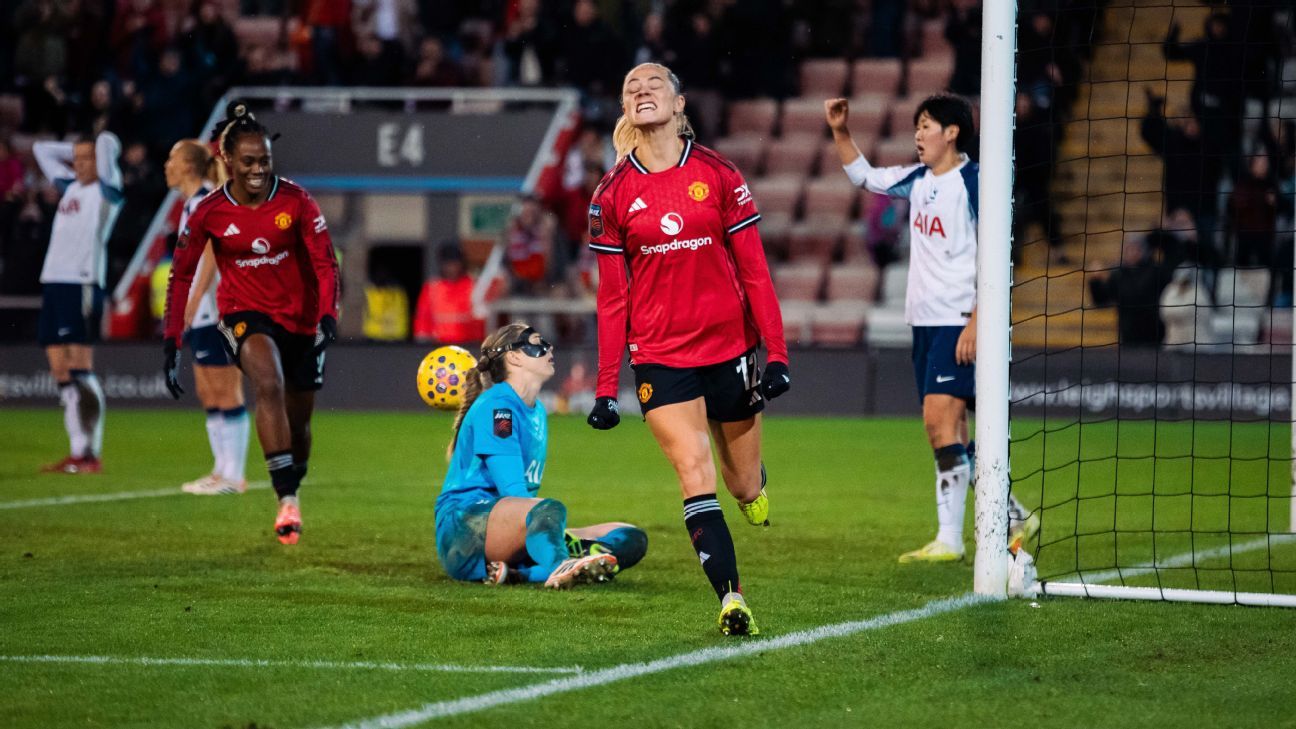
By the 60-minute mark at Leigh Sports Village, Manchester United were staring down the barrel of what would have been an historic Women’s Super League victory for Tottenham Hotspur. The visitors led 3-0 and had been ruthlessly efficient, delivering a clinical display in front of goal, with three of their four shots on target finding the net.
Tottenham had also succeeded in frustrating United defensively. By half-time, United had already attempted 15 shots — slightly above their 90-minute Women’s Super League (WSL) season average of 14.5 — as they struggled to convert their pressure into goals.
But complexion of the game shifted dramatically in the second half after Fridolina Rolfö was introduced. The 32-year-old’s impact was immediate and decisive and, after Ella Toone pulled one back in the 74th minute, Rolfö almost single-handedly dragged United back into the contest, scoring twice to complete the comeback and save a 3-3 draw — with her equalizer coming right at the death.
By full-time, United had amassed 34 shots (the most of any WSL side this season in a single game), 11 of them on target, and had an Expected Goals (xG) tally of 4.38; they also struck the woodwork four times. Spurs, by contrast, finished with an xG of just 0.78, and registered just five shots, four of which were on target.
Ultimately, it was a game of two halves. Spurs demonstrated some devastating efficiency early on but sat back too early and struggled to hold off a ruthless United, who were determined to fight back. The hosts may have shown resilience, intensity, and belief to salvage a point from a seemingly lost position, but they also showed just how vulnerable they can be.
After a great start to life in the UEFA Women’s Champions League (UWCL), United suffered a bruising 3-0 loss to OL Lyonnes midweek and failed to get a shot on target against the eight-time champions. Their once-unflappable defense looked shaky as they lost control, and vulnerabilities in attack began to seep into their defending.
So where do these two results leave them? Well, nine points behind WSL leaders Manchester City (in fourth place) and heading into the final UWCL matchday on Wednesday with a playoff spot assured, something many have long suspected is clear: Given the composition of the squad, United are not yet equipped to compete simultaneously for both the WSL and the UWCL.
However, the resilience that has often been absent in recent seasons, particularly when compared to the ingrained winning mentality of a side like Chelsea, is beginning to surface.
Manchester City, Arsenal, and Chelsea have shown in recent years just how demanding it is to sustain challenges on both fronts. City, despite holding a six-point lead over Chelsea in the WSL this season, missed out on European qualification and were unable to maintain momentum in either competition last year, primarily due to injuries. Arsenal, meanwhile, effectively sacrificed their domestic title ambitions after damaging defeats to Aston Villa (5-2) and Brighton (4-2), but that compromise ultimately delivered their first continental title in 18 years.
Chelsea provide perhaps the clearest example of the trade-off required. They have maintained domestic supremacy, winning the WSL in each of the past three seasons, but at a significant cost in Europe. Last season’s 8-2 aggregate defeat to Barcelona in the semifinals marked the third consecutive year they exited at that stage.
This season is the first time United have had to balance the demands of two of the toughest competitions in the world, and their performances across the past week reflect that learning curve. Ahead of a decisive Champions League fixture against Juventus on Wednesday, there are positives to take from the draw with Spurs: the timing and impact of the substitutions, and the grit shown to recover from a difficult position.
What cannot be overlooked, however, is how vulnerable United appeared at times. A lack of a clinical edge in attack has left increased pressure on a defense that, last season, was among the strongest in the league. As a result, United looked exposed, and well-organized opponents willing to take their chances will view this performance as a blueprint for how to frustrate and ultimately defeat them.
Yes, injuries and absences have compounded these issues; Celin Bizet is unavailable due to pregnancy, Hannah Blundell has only recently returned from maternity leave, and Millie Turner has been sidelined since her injury against London City Lionesses. That has left United with just two available central defenders and limited tactical flexibility.
But while a lack of depth may be a reasonable explanation against a side like OL Lyonnes, who boast one of the deepest and most talent-rich squads in Europe, it holds less weight against Spurs. Barring two new additions, Spurs fielded largely the same squad that United dispatched comfortably twice last season. The visitors also named just one attacking substitute on a thin bench, making United’s squad depth appear considerable by comparison.
So, a busy January transfer window feels essential if United are to keep pace in the title race and give themselves a realistic chance of progressing through to the UWCL knockouts. To even attempt to fight on both fronts, significant investment will be required. This could arguably be United’s most crucial spending window.
