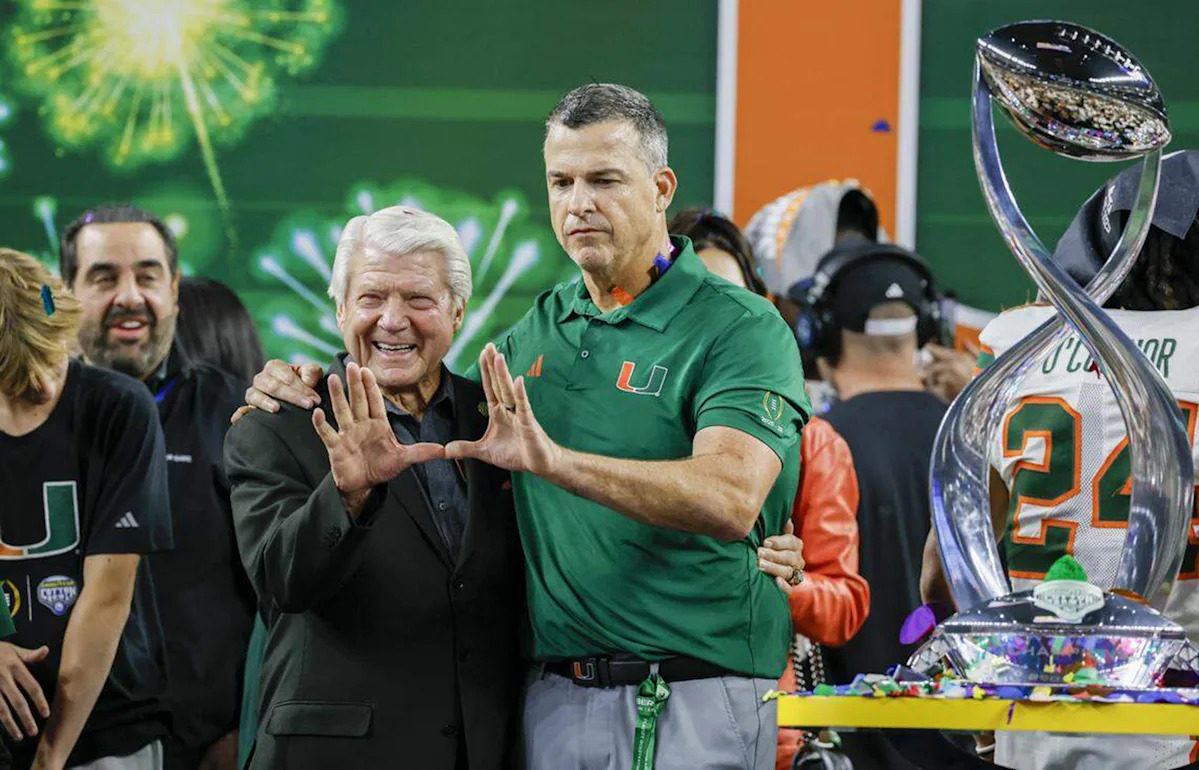
ORLANDO, Fla. — Once upon a time, the Miami Hurricanes didn’t chase relevance, they defined it. They didn’t ask for respect, they took it. College football had to acknowledge Miami’s swagger, speed and unapologetic defiance, whether it liked it or not.
That time, we were told, was gone forever.
Advertisement
Yet here we are, watching Miami prepare for Thursday night’s College Football Playoff semifinal against Ole Miss, a moment that still sounds surreal after nearly a quarter-century of false starts and fading echoes.
Hallelujah.
The U is back on top.
Or, at least, close to it.
For the first time in a generation, those words don’t sound foolish or desperate when spoken about the ’Canes. They sound earned because coach Mario Cristobal has steadily built a program that is worthy of being back on college football’s grandest stage.
For years, “The U” lived only in memory. In grainy highlight clips or in 30-for-30 documentaries. Or in the exaggerated, almost unbelievable stories told by aging fans who swore college football once had a soul, an edge and an attitude that rattled authority.
Advertisement
Miami wasn’t just a football program. It was a movement. A mood. A cultural phenomenon.
The Hurricanes were the bad boys before college football knew what bad boys were. They were gangsta before the sport learned how to monetize rebellion. They were the “Convicts” in the “Catholics vs. Convicts” battle with Notre Dame. They were Luther “Luke Skyywalker” Campbell and 2 Live Crew, profane and confrontational in an era when profanity still offended. Miami didn’t try to fit in. Miami didn’t want your approval. Miami thrived on your outrage.
The Hurricanes were a comet streaking across the college football sky. Brilliant, blinding and impossible to ignore. Five national championships in less than 20 years — an unprecedented run for a private school with no on-campus stadium, modest fan support and facilities that lagged miles behind the bluebloods it bullied.
It all started with the “Miracle in Miami” in 1983, when Howard Schnellenberger beat mighty Nebraska in the Orange Bowl and then boldly declared South Florida’s high school talent as the “State of Miami.” It was more than a recruiting pitch. It was a manifesto. Speed. Swagger. 305 attitude. The Hurricanes didn’t just recruit players; they recruited identity.
Advertisement
The ‘Canes weren’t just cool; they were the coolest thing in college football, and kids across America knew it. White kids from the Midwest. Black kids from California. Kids who had never set foot in Miami-Dade County but dreamed of palm trees, South Beach and a game played with an edge they’d never been allowed to show.
It didn’t matter that Florida and Florida State were bigger and richer. It didn’t matter that they had deeper booster pockets or shinier facilities. Miami was built on players. Always players.
And what players they were.
It almost didn’t matter who coached them. Schnellenberger laid the foundation. Jimmy Johnson weaponized it. Dennis Erickson and Larry Coker rode it to the summit. Different styles, same results. National championships. NFL factories. Hall of Fame legacies.
Advertisement
Michael Irvin. Warren Sapp. Edgerrin James. Ray Lewis. Ed Reed. The names still echo because they weren’t just great players; they were symbols of an era when Miami played football like it was settling a score.
Then, slowly and painfully, it stopped.
Miami teased us for years. A flash of relevance here. A top-10 ranking there. Coaches who promised to “restore the swagger.” Every false hope and turnover chain felt crueler than the last. Five years ago, I wrote a column begging Miami not to tease us again, not to talk unless it was ready to back it up. The bravado felt hollow then, like an aging biker-bar band strutting around the stage like they’re AC/DC.
Long before that, in 2015, Jimmy Johnson himself explained to me, while sipping on a Heineken at his home in the Keys, why the magic faded. College football changed. Television changed. Money changed. Facilities became palaces. Recruiting became an arms race. The advantage Miami once owned — elite schedules, national TV exposure, the clearest path to the NFL — vanished when everyone got those things.
Advertisement
Miami tried to live in the past while everyone else built the future.
Which is why this moment feels different.
This resurgence isn’t fueled by nostalgia or empty slogans. It’s being led by a man who lived the glory days but refuses to be trapped by them. Mario Cristobal doesn’t sell memories. He sells credibility.
Cristobal knows exactly what Miami was. He was recruited by Johnson and was an offensive lineman on the Hurricanes’ 1989 and 1991 national championship teams under Erickson. But he also must know what Miami can never be again. The 1980s and ’90s are gone forever. That era belonged to a unique intersection of geography, television and cultural rebellion that can’t be recreated.
Advertisement
College football today is mostly transactional. It’s mostly about NIL collectives and transfer portals. Swagger alone doesn’t get you anywhere anymore. You must have infrastructure and the ability to stack talent and retain it.
Cristobal understands that. He has rebuilt Miami the only way it can be rebuilt in this era — through relentless high school recruiting, especially along the offensive and defensive lines, and strategic, big-money additions from the transfer portal. It’s not romantic, but it’s effective.
This Miami team doesn’t feel like a nostalgia act. It feels like a new era.
The Hurricanes don’t just run fast; they hit hard. They don’t talk first and play later. They line up and impose themselves. That’s Cristobal’s fingerprint; an old Miami lineman who understands that toughness never goes out of style.
Advertisement
Make no mistake: it will never be like it was. There will never again be one rogue program hijacking the sport with attitude and intimidation. The money is too spread out. The exposure is too universal. The edge Miami once owned is now shared by dozens of programs with billionaire donors and television contracts.
But college football is undeniably better when Miami matters. It’s better when the Hurricanes aren’t a punchline or a history lesson.
The Hurricanes are back on college football’s biggest stage, not as a novelty, not as a throwback, but as a legitimate playoff team built for modern college football.
Nevertheless, the U is relevant again.
Advertisement
The U matters again.
The U is alive again.
The old Miami announced itself with taunting and trash-talking and middle fingers to the establishment.
This Miami announces itself with structure, discipline and the quiet confidence of a team that knows it belongs.
The old Miami was built on swagger.
This Miami is built on substance.
Different styles.
Same standard.
The U isn’t reliving its past.
It’s finally moved beyond it.
