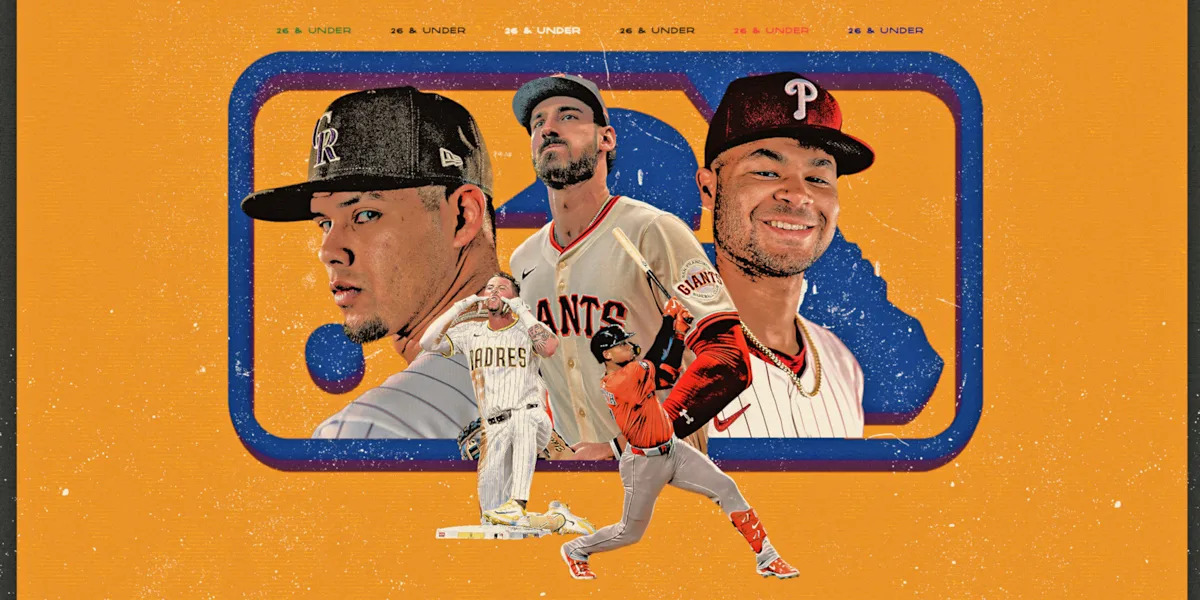
Welcome to the fourth edition of our MLB 26-and-under power rankings.
This project began in 2023 at FOX Sports and has continued the past two seasons here at Yahoo. It’s truly a highlight of our offseason, and we’re amped for this year’s edition, which provides a thorough assessment of each organization’s young talent entering the 2026 season.
Advertisement
Top prospect lists and farm system rankings are useful proxies for forecasting a big-league team’s outlook, but those come with notable limitations. Our process expands the scope of evaluation beyond the minor leagues in hopes of painting a broader, more comprehensive picture that includes young hitters and young pitchers already in the majors.
Prospects are prospects for a reason; their value is rooted in projection, not MLB output. By evaluating all players aged 26 and younger, our methodology rewards teams with more proven commodities — players who have actually performed in the majors. Minor leaguers and 2026 rookies are still pivotal parts of the equation, but we believe that placing a stronger emphasis on established major leaguers allows for a more accurate portrayal of teams’ young talent bases.
Of course, young talent is merely one component of what wins at the major-league level. The mega-moneyed Los Angeles Dodgers have surged to consecutive World Series titles without significant contributions from 26-and-under talent. They plan to do the same in 2026, and the Dodgers aren’t alone in this regard. Having veteran star power is paramount to success. Clubs with higher payrolls also tend to have larger margins for error when building their rosters than those that rely heavily on young players.
But one of the keys to sustained success is accounting for older players’ inevitable declines and backfilling those voids with steady waves of homegrown talent. If youngsters thrive upon reaching the bigs, a team can keep its competitive window propped open. As such, this project seeks to capture which clubs have a wealth of players whose best years are either in progress or still in front of them.
Our rankings are the product of a scoring system that assigns each organization a grade in four categories, with higher scores available for the major-league categories:
Advertisement
-
Young MLB hitters: scored 0-10; 26-and-under position players and rookie-eligible hitters projected to be on Opening Day rosters
-
Young MLB pitchers: scored 0-10; 26-and-under pitchers and rookie-eligible pitchers projected to be on Opening Day rosters
-
Prospect hitters: scored 0-5; prospect-eligible position players projected to reach MLB in the next 1-2 years
-
Prospect pitchers: scored 0-5; prospect-eligible pitchers projected to reach MLB in the next 1-2 years
Within the prospect categories, our scoring favors teams with players who can be reasonably expected to reach the majors in the near future. The vast majority of prospects included in this project have already reached Double-A, though we made occasional exceptions for elite prospects who could rocket up the ranks in a hurry. Another important note: If a prospect-eligible player is expected to be on a team’s Opening Day roster — Nolan McLean, for example — we evaluated them as part of the team’s young MLB group rather than with their prospect peers.
All players included as part of these rankings are entering their age-26 seasons or younger, defined by Baseball-Reference as a player’s age on June 30, roughly halfway through the regular season. This line of demarcation is particularly relevant in this year’s edition of our rankings because of which players “graduated” from eligibility this season — i.e., those who played their age-26 seasons in 2025. That group includes three of the best hitters (Juan Soto, Fernando Tatis Jr., Vladimir Guerrero Jr.) and three of the best pitchers (Garrett Crochet, Yoshinobu Yamamoto, Hunter Brown) in the world. That’s a staggering amount of impact talent to no longer be included in their respective teams’ young cores, and nearly all of those teams dropped substantially in the rankings as a result.
If you want to read more about our methodology, check out last year’s rankings for a deeper explanation.
We’re counting down all 30 organizations’ 26-and-under talent bases from weakest to strongest, diving into five teams at a time. Below, in addition to the scores for each team in each category, we’ll highlight the key players who fall into each bucket and contributed most to their organization’s place in the rankings.
Advertisement
Let’s begin at the bottom of the list.
30. Colorado Rockies (total score: 9/30) | 2025 rank: 29
Young MLB hitters (4/10): C Hunter Goodman, SS Ezequiel Tovar, OF Jordan Beck, 2B Adael Amador, INF Ryan Ritter
Young MLB pitchers (3/10): RHP Chase Dollander, RHP Victor Vodnik, RHP Seth Halvorsen, RHP Juan Mejia, RHP RJ Petit
Prospect hitters (1/5): 1B Charlie Condon, OF Cole Carrigg, OF Zac Veen, OF Jared Thomas, 2B Roc Riggio, SS Ethan Holliday
Prospect pitchers (1/5): LHP Carson Palmquist, RHP McCade Brown, RHP Brody Brecht, LHP Welinton Herrera, LHP Sean Sullivan
The Rockies ranked dead last in the first two editions of our 26-and-under rankings but managed to avoid the absolute basement a year ago, thanks to some modest gains among the big-league position players and what looked to be a roughly average farm system. But 119 losses later, Colorado is right back at the bottom, as some mildly encouraging progress on the mound in the majors was offset by stagnation on offense and not nearly enough growth among the top prospects. It’s worth noting that Colorado accumulated the same total score as division peers San Francisco and San Diego, but it’s tough to give the tiebreaker to a team coming off such an abysmal season. As a result, the Rockies are No. 30 once more.
Advertisement
Nevertheless, there are a handful of hitters and pitchers to like here. Hunter Goodman was Colorado’s All-Star representative last summer, and deservingly so. Catchers with his level of power are rare, and his juice proved potent away from altitude as well: Goodman hit 18 of his 31 homers away from Coors Field, with a solid .801 road OPS to boot. His defense behind the plate needs some polishing, and his shaky plate discipline could yield some lean years with the bat, but he’s a hitter to feel good about. Ezequiel Tovar’s lack of on-base skills might always limit his offensive ceiling, but his plus glove at shortstop ensures a steady floor as an every-day player.
Even by Coors Field standards, right-hander Chase Dollander was pummeled to an extreme degree at home as a rookie: He posted a 9.98 ERA in 46 home innings compared to a 3.46 mark in 52 road frames. But his success away from altitude is a reminder that the 24-year-old checks all the boxes from a scouting perspective in terms of what a frontline starter should look and throw like, and he’s still capable of achieving his potential with the right tweaks. Colorado has also quietly produced a trio of quality, hard-throwing, righty relievers in Seth Halvorsen, Juan Mejia and Victor Vodnik. It’s possible none of them will ever pitch in high-leverage for a good Rockies team, but they could soon be highly attractive trade chips.
There are some useful pieces lurking in the upper levels of the minors on both sides of the ball, none of them more important than Colorado’s two most recent first-round draft picks, Charlie Condon and Ethan Holliday. Having reached Double-A and played in the Arizona Fall League, Condon’s progress is a much more pressing concern than that of the teenage Holliday, but both must answer serious questions from evaluators about whether their suspect hit tools will allow for their tremendous raw power to play in games.
Advertisement
No matter what these young players have or have not demonstrated thus far, there’s a renewed sense of optimism about their development following the complete (and long overdue) overhaul of Colorado’s front office. That the Rockies finally sought external front office candidates after decades of insulation was refreshing, and now Paul DePodesta and Josh Byrnes are tasked with ushering the franchise into a new era of modern competence and competitiveness. The organization’s wave of coaching hires at both the major- and minor-league levels earned strong reviews from around the league. The 2026 Rockies are still going to lose a whole bunch of ballgames, but there’s reason to believe they could move into a much less discouraging spot in these rankings by next year.
The Rockies once again find themselves at the very bottom of our 26-and-under team rankings.
(Bruno Rouby/Yahoo Sports)
29. San Diego Padres (total score: 9/30) | 2025 rank: 15
Young MLB hitters (5/10): OF Jackson Merrill
Young MLB pitchers (2/10): RHP David Morgan, RHP Bradgley Rodriguez
Prospect hitters (1/5): C Ethan Salas, OF Tirso Ornelas
Prospect pitchers (1/5): RHP Miguel Mendez, LHP Kash Mayfield, RHP Garrett Hawkins, RHP Tucker Musgrove, LHP Kruz Schoolcraft
Advertisement
With Fernando Tatis Jr. and impact relievers Jeremiah Estrada and Adrian Morejon aging out of eligibility — and another round of win-now trades last July thinning out the farm system — the Padres have unsurprisingly plummeted in the rankings and were in consideration for the bottom spot. They’re saved from bringing up the rear by the presence of Jackson Merrill, who is comfortably the best position player on any of the teams in this tier, giving San Diego a tremendously valuable offensive pillar to build around.
Merrill surged to stardom in 2024 while playing a brand-new position in center field and raking for the playoff-bound Padres as a 21-year-old, ultimately finishing runner-up to Paul Skenes in the NL Rookie of the Year race. Further ascension seemed in store for Merrill as a sophomore, but injuries (hamstring, ankle, concussion) waylaid his second season. He was still productive, just not quite the game-changing talent he was as a rookie. 2026 will be a big opportunity for Merrill to reassert himself as one of the brightest young stars in baseball.
Beyond Merrill, however, this group thins out in a hurry. Like Colorado, San Diego boasts some exciting young relievers, with both David Morgan and Bradgley Rodriguez debuting last year in a bullpen already loaded with high-quality, high-leverage arms. Garrett Hawkins and Tucker Musgrove might not be far behind. But as far as young rotation candidates go, there’s very little to be found outside of Miguel Mendez, who has promise but finished last season with an 8.06 ERA across six starts in Double-A. It’s no accident the Padres just signed German Marquez, Griffin Canning and Walker Buehler in a matter of days. The most promising mound talent in the system is found at the lower levels, headlined by the team’s two most recent first-round picks, teenage left-handers Kash Mayfield and Kruz Schoolcraft.
Advertisement
Somehow still only 19 years old, Ethan Salas has been on the prospect radar for a while now. A nearly unprecedented and ultra-accelerated promotion pace pushed the catcher all the way to Double-A as a 17-year-old, but back injuries and struggles at the plate have stalled his development. His top-tier defense remains his calling card, and we should always be patient with catching prospects, but at some point, Salas will need to start hitting to still be considered a viable candidate to be a franchise backstop.
28. San Francisco Giants (total score: 9/30) | 2025 rank: 24
Young MLB hitters (3/10): OF Heliot Ramos, OF Drew Gilbert, 1B/DH Bryce Eldridge, OF Luis Matos, OF Grant McCray, C Daniel Susac
Young MLB pitchers (1/10): RHP Hayden Birdsong, RHP Randy Rodriguez
Prospect hitters (2/5): OF Bo Davidson, OF Dakota Jordan, 1B/OF Parks Harber, 2B Gavin Kilen, SS Josuar Gonzalez, 2B Nate Furman
Prospect pitchers (3/5): LHP Carson Whisenhunt, RHP Blade Tidwell, RHP Will Bednar, RHP Trevor McDonald, LHP Joe Whitman, LHP Jacob Bresnahan
Advertisement
What are the Buster Posey-run Giants good at? (Besides acquiring Rafael Devers, which, unfortunately, is not a repeatable skill.) So far, the answer is unclear, though the dearth of talent in this organization is mostly a problem that predates Posey’s tenure. This will be a big year for him and the organization.
Let’s start with Bryce Eldridge, upon whose shoulders much of San Francisco’s future rests. Built like an NBA wing, the 21-year-old first baseman debuted in September and looked overmatched in a small sample. But that burnt cup of coffee doesn’t change Eldrige’s projection. This guy has deafening raw power, top-of-the-charts stuff in the Joey Gallo mold and more bat-to-ball feel than your typical long-ball donkey. Still, dudes built like Eldridge — limbs for days, fresh out of the “Charlie and the Chocolate Factory” stretch machine — often struggle with elevated fastballs. If he makes enough contact, Eldridge will be an All-Star. Barry Bonds’ splash hit record (35) is definitely in play. But as with all first baseman, the bar is incredibly high.
Beyond that, it’s an underwhelming bunch. Heliot Ramos was an All-Star in 2024, but he has proven himself to be a dreadful defender in left and merely average with the stick. That’s not a cornerstone piece on a championship team. Drew Gilbert is a maniac and great TikTok fodder, but a lack of juice has him on the fourth-outfielder track. Daniel Susac might be a capable backup catcher.
Advertisement
Things aren’t much better on the bump, as the Giants were one of just three teams to receive a measly one out of 10 for their young MLB pitchers. Randy Rodriguez was an All-Star last season, surrendering just four earned runs across the entire first half (!!), but he blew out in August and will miss the entire 2026 season. He’s also a reliever and, thus, more volatile than a meme coin. Hayden Birdsong had a 2.31 ERA out of the ‘pen last season (good) and a 6.17 ERA out of the rotation (not good), so it’s doubtful he’ll evolve into an impact starter.
There are, however, some encouraging signs down on the farm, mostly in the lower levels. Josuar Gonzalez is only 18 years old and has yet to play stateside baseball, but he might just be The Next Great Dominican Shortstop. A year from now, he could easily be a top-10 prospect in all of the minors. Bo Davidson, an undrafted center fielder from a North Carolina community college, is an amazing story, but he hasn’t yet proved he can hit upper-minors arms. Second baseman Gavin Kilen was the 13th pick last year, and he should move relatively quickly as a high-floor, low-ceiling, Joe Panik type.
On the pitching side, not a single Giants farmhand was ranked in the top 100 by any of the major outlets, but there’s some solid depth here. Carson Whisenhunt’s unicorn changeup will propel him to an impact role of some sort, but it’s most likely in the bullpen. Trevor McDonald, Blade Tidwell and Joe Whitman are back-end types. Will Bednar is a reliever. Jacob Bresnahan is an arrow-up starter to get excited about, but the 20-year-old hasn’t yet pitched above low-A.
On the whole, it’s hard to believe there’s enough talent here to supplement San Francisco’s current core of Devers, Willy Adames, Matt Chapman and Logan Webb. For the Giants to even think about chasing down the Dodgers in the next few years, Eldridge needs to be an absolute monster. But even that might not be enough, particularly if Posey and Co. don’t uncover an impact arm or two.
Advertisement
27. Houston Astros (total score: 10/30) | 2025 rank: 21
Young MLB hitters (2/10): OF Zach Cole, OF Cam Smith, OF Zach Dezenzo
Young MLB pitchers (4/10): RHP Mike Burrows, RHP Spencer Arrighetti, Roddery Muñoz
Prospect hitters (2/5): OF Brice Matthews, OF Joseph Sullivan, C Walker Janek, OF Lucas Spence, OF Ethan Frey
Prospect pitchers (2/5): RHP Miguel Ullola, RHP AJ Blubaugh, RHP Ethan Pecko, RHP Bryce Mayer
For the Astros, 2025 was the end of an era. For the first time since 2016, Houston spent October at home, on vacation or caring too much about the Texans. Injuries damned the team all season, but the organization’s inability to fill the gaps with homegrown players was a major factor in Houston’s late-season collapse.
Advertisement
Is the Jose Altuve-Yordan Alvarez-Carlos Correa Era truly over? That depends, a great deal, on the fortunes of Cam Smith. Acquired in the Kyle Tucker blockbuster last winter, Smith wowed his way through spring training and onto the Opening Day roster, despite being less than a year removed from draft day. Mauricio Dubón, with a straight face, referred to him as “a 60-homer guy.” And through three months, the hulking slugger held his own, finishing June with a .776 OPS and better outfield defense than expected. Then the wheels fell off, with Smith going 38-for-202 in the second half, with just two homers. By mid-September, he was starting only a few games a week.
Getting Smith back on track will be crucial to Houston’s chances in 2026 and beyond. Hopefully, his aggressive assignment last spring didn’t stunt his development, and he starts pulling the ball in the air more often to take advantage of his big power. It’s hard to blame him too much for his rough second half, considering that 2025 was the longest season of his life by a wide margin. We still like Smith — but more as a regular than the perennial All-Star he was being billed as a year ago.
Zach Cole is a very fun, very out-of-nowhere, late bloomer who might get a chance at a regular role if the Astros don’t add an outfielder before Opening Day. A 10th-round pick out of Ball State in 2022, he climbed his way up the minor-league ladder before breaking out with a massive 2025 in which he OPSed .917 and earned himself an MLB call-up. Cole has a long swing and might punch out too much to profile as an every-day dude, but there’s real bat speed and real juice here.
Advertisement
On the mound, Mike Burrows, acquired from Pittsburgh over the winter, and Spencer Arrighetti, who missed a lot of 2025 due to injuries, kept Houston out of the cellar. Both guys project as mid-rotation arms, which is rarer than you’d expect for 26-and-unders.
This farm, unfortunately, is in very dire straits. The Astros were the only organization to not have a single prospect rank in the top 100 of any major prospect publications. That’s hard to do and a chilling reminder that Houston’s farm is squarely bottom-three. Trading away Jacob Melton and Anderson Brito for Burrows was a reasonable use of prospect capital, but the lack of reinforcements in the upper minors is striking. We like Brice Matthews, but it’s hard to see him getting playing time at second base, barring an Altuve injury.
It’s worth noting that the upcoming draft will be absolutely crucial for the Astros. Thanks to Hunter Brown finishing top-three in Cy Young and Framber Valdez leaving in free agency, Houston has four picks in the top 93 and its largest draft bonus pool in years. That presents a rare opportunity to replenish the system, one that Houston’s leadership group must take full advantage of. Otherwise, the next half-decade could be pretty bleak at Daikin Park.
26. Philadelphia Phillies (total score: 10/30) | 2025 rank: 30
Young MLB hitters (2/10): INF/OF Otto Kemp, OF Justin Crawford, OF Johan Rojas
Young MLB pitchers (2/10): RHP Orion Kerkering, RHP Andrew Painter
Prospect hitters (4/5): SS Aidan Miller, OF Gabriel Rincones Jr., 2B Aroon Escobar, 1B Keaton Anthony, OF Dylan Campbell
Prospect pitchers (2/5): RHP Moises Chace, RHP Gage Wood, RHP Jean Cabrera, RHP Alex McFarlane
Advertisement
The 2025 Phillies were, by many measures, the oldest team in MLB. No other club had a lineup and a pitching staff with an average age of 30 or older. This winter, president of baseball operations Dave Dombrowski has received a barrage of criticism for opting to “run it back.” But the 2026 Phillies, for better or worse, should be much younger than the previous model.
That’s mostly due to Andrew Painter and Justin Crawford, a pair of yet-to-debut 22-year-olds projected to make the big-league club out of spring training. Painter has long been considered one of the sport’s top pitching prospects, but two seasons lost to Tommy John and a statistically underwhelming 2025 have lessened his sheen. Still, the Phillies clearly believe in him; the club didn’t replace Ranger Suárez this winter, clearing the way for Painter to earn a rotation spot. They’re hoping a normal offseason will help him rediscover his old arm slot — it dropped over the course of 2025 — and establish himself as a rotation stalwart.
Crawford, the son of longtime big-league outfielder Carl Crawford, is one of the game’s most unique prospects. In the box, he’s a groundball machine, a true danger to both bugs and blades of grass. But this is no slap hitter; Crawford’s exit velocities are genuinely good. It’s just … usually … the ball is earthbound after contact. If he were a no-doubt elite center fielder, his odd offensive profile would be less concerning, but Crawford, despite plus-plus speed, is closer to solid than great out in the grass. He’s going to start in center on Opening Day for the Phillies and will surely take some lumps in his rookie season, but he could develop into an All-Star-level player if he learns how to lift the baseball.
The other big-league youngsters are supplementary types. Orion Kerkering, his unfortunate October yeet for the ages aside, is a dependable, controllable, back-end reliever. Otto Kemp will get regular playing time against southpaws and could emerge as a legitimate weak-side platoon option. Johan Rojas probably missed his window in Philadelphia; the glovesmith got a chance to play every day for stretches of 2023, ‘24 and ‘25 but never progressed as a hitter.
Advertisement
The last character to focus on is Aidan Miller, a consensus top-15 prospect. His power-speed combo is very rare for a shortstop, even though many evaluators have him pegged as a below-average option at the position. Despite being young for the level, the 21-year-old popped 13 homers and swiped 52 bags in Double-A last year. Miller is an advanced hitter for his age, though his pull-heavy approach — his 50.5% pull rate last year would’ve placed him seventh among qualified MLBers — leaves him susceptible to breaking balls away from him. Still, this is, at worst, a big-league regular who should debut at some point this season and eventually supplant Alec Bohm as the Phillies’ every-day third baseman.
