So, as we look ahead to the 2026 season, let’s look back on the just-completed offseason: Which teams improved by the most? It’s not exactly the same as “which teams are the best,” though there’s certainly some overlap.
The way to take a look at that is simple. We’ll take FanGraphs depth charts (and 2026 projected WAR) as of Thursday morning, compare them to what they showed back in the first week of November – after free agents had been removed from their teams, and before qualifying offer decisions were in, importantly – and check out the differences. Think about this way: In November, there was 163 projected WAR worth of talent on the free agent wire. Now, we’re down to 26 WAR still out there. That’s a lot of unaffiliated value that’s since found its way onto rosters, an average of +4.5 WAR per team.
That means almost every team got a little better, of course, given that we’re starting the clock at a time when free agents had already been removed. For example: The Astros, by signing pitcher Tatsuya Imai and making trades that brought them Nick Allen and Mike Burrows (while sending others out in return) added a touch over 3 wins to the projected value of roster compared to what it was in November.
Got it? Good. Remember, though, and we cannot express this part enough:
That’s a key distinction, one made clear by the Yankees’ outfield. It’s true that once again, it looks like the most playing time will be taken by Aaron Judge, Cody Bellinger and Trent Grisham. To many, that’s “running it back,” because it’s the same people.
But at the beginning of the winter, only Judge was under contract. No effort or additional money had to be expended for him to be part of the 2026 roster – his presence was already baked in. But for Bellinger, and to a lesser extent Grisham (who received and accepted a qualifying offer), the team had to take proactive steps (and spend lots of money) for them to return. It’s not, no matter how much people believe otherwise, only an improvement if money is spent on a player who was on a different team.
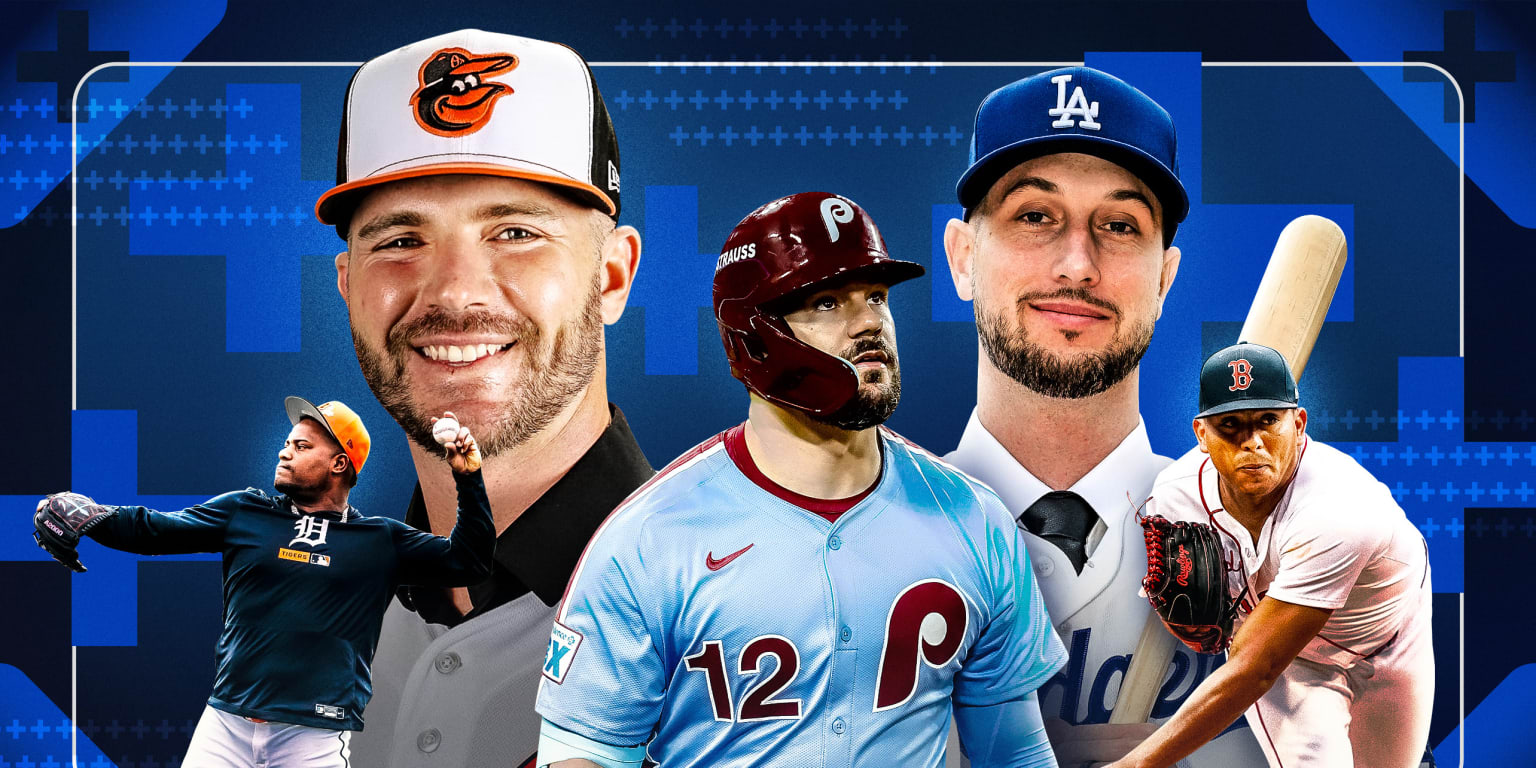
With that in mind, we’re left with these 10 teams as the biggest improvers from the start of free agency until today …
Biggest adds: RF Kyle Tucker, RP Edwin Díaz, IF Miguel Rojas
You’re stunned that this team is atop the “most improved” list, though the hard part is remembering that the back-to-back World Series champs had merely the fifth-most wins last season and didn’t even score a top-two seed in the National League – so there was some room to improve. As we said in an offseason kickoff look, the team that seemingly had everything really did need to improve on a below-average outfield group, and they did that and more by signing Tucker, who helped take last year’s 18th-best outfield and turn it into one projected to be a top-five group.
The ripple effect there also helped improve the second base situation, which at one point early in the winter was rated as the 30th of 30 teams – or, last. It’s still only middle of the pack now, but greater focus from Tommy Edman, who is now expected to be less of an outfield option, should help. Let’s not overlook the impact of Díaz in the bullpen, of course, though he’s here a lot more to nail down outs in October than in July.
Biggest adds: DH Kyle Schwarber, C J.T. Realmuto, OF Adolis García, RP Brad Keller
This won’t be popular, we know, as Phillies fans have the same sorts of “running it back” complaints as Yankee fans. But their placement here is also simple enough to explain: At the start of the winter, the team’s top three priorities were “we have no catcher,” and “what would we do if Schwarber leaves,” and “Nick Castellanos can’t be the right fielder any longer.” Each of those things got resolved.
Realmuto came back, and even in his post-peak present he’s still a considerable upgrade on what had been the 30th-ranked catcher spot in November. So did Schwarber, an elite bat. While there’s some chance that the rebound bet on García turns out the same as the one on Max Kepler a year ago, it was clearly time to move on from Castellanos, and on defense alone it’s a big step up. Quietly, there’s also the fact that Keller was fantastic out of the Cubs bullpen last year.
Are the Phillies better compared to their 96-win 2025 roster? No, probably not. Despite manager Rob Thomson’s confidence, the rotation is thinner and the outfield looks incredibly problematic. Is it better than what they had to start the offseason with, though? Definitely. That’s how much work needed to be done.
Biggest adds: SP Ranger Suárez, SP Sonny Gray, 1B Willson Contreras, IF Caleb Durbin, SP Johan Oviedo, IF Isiah Kiner-Falefa, IF Andruw Monasterio
Boston may not have any single hitter expected to put up huge power numbers, and fans surely weren’t happy to see Alex Bregman depart for Chicago, but that doesn’t mean it was a quiet winter off Lansdowne Street. That’s particularly true with regard to the rotation, where Boston now boasts a group of starters both talented at the top and deep at the end, leading to baseball’s top-projected unit. Contreras helps, too, but a sneaky upgrade here is simply the fact that multiple moves for middle infielders help put an end to any notion that Ceddane Rafaela would have to play second base, and the more of his glove they get in center field, the better.
Biggest adds: 1B Pete Alonso, RF Taylor Ward, RP Ryan Helsley, IF Blaze Alexander, RP Andrew Kittredge, SP Shane Baz, SP Chris Bassitt
The biggest criticism of the Orioles’ winter is that they didn’t do nearly enough to improve the top of their starting rotation, and we agree. A group projected as 17th best in the Majors may not be good enough, though the depth should be improved. But Alonso is a two-to-three win upgrade over what they had at first; Ward adds more than a win to their previous outfield configuration; and while Mets fans will never believe it, there really is reason to believe in a Helsley rebound.
Those are good things. Here’s the problem, though: The 2026 Orioles may simultaneously be “an improved, above-average team” and also “fourth-best in the AL East.”
Biggest adds: SP Dylan Cease, SP Cody Ponce, 3B/1B Kazuma Okamoto, RP Tyler Rogers
The obvious upgrades here are in the rotation, where last year’s group was just-OK despite the run to Game 7 of the World Series, then lost Max Scherzer and Chris Bassitt to free agency. It was an obvious place to add, and they did that with Cease and Ponce. That boosts the rotation to a better situation (No. 7 projected), and Okamoto’s addition boosts the middle infield a little as well, because his addition allows other players to add more depth in other spots. The news that Anthony Santander will miss much of the season with shoulder surgery doesn’t help, but the new players surely will.
Biggest adds: SP Framber Valdez, SP Justin Verlander, RP Kenley Jansen, RP Drew Anderson, 2B Gleyber Torres
This would have looked a lot different a week ago, when the Detroit offseason had been disappointingly quiet, but it turns out adding an ace starter and a franchise legend who’s still got some game can really change your outlook – particularly now that their rotation is considered an elite unit. Torres’ decision to return via the qualifying offer helped as well, especially if you’re willing to believe that it was his injury-plagued second half that was the fluke, not his elite first half.
Biggest adds: 3B Alex Bregman, SP Shota Imanaga, SP Edward Cabrera, RP Phil Maton, RP Hoby Milner, RP Hunter Harvey, 1B Tyler Austin
At the end of the season, Kyle Tucker was lost to free agency, so when the offseason began, they were down a big bat, most of a bullpen, and a chunk of a starting rotation. Not much to do, right? Adding Bregman was the obvious big get, which has ripple effects that allow Matt Shaw to be used in a few spots. But a lot of this is about what they did on the mound, particularly if there’s more in Cabrera’s tank, as they hope there is.
Biggest adds: 2B Luis Arraez, CF Harrison Bader, SP Tyler Mahle, SP Adrian Houser
The extra pitching depth certainly helps, but the Giants didn’t really add any needle-movers on the mound this winter. This comes down to the fact that Arraez, divisive though his style of play may be, joins a team that had an untenably weak situation at second base – as we dove into in December when they were projected as 29th at the keystone. Also on that list was right field, which was looking like a bottom-five unit until Bader joined up to cover center, allowing Jung-Hoo Lee to slide to right. Small upgrades all, but small upgrades add up.
Biggest adds: SP Michael Lorenzen, SP Tomoyuki Sugano, RP José Quintana, UT Willi Castro, OF Jake McCarthy, 2B Edouard Julien
It’s going to take time for the new Rockies regime to make real actionable changes that turn around the team’s record on the field, but when you lose 119 games, it’s not that hard to find places to improve, either. Last year’s club set an all-time record for highest rotation ERA (6.65), and then had to also replace long-time starter Germán Márquez this winter, too. While Lorenzen, Sugano and Quintana might not be the bedrock of the next good Rockies team, they should, at least, help soak up a whole lot of competent innings this year – and Colorado may have added three starting pitchers and three starting position players in an offseason. It’s a start.
Biggest adds: 3B Bo Bichette, 2B Marcus Semien, SP Freddy Peralta, CF Luis Robert Jr., 1B Jorge Polanco, RP Luke Weaver, RP Devin Williams, SP Tobias Myers
This was not exactly a popular offseason at times, but it sure ended up being a busy one, completely changing the face of the team. It wasn’t all adds, obviously. Brandon Nimmo and Jeff McNeil were traded, for example. But they got the top-of-the-rotation starter they needed in Peralta, a pair of good relievers in Weaver and Williams, a top-tier bat in Bichette, a historic strikeout-improver in Polanco, and should, hopefully, have improved the run prevention unit they talked about so much.
