If you’re hanging on to your old wedges because they were $189 each and you just don’t want to spend another $189, this may change your mind.
I’m not going to tell you the least expensive wedges on the market are the best. But I will tell you this: if you’re playing premium wedges with worn grooves, it could be time to let them go.
We’ve tested what happens when wedges wear out. We’ve tested what brand-new wedges (even those under $130) can do. When you put those two datasets next to each other, the conclusion is hard to ignore.
What happens when wedge grooves wear out
In a MyGolfSpy Labs test, we set out to isolate groove wear.
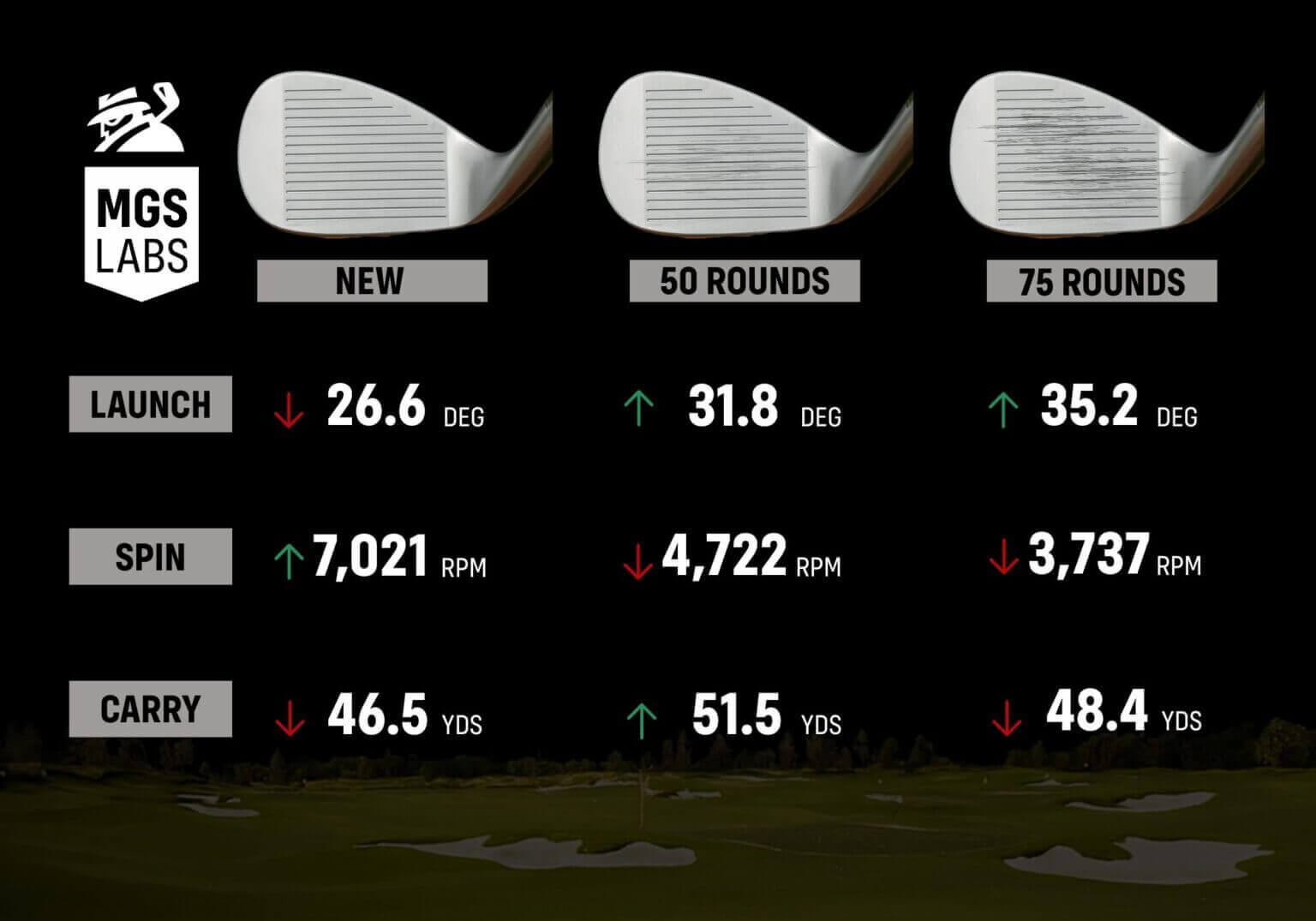
Using a brand-new 56-degree wedge, wear was simulated to reflect roughly 75 rounds, based on guidance from Titleist and its Vokey team. The wedge was tested at three stages:
- Brand-new
- After ~50 rounds of simulated wear
- After ~75 rounds of simulated wear
All shots were hit off grass to a 50-yard target, focusing on the metrics that matter most with wedges: spin, launch and consistency.
The result after 75 rounds
- Average spin: 3,737 rpm
- Launch angle: 35.2°
For context, the same wedge produced more than 7,000 rpm when it was brand new.
How worn wedges compare to new wedges tested in 2025
In the Best Wedges of 2025 test from MyGolfSpy, we evaluated 18 new wedges with multiple testers and a total of 13,860 shots recorded.
Every new wedge in this group produced roughly 3,000 more rpm of spin and launched the ball six to eight degrees lower than the worn wedge.
50-yard dry comparison: Worn premium versus new value wedges
| Wedge | Condition | Price | Spin (RPM) | Launch (°) |
|---|---|---|---|---|
| Premium wedge (75 rounds worn) | Worn | — | 3,737 | 35.2 |
| Sub 70 287 | New | $135 | 6,836 | 29.06 |
| Sub 70 JB V2 | New | $135 | 6,727 | 29.46 |
| Takomo Sky Forger 002 | New | $99 | 6,819 | 29.04 |
| Wilson Infinite | New | $139 | 6,941 | 29.08 |
| MacGregor Tour Grind | New | $129 | 6,860 | 29.48 |
Why spin and launch change as wedges wear
As grooves wear down, they lose their ability to grip the ball at impact. When that happens:
- The ball slides up the face instead of grabbing
- Spin drops dramatically
- Launch increases because friction is reduced
That combination of low spin and high launch is exactly what shows up in the worn-wedge data. It also explains why distance control becomes unpredictable. Without consistent friction, two shots with the same swing can produce very different outcomes.
Another option you have
Current-model wedges are not your only solution.
If you’re comfortable playing technology that’s a generation older, there are brand-new wedges from recent testing cycles that still offer strong spin, predictable launch and solid consistency.
These wedges still have fresh grooves and much more to offer than a premium wedge with worn grooves.
Here are a few examples currently available:
- TaylorMade Milled Grind 4 – $129
- Titleist Vokey SM10 – $159
- Cleveland CBX Full-Face 2 – $119
- Cleveland RTX 6 ZipCore – $139
- Mizuno T24 – $129
All of these models delivered strong test results in 2024, particularly in spin and consistency, and all are now priced well below their original launch cost.
This isn’t “cheap beats expensive”
There are meaningful performance differences between wedges. Sole design, bounce options, grind versatility, turf interaction and feel all matter if you’re trying to find the best wedge for your game.
But none of that matters if you can’t spin the ball, your launch is unpredictable or your distance control is suffering.
If those things are happening, the smartest move may be simply putting fresh grooves in your bag.

The takeaway
If your wedges are worn and you’re holding on to them simply because they cost you a lot of money a few years ago, it may be time to rethink that decision.
For many golfers, the ideal next step is a new premium wedge, properly fitted for loft, bounce and grind. Modern groove designs and face treatments can help maintain performance longer, especially in wet conditions. But it’s not the only choice.
The point is that you have options—and the worst one may be trying to force a worn premium wedge to keep working.
The post My Take: Spending Less On A New Wedge Beats Hanging On To A Worn One appeared first on MyGolfSpy.
