If you paid attention to the recent Rolex 24 at Daytona — either through boots on the ground or otherwise — you had to notice the overriding fact that it’s only a “sporting” event to a certain percentage of those on hand.
To many others (most, perhaps?), it’s simply an event. Not just a place to be, but the place to be.
Advertisement
It seems as if that line of thought will officially blend into NASCAR’s strategy with the dozen tracks it owns that are part of the current Cup Series schedule.
When will that become evident?
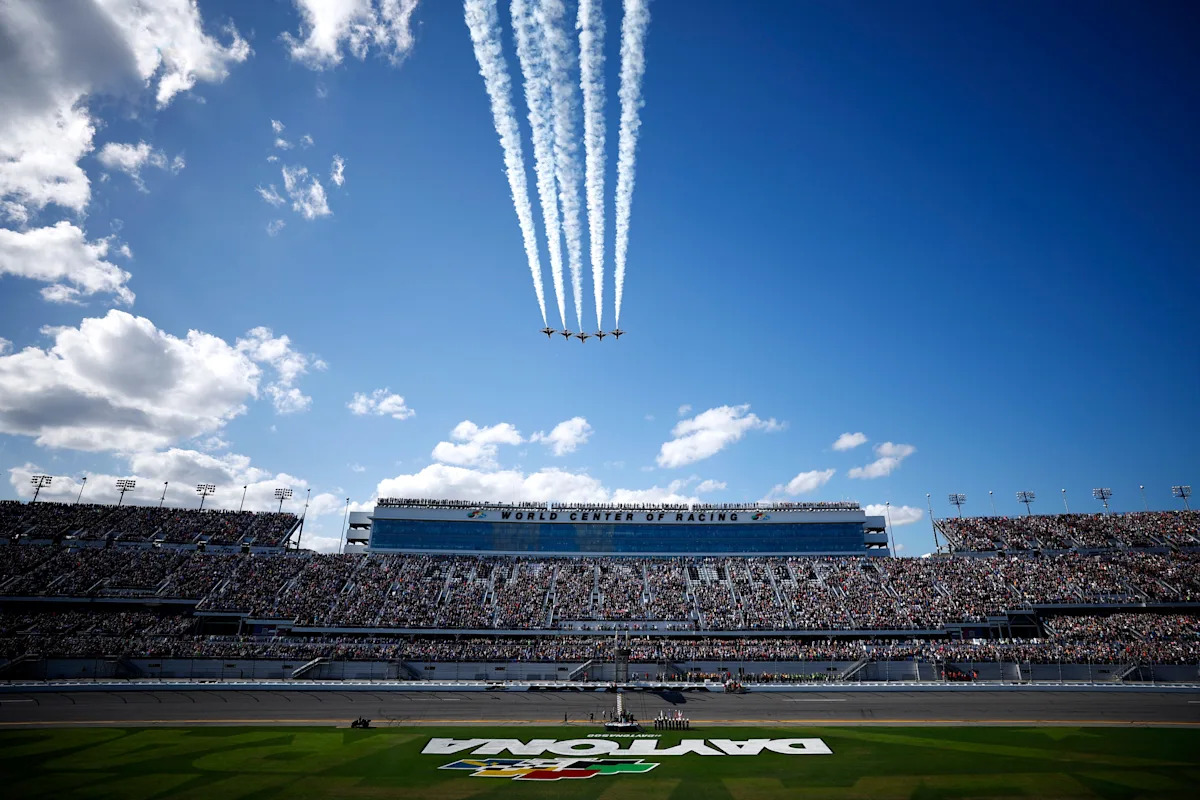
The annual pre-Daytona 500 flyover by the U.S. Air Force Thunderbirds falls under the heading of “fan experience.” NASCAR is looking to bring more of those types of experiences to its racetracks.
“Probably not immediately, in all honesty,” Ben Kennedy said Tuesday morning as an internal memo was being delivered to all NASCAR employees.
But it shouldn’t be long before the game plan — some 18 months in the making, he said —– begins showing itself.
“Our hope over time is that we’re turning tracks into venues and races into events,” said Kennedy, an executive vice president whose title includes “Chief Venue and Racing Innovation Officer.” He’s also a fourth-generation member of the NASCAR-operating France family.
Advertisement
“When fans come to a racetrack, whether it’s on the day of the Daytona 500 or any other day during the year, our plan is we’re continuing to raise the standards and expectations they have, and that we’re turning the races into these weeklong events.”
Kennedy’s memo to the assorted NASCAR staffs featured updates on many personnel moves and maneuvers involving existing officials, as well as plenty of the modern corporate lingo, including with the new structure’s “five strategic pillars,” which are Live Events and Experiences, Admissions and Performance Marketing, Venue Optimization, Premium and Signature Experiences, and Innovation and Growth Initiatives.

Ben Kennedy
“We’re working on some new offerings we’re going to announce in a few weeks, from a hospitality perspective,” Kennedy said. “We’re also really focused on making sure that we present a lot of the traditions and the character and brands that our tracks have today.
Advertisement
“Every track has its own brand and we want to find a way to lean into that brand even more than we have in the past. I think you’ll see a higher level of consistency across our tracks.”
He expects tracks to expand their reach beyond the one or two weeks of year when they are hosts to NASCAR events. NASCAR’s home track, Daytona, for instance, not only has the Rolex 24 weekends (testing, followed by the race), but a pair of motorcycle racing weeks, the mammoth “Welcome to Rockville” concert weekend, and even the annual Christmas season’s “Magic of Lights,” which began in 2020.
“We’re going to continue to help manage the process,” Kennedy said. “It’s another focus we have, continuing to keep our tracks more active year-around. More on-track activity throughout the year, but more activity throughout the community as well.”

The pageantry of Daytona’s Rolex 24 could serve as a model of what NASCAR is looking to bring to its other racetracks and events.
Corporations don’t overhaul and/or enhance strategies as a stretching exercise. Eventually, there’s a bottom line, and it’s usually just that: the bottom line. “Revenue generation” was listed among the goals of the new game plan.
Advertisement
Some might wonder if revenue generation is more crucial in the wake of the recent antitrust lawsuit, which was settled last month before Day 9 of the trial in Charlotte, N.C. Given how this restructuring project started a year and a half ago, Kennedy said, there’s no connection. He said the roots of this dates back to 2019, when NASCAR merged with its former track-ownership partner, International Speedway Corp., and therefore took ownership of ISC’s tracks.

.
“Completely unrelated to the lawsuit,” Kennedy said. “We made a lot of changes as we went through the merger in 2019 of bringing ISC and NASCAR together, and through that we centralized a lot of things.
“That said, we were at a bit of an inflection point where the model had morphed into something that wasn’t as effective as we wanted it to be. So about 18 months ago we decided to reassess the model, and over the past 18 months, we’ve had conversations with people at tracks, and ultimately this is the output of it.”
This article originally appeared on The Daytona Beach News-Journal: NASCAR internal memo outlines new model for races and racetracks
