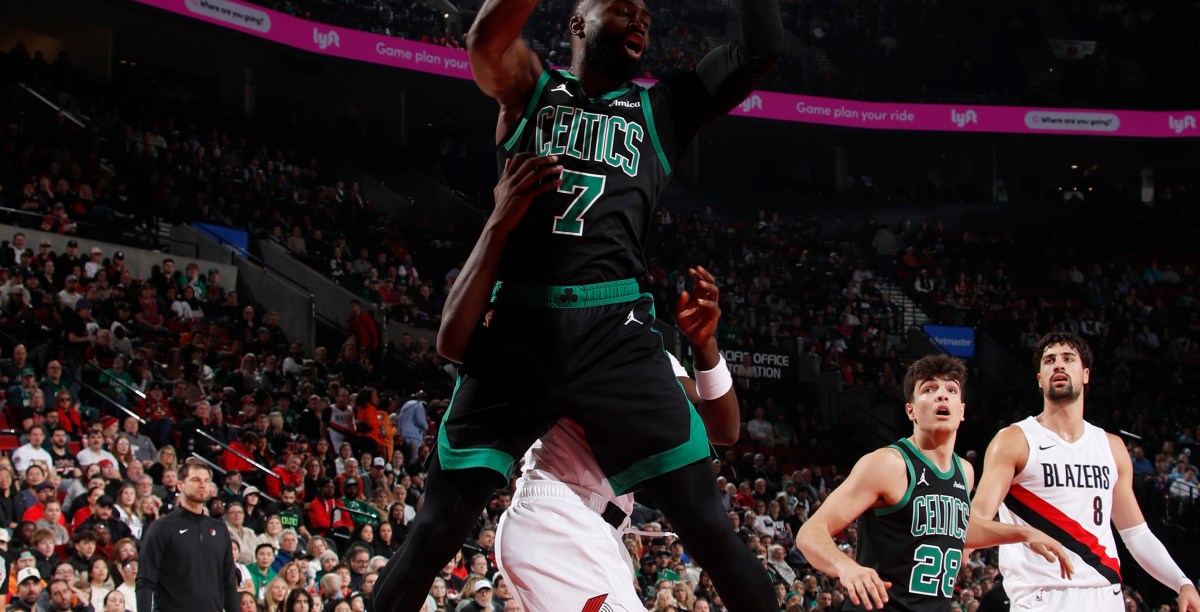
A cliché? Yes. Forgotten a few weeks into the year? More often than not. New Year’s resolutions aren’t for everyone, but as we wave goodbye to 2025 and welcome in 2026, I’m going to set a resolution for each Celtic for the remainder of the 25/26 season.
To start us off, we’re looking at Jaylen Brown. In a season of reaching higher highs than many of us believed possible, his performance so far may leave you thinking that Brown should be left alone, lauded, and celebrated. Honestly, on a different day, I might be inclined to agree, but Brown is fully realizing his potential. With the likes of Victor Wembanyama and Giannis Antetokounmpo missing time, I think Jaylen has a real chance to make All-NBA First Team, and with those lofty expectations, there’s one area of his game I’d still like to see improvement in. Let’s look at Jaylen Brown in fourth quarters.
If you’re reading this, then you know that Brown is putting up career numbers in both volume and efficiency. On the season, Brown is a hair’s breadth (pun unintended) below thirty points per game, and reading into the last ten games, it seems he’s still improving as the year goes on.
31.3 PTS | 7.1 REB | 5.5 AST | 1.1 STL | 0.6 BLK
62.9 TS% | 55.7 2P% | 41.7 3P% | 79.4 FT%
9.7 FTA | 35.6 MIN | +6.5 +/−
This ten-game tour de force contrasts slightly with Brown’s closing performance against the Blazers over the Christmas period. Two clutch-time turnovers meant the spoils stayed with Rip City, and it led me to dig into Brown’s quarter-by-quarter breakdowns on the year.
Boston are the second-best team in the entire association in fourth quarters this season. They’re a +9.6 in net rating, yet when Brown is on the floor in the fourth, the Celtics have a -3.8 net rating. If you look at Celtics players’ plus-minus by quarter this year, Brown ranks 4th, 3rd, 8th, and 13th from the first through fourth quarters, respectively. That stark contrast begs belief, but it suggests there’s still work to be done for JB in closing situations.
Now, we’re a little over a third of the way into the season, and these numbers could normalize. In general, fourth-quarter data can also prove less trustworthy, as you can’t filter out garbage-time minutes on sites like NBA.com. Still, that drop-off in effectiveness is consistent with other ultra-high-usage players of the past. Luka Dončić was criticized for years for his decline in efficiency and output in fourth quarters. During the Mavericks’ deep playoff runs, Kyrie was often dubbed the de facto closer, with Luka apparently spent after three quarters of ultra-high usage. Luka’s physical condition was the go-to explanation for that change in effectiveness, but that isn’t a criticism you could levy at Brown.
It’s not Brown’s shooting either. In the fourth, JB is still scoring 6.7 points (15th best in the league) on 60% true shooting. He’s shooting close to fifty percent from three in fourth quarters too, so it’s not as if the scoring majesty we’ve been treated to so often this year disappears in the clutch.
Perhaps these surprising numbers can be explained by assist-to-turnover ratio. It’s hard to spot the issue at first glance, but what does jump out is that Brown’s ATO drops from an elite 2.36 in second quarters to 0.8 in fourth quarters. As the pace of play slows even further toward the end of games, it would seem the ball starts to stick, and the static nature of the Celtics’ offense can be exploited by opposing teams. See the two turnovers from the other night against the Blazers:
Brown has played at his own pace all season, but in clutch scenarios teams are often more willing to take risks by deploying more aggressive defensive coverages. On this particular possession, Brown delays his initiation a half-second too long after Queta’s roll, leaving him isolated on an offensive island with a swarm of limbs scrambling to steal the ball. Not a minute later, Brown saw a similar defensive coverage:
On this play, it’s Derrick White setting the screen. The Celtics’ two most capable and valuable players operating together makes a world of sense. White slips away, ready to receive the ball, but an emboldened Blazers perimeter tag team swarms once more.
To me, these actions are too stagnant. The league has embraced movement and dynamism to a greater degree this year than at any point in the last forty years. Brown is partly to blame for his lack of urgency, but the play itself is too conservative to begin with. It puts Brown in a position where he is entirely reliant on craft, will, and skill to generate points late in games. From a scoring perspective, that production has continued to show up in the fourth, but at present there is a fundamental issue with how the offensive blueprint isolates Brown from his teammates and how his cadence clashes with aggressive defensive coverages.
Don’t get me wrong. Jaylen is to be celebrated, even deified, for his efforts this season, but there is still work to be done. Heading into 2026, I’d like to see Jaylen bring his assist-to-turnover ratio down in the fourth, and I’d like to see him do so in two ways.
First, pace of play. I want Brown to look to attack more quickly in clutch situations, rather than allowing the defense to set and load up. Keep them reactive. Keep them on their toes.
Second, and this is a bit of cheating, because it’s as reliant on Joe Mazzulla as it is on the Celtics’ number one, put the ball in Derrick White’s hands more often. Allow White to set the table for Brown in the fourth. White’s ball security is elite; he’s a possession-saving stalwart, and shifting more responsibility into D-White’s capable hands can help Brown be his best self as the Celtics move into 2026.
