Wells and Hymer Keynote New York Chess Education Conference
Growth mindset principles take center stage as educators reimagine chess in schools
By Robert McLellan
Famed UK chess coach grandmaster Peter Wells, and Dr. Barry Hymer, formerly a professor at Cumbria University and Peter’s co-author for the book Chess Improvement: It’s All in the Mindset, were recently keynote speakers at the Mindsets Chess in Education Conference held in New York on December 6.
Dr. Barry Hymer and grandmaster Peter Wells signing their book
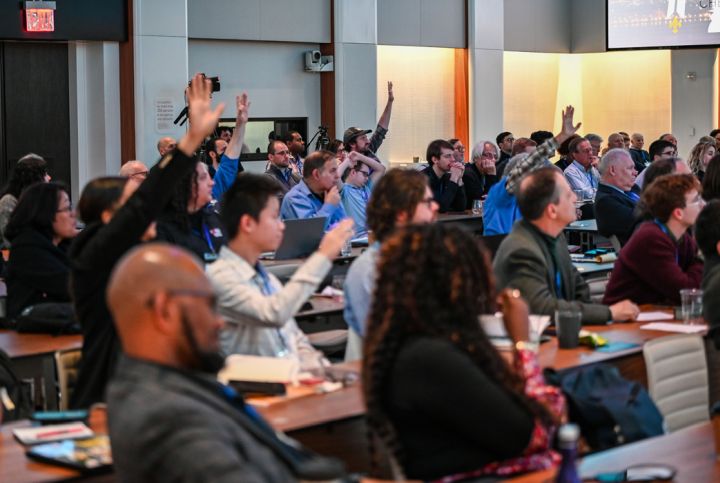
The conference, presented by the National Scholastic Chess Foundation (NSCF) and Kasparov Chess Foundation (KCF) at Quorum in Rockefeller Center, attracted over 150 educators, school administrators, and researchers from across the three continents. Drawing on the mindsets framework, the conference explored how chess instruction can move beyond assumptions about “natural talent” toward deliberate approaches that emphasize growth, mastery, and purposeful play through research presentations and practitioner panels.
Challenging the Chess Boom Era
Wells and Hymer explored the intersection between educational and competitive chess, drawing on Carol Dweck’s research to contrast fixed mindset beliefs—where talent is viewed as innate and success measured by easy wins—with growth mindset approaches that see ability as cultivated through learning, effort, and productive struggle.
The duo posed two provocative questions: has their book’s message survived the chess boom era, characterized by tricks and traps, entertainment content, status obsession, and engine reliance? And can competition truly align with a growth mindset?

Rather than presenting these as irreconcilable tensions, Wells (above) and Hymer advocated for synthesis. They examined what they see as false binaries separating learning goals from performance metrics, proposing instead what they termed “serious play”—an approach grounded in intrinsic motivation, challenge, feedback, productive failure, and metacognition that recognizes the gifts both educational and competitive chess offer.
Following their keynote on Saturday, Wells and Hymer delivered a second presentation on Sunday at the historic Marshall Chess Club, offering fresh insights in a more intimate setting for deeper discussion with educators and chess enthusiasts.
Pedagogy and Purpose
Saturday’s morning sessions explored how these mindset principles translate into classroom practice. Dr. Jeff Bulington of the Franklin Chess Center in rural Mississippi opened the morning sessions by addressing a fundamental question: why should limited instructional time be devoted to chess? He examined the challenge of transfer—acknowledging that while chess skill is highly specific, when taught intentionally, chess can develop transferable skills in planning, decision-making, and strategic thinking. Bulington emphasized combining “chess in depth” with “chess in breadth,” grounding programs in clear pedagogical purposes rather than claims of automatic cognitive transfer.
A panel on the philosophy of games and learning explored how games cultivate curiosity, resilience, and experimentation. Dr. Troy Seagraves of Purdue University’s Virtual Reality and Artificial Intelligence Lab discussed how games capture attention and foster task-oriented reasoning. FIDE Master Dr. Loren Schmidt of Heritage University examined feedback loops in chess, demonstrating how immediate response to moves—paired with a community that discusses and analyzes play—creates essential conditions for developing both chess skill and broader meaning-making systems.
The focus then shifted to chess in the classroom. Alan Abrams, co-author of “Great Moves: Learning Chess Through History,” discussed placing chess instruction within literacy education. Mike Amori, who teaches alongside Abrams at The Chatsworth School, demonstrated integrating chess with storytelling and improvisation, showing how well-designed programs can support literacy, creativity, and social-emotional development.
NSCF Executive Director Matan Prilleltensky presented a mastery-based approach using the Steps Method curriculum developed by IM Cor van Wijgderden and Rob Brunia. The curriculum builds foundational knowledge systematically, teaching concepts like profitable exchange and the four basic methods of defending while keeping students focused on problem-solving. Prilleltensky stressed that mastery is demonstrated not through memorized positions but through what students can apply in real games.
Kasparov on Chess in the AI Era
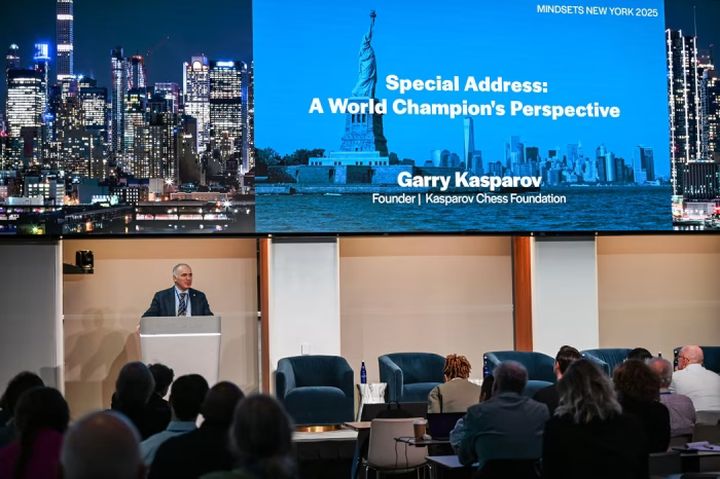
World Chess Champion Garry Kasparov delivered a special address, connecting lessons from elite competition to everyday teaching and learning. He reflected on how chess education will evolve as society transitions from an era where all knowledge can be accessed from a mobile phone to an AI-driven world where we can outsource even our thinking.

Kasparov drew on his own experience learning chess from books and magazines that, when available, were shared among players in his city. He spoke about learning from his predecessors and contrasted that with today’s environment where players consult engines rather than trust their own assessment. His message emphasized how educators can use chess to help students face challenges directly and develop independent analytical thinking.
Research and Pathways for Long-term Success
The afternoon sessions broadened the scope, connecting mindset principles to research findings on female student participation in chess, and discussions that explored how to grow the acceptance of chess in schools and colleges, and how we define success in scholastic chess.
Dr. Brian Kisida of the University of Missouri, Columbia, Dr. Matthew Pepper of Basis Policy Research, and Dr. Michelle Wickman of Saint Louis University presented research on gender gaps in competitive chess. Their analysis of over 106,000 young USCF players from 2000-2019 revealed that while females start with lower ratings, they improve at similar rates to males. Most significantly, the gender gap narrows as female participation increases, especially at higher skill levels, providing empirical grounding for equity discussions in chess education.
An educators’ panel moderated by FM Sunil Weeramantr brought together highly respected chess educators Michael Khodarkovsky, WIM Beatriz Marinello, Sophia Rohde, and Robert McKenzie,. Panelists discussed their early exposure to chess in their home countries and how they’ve successfully embedded chess into school curricula, navigated questions from administrators and parents, and aligned chess with academic standards and social-emotional learning objectives.
Building bridges from high school to competitive collegiate chess was the focus of a panel featuring Grandmaster Alex Onischuk of Texas Tech University, Dr. Jonathon Singler of Webster University, and FM William Graif. They explored how high school programs can prepare students for collegiate-level competition, scholarship opportunities, and sustained engagement. The panel addressed how the scarcity of competitive chess opportunities at the college level causes attrition among even the strongest high school players and how a collegiate chess culture can be developed.
In another session, Dr. Alexey Root of the University of Texas at Dallas, Dr. Jeff Day of Texas Tech University, and Dr. Singler discussed models for offering chess as a for-credit academic course. The discussion highlighted curriculum design, assessment, and institutional considerations for elevating chess from extracurricular activity to recognized academic study.
In the final panel, moderated by Weeramantry, former scholastic players Will Trepp, Jack Kochansky, and NM Benson Schexnaydre challenged traditional metrics of success focused on ratings and trophies. The discussion advocated for broader definitions that include personal growth, character, leadership, and lifelong engagement with the game.

During closing remarks, co-chairs Weeramantry and Khodarkovsky (above) invited representatives from the Saint Louis Chess Club on-stage to announce the dates for the 2026 Chess in Education Conference.
Community and Connection
Beyond formal programming, satellite events across three days created space for connection. A pre-conference reception at Hunter College Campus Schools showcased a program that has modeled scholastic chess excellence in America for over 40 years. Saturday evening featured a reception hosted by Chess Place at La Fonda in Spanish Harlem, where attendees enjoyed live jazz, local cuisine, and casual chess. The weekend concluded Sunday afternoon at the historic Marshall Chess Club with Wells and Hymer’s second presentation. These gatherings underscored that play, joy, and community are essential components of meaningful learning.
The Mindsets conference was made possible through the generous support of The Saint Louis Chess Club, US Chess, US Chess Trust, ICC: The Internet Chess Club, Mark Wieder, Chess in the Schools, and the New York State Chess Association.
For a complete report and photo galleries from the weekend, visit: https://nscfchess.org/mindsets-2025/
