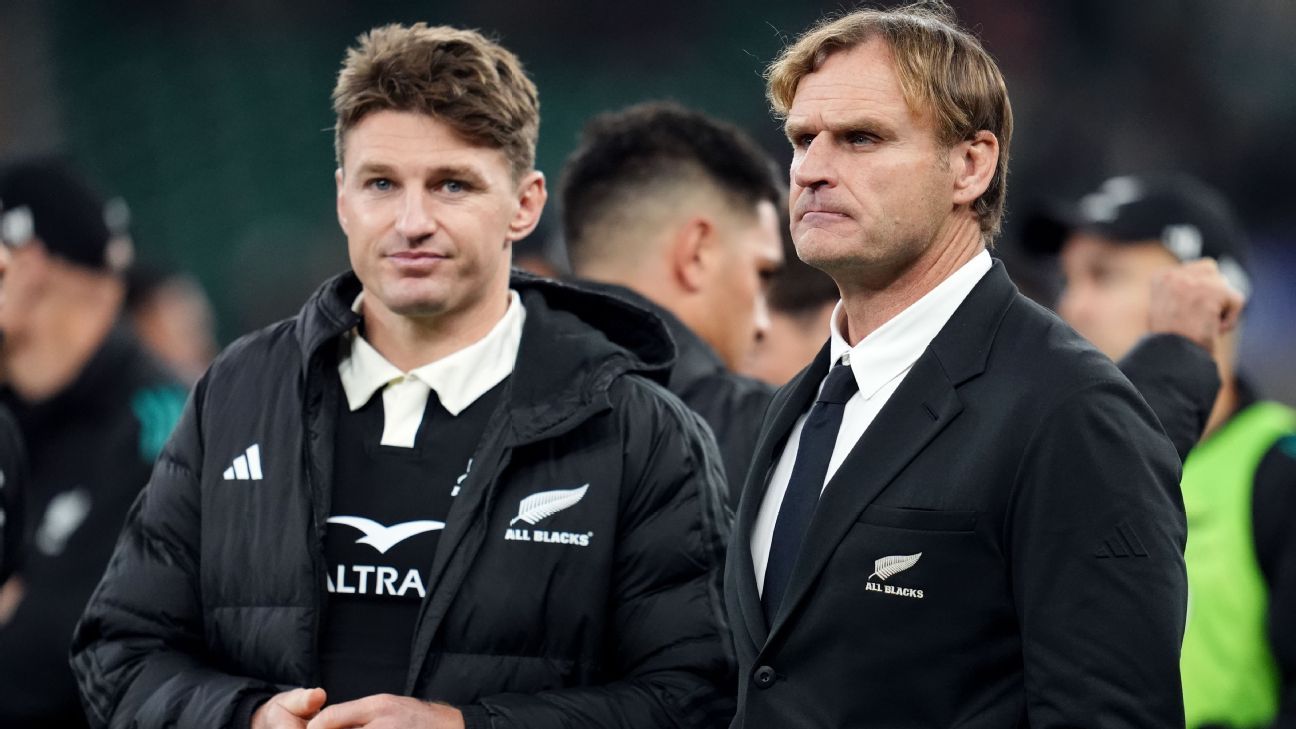
Change is coming to New Zealand Rugby [NZR] — just how many, and how far-reaching, is the question.
As with any major company or professional sports team, scrutiny starts at the top.
New Zealand Rugby is in the process of appointing a new chief executive as Mark Robinson’s six-year tenure comes to a close.
Six Nations boss Tom Harrison, the former head of the England and Wales cricket board, interviewed to replace Robinson and is believed to be the frontrunner for the job.
While Harrison boasts experience in broadcast negotiations and with private equity firms, an Englishman potentially running NZR presents inevitable challenges.
It’s far from all doom and gloom but the pressing issues facing New Zealand rugby, as with many of its counterparts, is akin to a child’s Christmas wish list.
From appointing a new Black Ferns coach and attempting to elevate their status following their disappointing Rugby World Cup semifinal defeat against Canada to tackling the intense, growing threat from the NRL, drilling into the All Blacks’ stagnation, juggling delicate relationships with national unions, ensuring Super Rugby Pacific’s long-term viability and managing the complex provincial union desires and the community rugby’s future.
Such an extensive list is daunting for anyone to confront.
The All Blacks, as the money-making arm that funds the New Zealand game at all levels, is the first point of call.
Post season reviews are expected to be completed by the time the next New Zealand Rugby boss starts next year with any candidate likely needing to serve out a lengthy notice period.
The All Blacks reviews could be pointed, too, as senior players voice their views with the state of the team two years into Scott Robertson’s reign.
Robertson was appointed to assume charge after the last World Cup, while Ian Foster was at the helm, by an NZR board that has largely been overhauled and by a chair (Dame Patsy Reddy) and chief executive who are no longer present.
That’s not to suggest Robertson will be turfed out but the landscape he arrived, and his initial internal backing, has drastically altered and there is a growing sense change is needed to spark the best from the All Blacks.
A 10/13 record this year, 20/27 from two years in charge, is not horrific by any means but a 74% winning record is concerning by All Blacks standards, and a long way from the transformational presence Robertson pitched following seven straight titles with the Crusaders.
The loss at Twickenham that crushed the All Blacks’ Grand Slam hopes must be the catalyst for serious introspection.
With a six-week, four-test tour of South Africa looming next year vast improvements are required as the world champion Springboks, having won 27 of their last 31 Tests, put further distance between themselves and the chasing pack.
The All Blacks coaching team will undergo further change with Jason Holland following Leon MacDonald as the second of Robertson’s original assistants to voluntarily exit.
Robertson’s remaining coaching team warrants wider scrutiny, too, with the attack struggling to fire all year other than bursts of individual brilliance and Scott Hansen assuming much of the responsibility for overall team strategy.
Consistent third-quarter fades raise concerns about communication and messaging while the on-field leadership and decision making has also baffled at times.
With a new chief executive yet to be appointed, World Cup winning All Blacks captain David Kirk shapes as a pivotal figure.
After a year in the role as chairman, Kirk’s ruthlessness could drive further changes to the All Blacks coaching staff if he is not satisfied by player feedback and plans to resolve the wild inconsistencies within games.
The All Blacks lack of progress under Robertson was highlighted once again by the team and coaching absence from any World Rugby award nominations. Will Jordan and Cam Roigard were also the only players included in World Rugby’s team of the year.
Lower down the tree Super Rugby Pacific is beginning to establish itself as rugby’s best on field product.
The willingness of officials to let the game flow, to remove frustrating dead time at the set piece and rid the game of unnecessary stoppages by minimising the overbearing TMO influence are major advantages Super Rugby Pacific holds in often promoting better spectacles than the Test scene.
The format remains an issue, though, with 11 teams requiring two bye weeks for all sides while financial clouds continue to hover over the likes of Moana Pasifika.
The other question is whether Super Rugby Pacific is best preparing its athletes for the international arena.
Attack first mindsets make for entertaining matches, but the All Blacks struggles under the high ball underline one aspect where New Zealand has been found wanting.
No competition is perfect – the United Rugby Championship’s intense travel demands are frequently bemoaned – but South Africa’s absence from Super Rugby undoubtedly strips the competition of a quality, contrasting style.
In Robertson’s quest to build four deep in every position the All Blacks this season promoted nine more rookies to the Test arena, boosting the tally to 19 debutants in the last two years.
Highlanders halfback Dylan Pledger is among the brightest prospects in the New Zealand game – a certainty to join that growing group by donning the black jersey before the next World Cup.
Kyren Taumoefolau, who will debut for the Chiefs this season after switching from Moana, and Highlanders flier Caleb Tangitau will also push hard for national inclusion on the edge.
New Zealand’s next generation of talent, though, were handed a reality check earlier year when the Australia under-18s humbled their trans-Tasman counterparts by a combined 136-81 scoreline in their two matches.
While the discrepancy between NZ Schools and Australian under-18s allowed the latter to capture more development players, those results sparked concerns with New Zealand’s talent identification and retention.
There was once a time when the cream of New Zealand schools automatically gravitated to rugby union, but the Warriors’ rise and the popularity of the NRL can be seen in Harry Inch, the Nelson College and NZ schools first five-eighth, spurning the Crusaders to sign a two-year deal with the Auckland league franchise.
As the time comes to reflect, there is no escaping the reality that this has been an underwhelming year for New Zealand rugby.
The largely barren trophy cabinet does not lie.
From the All Blacks to Black Ferns, expectations were not met.
Sitting idle is not an option for a rugby nation that demands excellence.
Intervention is needed to cajole change.
