In March, NFL free agency will drastically alter the landscape of the league at large. Yet with teams once again keeping the overwhelming majority of marquee names from hitting the open market, any franchise in search of a transformative figure might need to engage in another form of deal-making.
Trading big-name talent is hardly taboo in the NFL, with the likes of Micah Parsons, George Pickens, DK Metcalf, Laremy Tunsil and Joe Thuney having been dealt last year. And while the first two deals didn’t materialize until the summer, franchises often pounce on the period before free agency to secure proven starters.
Advertisement
Many offseason trades amount to a wiping of the slate for multiple parties, with teams often eager to clear their books or simply recoup some value for a player no longer in their plans. This year, however, could give rise to a change of scenery for several players who still have a good deal to offer.
With that in mind, here are 12 big-name NFL players who could be traded in the coming weeks:
Since receiving a massive five-year, $230.5 million extension in July 2022, Murray has neither been sufficiently effective nor available to live up to his massive payout. Yet Arizona has trudged along, awaiting a return to form that has never materialized. With a new coach in place and another major financial decision on the horizon, the 2019 No. 1 overall pick’s time in the desert might finally be up.
Advertisement
ESPN’s Adam Schefter reported earlier in February that the Cardinals were exploring a possible trade of Murray, as were the Miami Dolphins with quarterback Tua Tagovailoa. There might not be a buyer for either high-priced passer, with diminishing production and concerning injury history dovetailing to damage each signal-caller’s stock. Of the two, however, Murray is the more enticing option in an offseason where teams could be sent scrambling to find quarterback solutions beyond a seemingly weak draft at the position.
There’s a clear incentive for Arizona to get something done, as dealing him rather than cutting him outright would save nearly two-thirds of the $54.7 million dead cap hit he would otherwise carry. And the Cardinals can’t afford to string this one out, with an additional $19.5 million in Murray’s 2027 salary becoming guaranteed if he’s still on the roster by March 15. Ultimately, any acquiring team likely would be taking on a good deal of assurances in pay while receiving few with regard to the dynamic dual-threat’s play. But don’t rule out the possibility of a deal just yet, especially if the Cardinals are willing to help bridge any financial gap.
QB Mac Jones, San Francisco 49ers
No team knows the value of a good backup quite like the 49ers, who in recent years have endured a calamitous spate of injuries defying most logical explanations. That’s made it critical for San Francisco to keep valuable backstops such as Jones around for as long as the team can.
Advertisement
Under contract for another year at a meager $3.07 million, Jones sizes up as the ultimate prize as a bridge quarterback – if he were to be made available. And as teams weigh whether there’s another Sam Darnold reclamation project out there to seize upon, there’s probably considerable appeal for the man who replaced Darnold in the Bay Area and has already shown marked progress in turning things around.
It stands to reason that the 49ers would resist parting with the rejuvenated 2021 first-round passer, who last season posted a career-high passer rating of 97.4 while starting eight games in place of Brock Purdy. And Schefter reported before the Super Bowl that the 49ers weren’t planning on trading Jones this offseason.
Plans can change, however. Any initial conversations around Jones might take on a more feverish tone around or shortly after the first wave of free agency, as several teams in the market for a short-term solution behind center are bound to be left without an answer. As those same franchises ponder scouring a draft offering little in the way of promising passers beyond expected No. 1 pick Fernando Mendoza, maybe one might conjure an offer capable of swaying the 49ers’ mind.


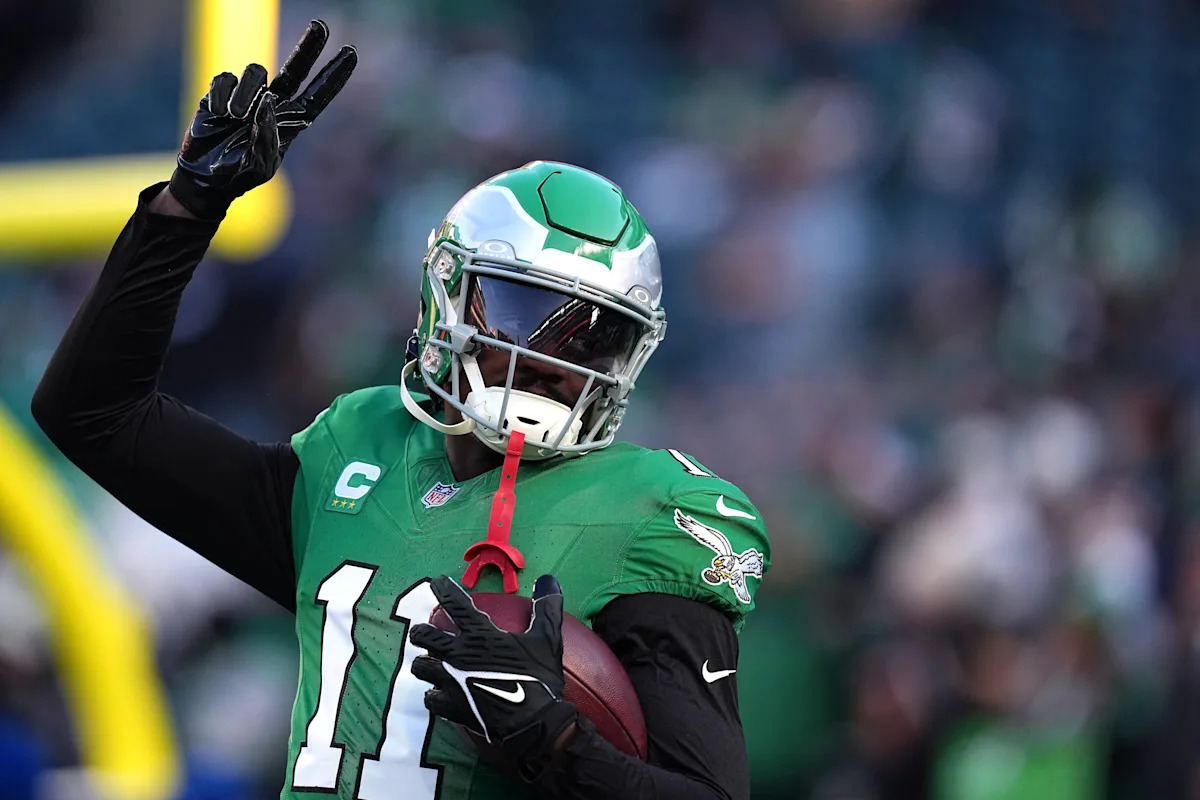
WR A.J. Brown, Philadelphia Eagles
There are plenty of indicators that suggest Brown is staying put in Philadelphia. The financial toll of moving him might be insurmountable, with the Eagles taking on a $43.5 million dead cap hit for doing so before June 1. Howie Roseman and Nick Sirianni also seem intent on getting things right with both the offense and the team at large, and robbing the attack of one of its top playmakers would be at odds with that mission.
Advertisement
But if Eagles brass doesn’t want to forge ahead with the volatile pass catcher, then maybe a split really is possible.
Figuring out proper compensation for Brown could be tricky given all the variables, but perhaps some team sees itself as capable of incorporating the three-time Pro Bowl selection the way the Eagles did when he first arrived in the stunning draft-day deal with Tennessee. In a more functional aerial attack, he might help put an established contender over the top.
WR Keon Coleman, Buffalo Bills
Bills co-owner Terry Pegula in January put a bizarre spin on the trolley problem, diverting a freight train of criticism from Brandon Beane’s pathway onto Coleman’s. Pegula defended Beane, who was promoted to president of football operations after Sean McDermott’s firing, in part by saying it was the coaching staff that had pushed to select the receiver No. 34 overall in the 2024 NFL Draft.
Advertisement
Beane subsequently tried to defuse the situation by taking responsibility for the pick, and new coach Joe Brady offered staunch support of Coleman in his introductory news conference. But the struggling pass catcher was already facing a considerable climb to get back into the mix for Buffalo’s woeful receiving corps. Despite boasting many of the traits the Bills would naturally seek in a sorely needed split end for Josh Allen, the 6-foot-4, 215-pound Coleman was a healthy scratch for four games down the stretch. His second year came to be defined by questions surrounding his maturity and preparedness.
What’s the upside for any potential takers? Simple: Buying low on talented players on rookie contracts tends to be good business. Coleman has various limitations – particularly related to creating separation – that have contributed to his stalled growth, but his stock shouldn’t be considered scorched earth. For a team that needs a big body to compete for contested catches, Coleman still carries solid value.
Brady repeatedly contended that Coleman would be back with Buffalo next season, and parting with a top-40 pick after just two years is hardly ideal. But for a franchise that was so fixated on the locker-room vibes after the divisional-round loss to the Denver Broncos, it might be wise to not let this loom over the season ahead.
WR DJ Moore, Chicago Bears
Don’t take his inclusion as an indictment of the season-ending miscommunication with Caleb Williams that sunk the Bears in the divisional-round playoff loss to the Los Angeles Rams. Rather, moving Moore could serve as a means to right-size the receiver room in Chicago.
Advertisement
Wideout Luther Burden III and tight end Colston Loveland looked nothing short of essential to the passing attack after late-season surges to cap their rookie years. Rome Odunze, too, should be a fixture of the passing attack so long as he can stay healthy. Where, then, does that leave Moore? The speedy target increasingly looks like a relic of a bygone era in Chicago, with a skill-position sea change already underway.
There might not be many bidders for a soon-to-be 29-year-old who is coming off posting career lows in catches (50) and receiving yards (682). But cutting him outright would entail a prohibitive $35.5 million cap hit, while dealing him would allow Chicago to clear $16.5 million in space. For that reason, maybe a minimal return would prove sufficient to facilitate a swap that would allow the team to stave off cap-saving moves elsewhere.
There are several receiver-needy teams with a good deal of cap space and diminishingly few worthwhile free-agent options worth plugging in as a pass catcher. Taking on Moore’s $23.5 million guaranteed salary for 2026 might be a non-starter to some, but he could provide the same kind of assistance he previously did with the Bears and Carolina Panthers in lifting up an underdeveloped receiving corps.
WR Brian Thomas Jr., Jacksonville Jaguars
Selling low is seldom a good idea for NFL teams, particularly when the player in question is at a premium position and on a rookie contract. With those factors in play, moving Thomas after his letdown sophomore campaign might not be very appealing to the Jaguars. But it’s not unfathomable that a regime that inherited the former first-rounder might flip him to a team that still sees him as a top-flight target.
Advertisement
While plenty of figures in Jacksonville flourished in Liam Coen and James Gladstone’s first year at the helm, Thomas floundered, with his receiving yards down nearly 50% from his sterling rookie campaign (1,282 to 707) and his touchdown catches dropping from 10 to two. The Jaguars, however, didn’t stand pat as Thomas struggled with drops and finishing plays. Jakobi Meyers arrived via trade and immediately became the reliable owner of the intermediate area that the attack needed, to the point that he was signed to a three-year, $60 million extension in mid-December. And Parker Washington broke out as a slot weapon, averaging 114.5 yards per game over his final four contests.
Is there space for Thomas in an increasingly crowded receiving corps? Meyers and Washington look essential to Trevor Lawrence’s resurgence, while Travis Hunter Jr. should at the least moonlight on offense. Still, Coen said Thomas would “100% be a part” of the Jaguars’ future. Lawrence came on strong down the stretch with Thomas operating in more of a designated deep-threat role, which the 6-foot-2, 209-pounder could reprise this fall.
Still, Gladstone acknowledged that the notion of a true No. 1 receiver “doesn’t necessarily exist” in Coen’s system. Perhaps another team looking for that true go-to option might try to swing a deal to put Thomas in that role. The Jaguars could stand to recoup some draft capital after parting with this year’s first-rounder to acquire Hunter. Sticking things out for another year is the most reasonable route for Jacksonville, but maybe an aggressive offer at least makes things interesting.
WR Jaylen Waddle, Miami Dolphins
How far is Miami’s new regime willing to go in its reset? Tagovailoa looks likely to follow Tyreek Hill and Bradley Chubb out the door, leaving the Dolphins to wade through what’s widely expected to be a transition year in 2026. If the organization is willing to tear things down to the studs, though, it could find a significant market for its most valuable asset in Waddle.
Advertisement
The speedy 27-year-old wideout sparked interest at the November trade deadline but was ultimately retained by the Dolphins. Now, however, new general manager Jon-Eric Sullivan and coach Jeff Hafley might view the franchise’s future differently than a group trying to keep things together a few days after longtime general manager Chris Grier’s split with the organization. With several receiver-needy contenders potentially fishing around – particularly in the AFC, which appears as wide-open as it has been in years – there could be strong demand for the five-year veteran.
Yet there’s a pretty strong case for the Dolphins to keep Waddle around. Along with running back De’Von Achane and center Aaron Brewer, the speedster is one of the lone holdovers for Miami’s offense, which should still be heavily interested in feeding him targets with pass game coordinator Bobby Slowik taking over coordinator duties. His contract now seems entirely reasonable in the short term, with just an $11.6 million cap hit awaiting this year. Moving Waddle would actually put Miami another $11.6 million in the red on cap savings, so the price to acquire him could be prohibitively high. But if the Dolphins can capture the kind of asset that would expedite a turnaround, sending Waddle on his way should at least be a consideration.
So far, it’s been all chatter surrounding the five-time Pro Bowl selection and his future. If Crosby really does end up pushing his way out of Las Vegas, it could end up as the most consequential transaction of the offseason.
Advertisement
Fox Sports’ Jay Glazer said ahead of the Super Bowl that he expects Crosby to be dealt ahead of the NFL draft, with the star edge rusher not wanting to be part of another rebuild. Crosby responded earlier in February by saying on “The Herd with Colin Cowherd” that “I just sit back and laugh because I know my truth and when I go to bed at night, I have a smile on my face because I don’t have to explain nothing to nobody.”
The parallels to Myles Garrett’s trade demand last season are natural, but there’s another star pass rusher to consider here in Micah Parsons. If Crosby can’t settle his competitive differences with the Raiders the way Garrett did with the Browns last year, the package the Packers paid for Parsons – two first-round picks and defensive tackle Kenny Clark – will likely loom as a point of comparison in any trade talks. Crosby, who turns 29 in August, is a step below where Parsons was in peak production and health. Yet he’s one of the game’s handful of elite entities as a true force off the edge against both the pass and run.
And regardless of the price, the chase for him could be fascinating, with a bevy of returning playoff teams having plenty of incentive to ramp up their defensive fronts. Selling Crosby would be a difficult step for the Raiders as they finally look to get off the ground floor, but doing so might help the team embrace a more realistic timeline for a run to competitive relevance.
DT Ed Oliver, Buffalo Bills
Oliver hasn’t carried the same level of trade speculation as most of the other figures on this list. For a Buffalo team that seems intent on mounting its Super Bowl push right away, parting with one of its defensive linchpins might be a non-starter.
Advertisement
Still, there are some substantial questions about how Oliver will translate to new defensive coordinator Jim Leonhard’s scheme. The 3-4 looks don’t exactly cater to the strengths of the 6-foot-1, 287-pound defensive tackle, who created havoc from a three-technique role but lacks optimal length for a move to defensive end. With no guaranteed money left on his deal, it might be time to extend Oliver or see what he could fetch in a trade.
Re-upping him might be the simplest way to forge ahead and reduce his nearly $24 million cap hit for next season. But Buffalo should find plenty of takers if they put Oliver on the block, even as he comes off a season in which he missed all but three regular-season games due to a torn biceps. The trajectories of the last two Super Bowl champions in the Eagles and Seattle Seahawks have underscored the necessity of creating interior disruption. Few do that as well as the 28-year-old Oliver.
OLB Kayvon Thibodeaux, New York Giants
After keeping his job amid the Giants’ shift from Brian Daboll to John Harbaugh, Joe Schoen has to do some clean-up work on an uneven roster. One such step might involve Thibodeaux, his first draft pick as general manager.
Advertisement
The 6-foot-5, 258-pounder’s status with Big Blue had been in question dating back to last year’s draft, when the team doubled down on its greatest strength by taking edge rusher Abdul Carter with the No. 3 overall pick. Now, Thibodeaux is set to play on his fifth-year option, and it’s difficult to see a path back to New York beyond this season. Flipping him would allow Schoen and Harbaugh to better recalibrate the roster to address needs.
Yet Schoen resisted putting Thibodeaux on the block at last year’s deadline, and the No. 5 overall pick in 2022 landed on season-ending injury reserve in December with a shoulder issue. Establishing his trade value now could be difficult as he comes off a career low 2½ sacks. And New York would need to be confident that Carter can be counted on after he was twice benched by interim coach Mike Kafka.
The Giants should at least listen to what the market is for Thibodeaux this offseason. The simple solution, however, might be to allow him to showcase his skills early next season before trying to move him ahead of the trade deadline.
CB Trent McDuffie, Kansas City Chiefs
For Kansas City, the path back to the front of the AFC likely entails acquiring more high-end talent rather than shedding it. Dumping McDuffie would be a divergence from that route, but it might serve the Chiefs well in the long run.
Advertisement
A 2023 All-Pro selection with the versatility to thrive in the slot or outside, McDuffie is the kind of coverage asset teams typically covet. Brett Veach, however, has typically shown a strong proclivity for bringing along younger cornerbacks than paying established ones. If Kansas City isn’t prepared to sign McDuffie to a sizable extension this offseason, capturing an early draft choice for him would help the reloading effort. And clearing his $13.6 million fifth-year option would assist the near-term flexibility for the cap-strapped Chiefs.
McDuffie wouldn’t net a Sauce Gardner return, but he should still be highly alluring to established contenders. A top-50 pick would be a fair ask.
CB/S Jalen Ramsey, Pittsburgh Steelers
The eight-time Pro Bowl selection has already been sent packing in three different deals through his 10-year career. Could a fourth be on the horizon?
Advertisement
Ramsey joined the Steelers last summer as the latest marquee addition to a veteran-laden team. But things didn’t quite work out for the league’s highest-paid defense, which ranked 26th in total yards allowed. Ramsey moved to safety full-time at midseason to cover for a rash of injuries at the position, a move that the versatile defensive back said brought “a renewed energy” for him. The switch coincided with the Steelers’ pass defense firming up a bit down the stretch.
But even with Pittsburgh resisting a rebuild, an entirely different coaching staff following Mike Tomlin’s resignation could complicate the outlook for Ramsey. Two-high shells haven’t been a staple of new defensive coordinator Patrick Graham’s past schemes, meaning Ramsey in a bit of a tough spot. At 31 and carrying a $19.5 million cap hit that can be wiped out completely if he’s moved, the three-time Pro Bowler simply might not be a great fit anymore.
Still, Pittsburgh might not be eager to figure out the back end without him, as his presence at safety helped the defense cut down considerably on big plays allowed.
This article originally appeared on USA TODAY: 2026 NFL trade candidates: A.J. Brown, Maxx Crosby top list
