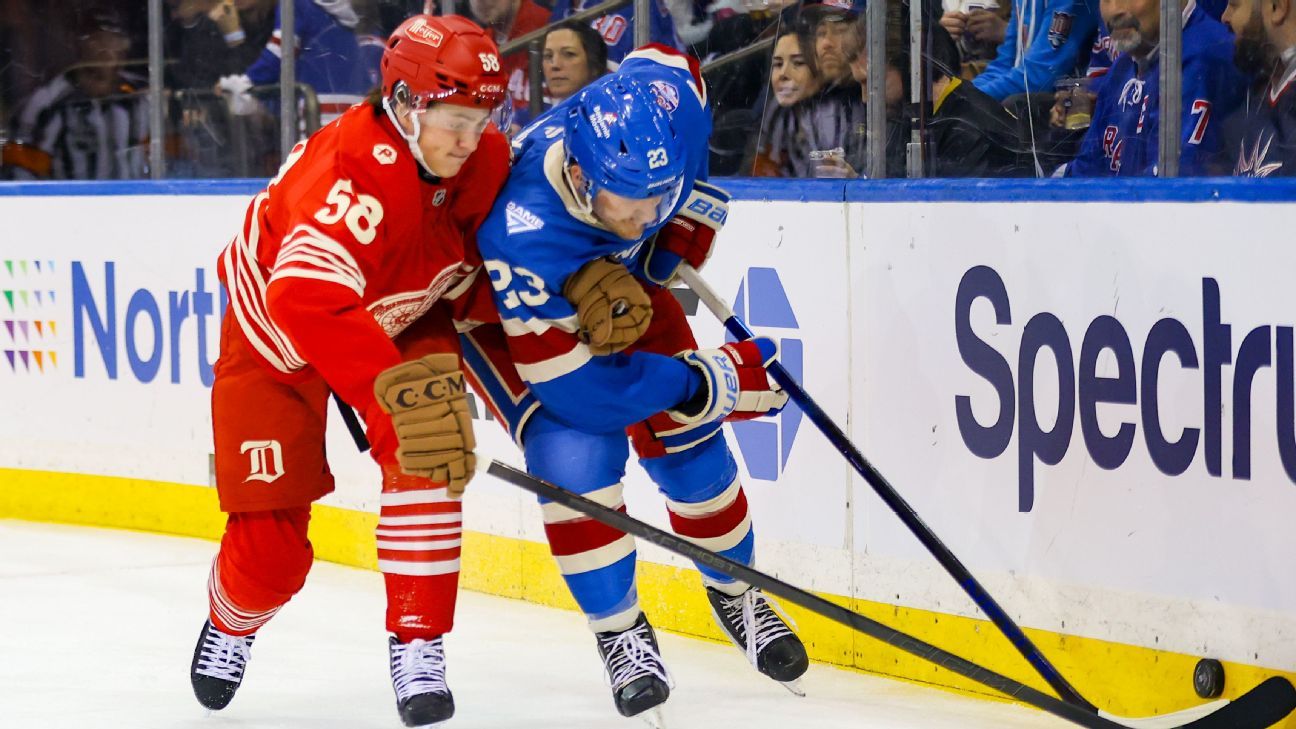
The NHL is about to get more colorful.
The league’s board of governors is eager to have more games in which both home and road teams wear solid-colored jerseys, a trend that has captured the attention of fans and broadcasters this season. The New York Rangers have played in multiple “color vs. color” games — during which both the home and road teams in a given game wear colored jerseys — during their centennial celebration season against the Detroit Red Wings and, most recently, the Chicago Blackhawks. The Colorado Avalanche plan on wearing their light blue Quebec Nordiques throwback jerseys when they visit the red-clad Montreal Canadiens in January.
Brian Jennings, NHL chief branding officer and senior executive vice president, made a presentation at this week’s board meeting in Colorado Springs which highlighted several games that eschewed the tradition of road teams wearing white jerseys. He told ESPN that he was “pleasantly surprised” by the reception from the NHL’s owners and executives, who enthusiastically endorsed the idea of more all-color games at the meeting.
“I had about 18 team presidents and some owners come to me afterward to say, ‘Hey, I’d love to follow up with you to find out if you have some ideas for our club,'” Jennings said. “When it [works], it’s just a far superior television and in-arena product, in my opinion.”
Last century, the NHL had one team wear white jerseys and another team wear solid-colored jerseys because games were shown on black-and-white televisions. In the 1970s, road teams switched from white jerseys to color jerseys for a practical purpose, according to Jennings.
“There weren’t the modern arenas with the washing machines and stuff. White jerseys would show a lot of stains and puck marks. Dark jerseys became the road jerseys,” he said.
In the 2003-04 season, the NHL switched up its fashion so road teams could wear white sweaters again while home teams wore colored ones — in part, so home teams could wear their third jerseys in front of their fans who, in theory, would buy more of them.
The NHL’s outdoor games likely started this recent interest in “color vs. color” games, like the 2014 Winter Classic at Michigan Stadium between the Red Wings and the Toronto Maple Leafs. Jennings said there were preseason “color vs. color games” and at least one during regular season last season. But the 4 Nations Face-Off in February caught fans’ attention for its “color vs. color” USA vs. Canada games, as teams had only one jersey made for the event.
Adding color to road team jerseys has been a gradual shift in the NHL. Jennings said the first significant uniform change for visiting teams recently was their helmets.
“We started with some of the color contrast with helmets, with the white uniform base, when that started to gain some speed with the general managers,” he said. “When you look at the white ice surface, with white socks, a white helmet and a white jersey, it just kind of bleeds and you lose the contrast on it. It’s just not a compelling look.”
The Anaheim Ducks, Carolina Hurricanes and San Jose Sharks were among the first teams to start wearing colored helmets with their white road jerseys.
But the real boost for Jennings’ case came when the Rangers played the Red Wings on Nov. 16 in a blue vs. red battle, which caught the attention of the popular Art But Make It Sports social media account.
“These are two Original Six teams celebrating with a centennial uniform that has a simplicity in its design but looked so vibrant,” said Jennings. “All the callouts from the announcers to the producers to ultimately the reaction from the fans was really, really strong.”
The NHL plans on having an increased number of “color vs. color” games next season, with a focus on rivalry nights and nationally televised matchups. But white road jerseys aren’t going away. Jennings said after reviewing this year’s schedule that 57% of games were good for “color vs. color” and 43% of games were a “no-go.”
What would make a game a no-go? There are three basic obstacles teams face before making the call on a “color vs. color” game:
The first is color contrast. The Rangers’ blue and the Red Wings’ red are an ideal contrast, but “color vs. color” might not work if the Rangers played the Maple Leafs, for example.
“It needs to be a significant enough color contrast to the visual eye,” Jennings said. He also said that the NHL is very “sensitive to color blindness” among fans, which also demands a distinct contrast in color schemes.
Travel baggage is also a factor. Jennings said the NHL is also sensitive to its teams having to lug around two different “whole uniform systems” on lengthy road trips just to play a “color vs. color” game on one of their stops.
Finally, sponsorships must be considered. In 2022, the NHL began its jersey “patch program,” which put sponsor logos on team sweaters for the first time. Though some teams have different sponsors for home and away uniforms, Jennings said teams have to make sure they’re not “running afoul of their commitments” to those sponsors.
One issue that Jennings and his team have worked around is the NHL rulebook. Rule 9.1, which covers team uniforms, states that: “Each member Club shall design and wear distinctive and contrasting uniforms for their home and road games.” Jennings said that as long as NHL hockey operations and the teams’ general managers sign off on the “color vs. color” matchup, they’re good to go.
“We’re hopeful that as more of these get done, that more clubs get comfortable with it and there’s not such a formal kind of sign-off aspect of it,” he said.
But hockey’s formality has been the opposing force to hockey’s progress through the years. Jennings praised the NHL for making “color vs. color” matchups happen, shouting out Stephen Walkom, the NHL’s senior VP and director of officiating, as “a great linemate” in pushing this initiative forward.
“Things in hockey sometimes can happen at a little bit of a slower pace. You have a lot of people that can sometimes be against change. But we think that this is a positive change,” Jennings said. “The game on the ice is sacrosanct. All of these other things are elements to add to the entertainment value, including an enhanced viewing experience. Those moments when you see them are the best proof that I have.”
