This story was excerpted from Martín Gallegos’ Athletics Beat newsletter. To read the full newsletter, click here. And subscribe to get it regularly in your inbox.
MESA, Ariz. — There was a point not long after his Major League debut last season when Nick Kurtz essentially morphed into Superman for the Athletics, flashing superhuman strength against all foes en route to a historic first year that earned him American League Rookie of the Year honors.
But even Superman has his kryptonite.
There wasn’t much that Kurtz didn’t excel at in 2025. A quick glance at his Baseball Savant page will show a sea of red throughout his batting profile, signaling that Kurtz performed as one of the game’s elite hitters across most categories.
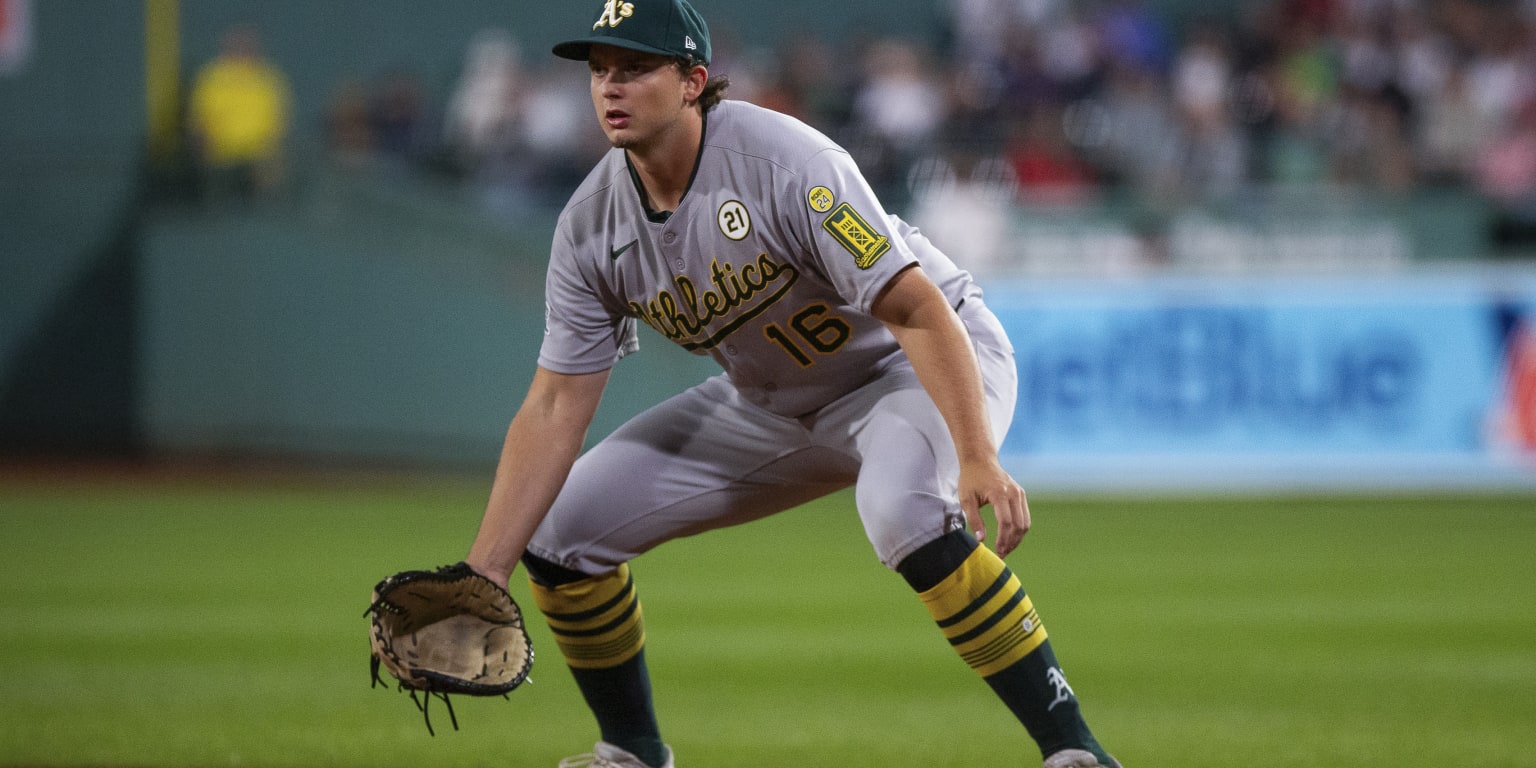
One category below that, however, will show you his one weakness: Defense. Among all qualified first basemen, Kurtz’s -6 OAA (Outs Above Average) and -4 runs prevented both ranked near the very bottom of the Majors.
Now, when you smash 36 home runs with 86 RBIs in 117 games and join Aaron Judge and Shohei Ohtani as one of only three players with at least 400 plate appearances to have posted an OPS over 1.000 like Kurtz did last year, it might be easy to brush off defense and maintain most of the focus on that dynamite bat.
But for the A’s to make the leap into playoff contention they envision for themselves this season, they must improve defensively as a unit, Kurtz included. As a whole, the A’s posted -34 defensive runs saved in ‘25, the fifth-worst mark in MLB.
Doing his part as he split time this offseason training at Wake Forest — his alma mater — and Duke University, Kurtz dedicated a good chunk of his time to defense.
“I called him in December just to say hi,” A’s third-base and infield coach Bobby Crosby said. “He goes, ‘You won’t believe what I just got done doing.’ I’m like, ‘What?’ He goes, ‘Practicing popups.’ This is in December.”
While Kurtz’s ‘25 campaign was filled with incredible feats, there were a couple of somewhat embarrassing lowlights on defense, mainly when trying to track down popups. Especially when playing at Sutter Health Park, where the wind becomes a major factor at times, Kurtz had a difficult time whenever he ventured out into shallow right field or foul territory.
“If there was one thing that isn’t his strong suit, that was it,” Crosby said. “He kind of stabs at them. He needs to let it come to him. He has swag when he hits. He needs to have swag on popups.”
In search of that “swag” this winter, Kurtz set up a popup machine on the practice field to launch balls as high as they could go, creating as much difficulty as possible.
“That way, hopefully, the normal ones don’t seem as hard,” Kurtz said. “You’re not going to ever see the same popup. … It’s just dealing with the sun, the wind, getting used to high skies. The wind in Sacramento is a little different than anywhere else, so I’m just practicing for all that stuff.”
In Crosby’s mind, there is no doubt that Kurtz can emerge as a top defender. Why? Because he carries the same work ethic onto the practice field for drills as he does into the batting cage.
“He wants to work and get better,” Crosby said. “He wants to keep growing as an infielder, which is kind of weird with a guy that good with the bat to care that much about defense. But he does. … I think he’s going to be an elite defender. He has everything that you need. He has the instincts. He has the hand. He has the glove.”
As for the offense, what more could Kurtz improve on? For him, one clear goal is to hit lefties better. Last year, he hit .197 with a .685 OPS vs. left-handers as opposed to hitting .336 with a 1.153 OPS vs. right-handers.
Kurtz focused on honing his approach against lefties this winter. Sure enough, on the first day of live BPs at A’s camp on Tuesday, Kurtz reached a 3-1 count against left-hander Jeffrey Springs and launched a fastball well beyond the wall in left-center at an estimated exit velocity of 120 mph, according to equipment set up at the A’s practice field.
“Honestly, I just want to try to be the same guy I was last year,” Kurtz said. “Consistency is a big part of it. Knowing what it looks like when I’m feeling good at the plate. Then, training myself every day in the offseason to hit a ball a certain way in BP so it becomes more normal.
“You’re going to go through a slump. You’re going to go through times where you don’t know what you’re doing with your swing. It’s figuring out what it feels like when the swing is going good and how I can replicate that when things do start slumping.”
