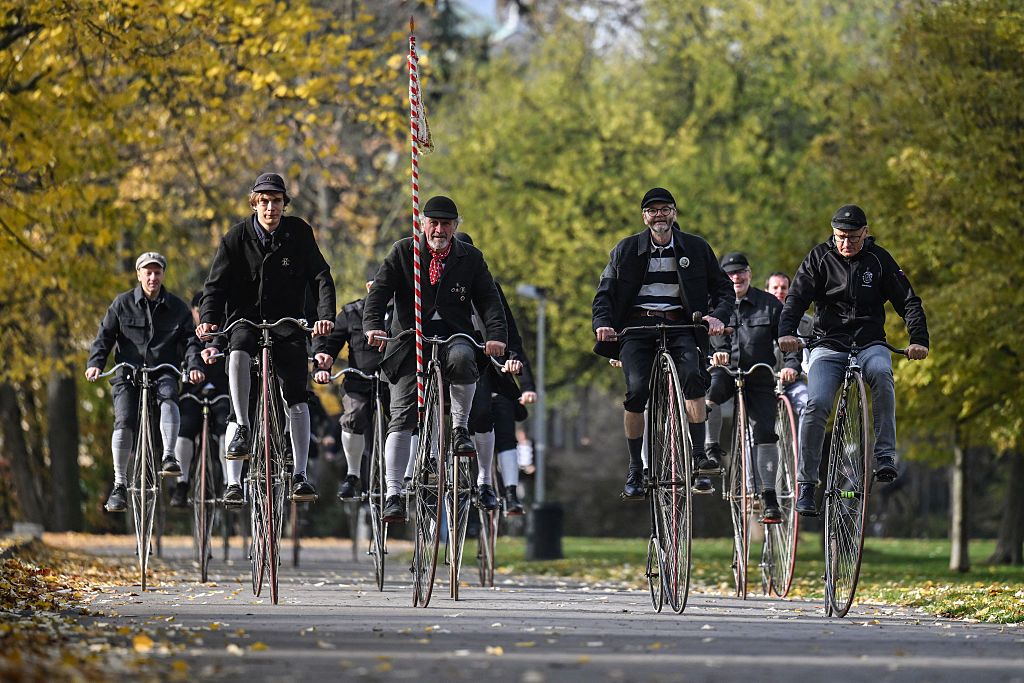
Stop right there. Before anyone orders carbon rims the size of penny-farthings, road wheels are not getting bigger. Not to 32 inches. Not now, not ever.
Yes, tyre brands are messing around with prototypes. Yes, a few prototype bikes have appeared and leaked on Instagram; yes, the message boards are alive with rumours; and no doubt, someone, somewhere, has murmured “performance potential”. But the road cycling world has already looked at the idea, squinted, rolled its collective eyes, and moved on to something more useful instead.
The physics just don’t work for the road or gravel. I’d argue the idea is questionable at best in MTB.
What 32-inch really means
A 32-inch wheel is roughly ten percent larger in diameter than a 700c wheel. That’s not a tweak. Fork length, headtube length and stack, trail, reach, and clearance all change. Mountain bikes with long, high, raked out front ends and suspension can absorb this; road bikes cannot – more importantly, they just don’t need to.
Road and gravel bikes do not have a rollover problem. Roads are smooth. Wider tyres and lower pressure already handle the kind of bumps, drains, potholes, and speed humps we encounter perfectly well. The touted “rollover advantage” is completely meaningless on tarmac.
Furthermore, our road bikes are already fully loaded at the front; you only need to look at the numbers and what they’re coping with. The headtubes are already a packaging marvel.
Internal cable routing, oversized and now internally integrated bearings, integrated stems, disc brake hoses, aero profiling (making them ever wider and narrower at the same time), and wider tyres, all compete for space at the front end, with the invisible hand of stack height bearing down on the space available. There simply isn’t much vertical real estate to package a larger wheel without compromising geometry, fit, handling and even aero.
Need proof? Let’s see some numbers. On a flagship road bike like the Specialized S-Works Tarmac SL8, the progression from small to reasonably sized frames in 44cm to 52cm, and then to 56cm, shows how little head tube/stack there already is.
The smallest 44cm frame has just 99mm to play with. Ok, that’s very small, and you’re into more restrictive limits when you need enough area to attach a top tube and downtube to the front triangle. But a 52cm frame has a 126mm head tube for a stack height of 527mm. Even a 56cm frame (medium to large and bang average in the European market) isn’t roomy and offers only 163mm of head tube for a stack height of 565mm.
This demonstrates how small the front end is on an aggressive race bike. Whilst 44cm might be an outlier, 52cm isn’t small in the run of things, and a large number of pro riders will be on frames that size, not to mention half of Asia, where a 56cm frame is unusual.
Pro-rider, Remco Evenepoel, is 171cm tall and races on a 52cm S-Works Tarmac SL8 – arguably sized down for a rider of his size. In this situation, his position uses every millimetre of available head tube, reach, and bar drop, leaving no room for a larger fork and front wheel package. Is Remco or a pro like him really going to size up, push his position into the wind, and compromise his fit for an extra-large wheel? No, of course not.
The front-end geometry problem
Even if we suspend disbelief for a moment, the geometry headaches arrive immediately. A 32-inch wheel requires a longer fork for clearance, which lifts the front of the bike and pushes the steering away from the rider. Designers are then faced with some unappealing choices: either increase the reach, or trail, or keep the reach the same but increase toe-overlap.
Some toe overlap is necessary in a fast road race bike at certain frame sizes, allowing wheelbases and steering geometry that are desirable in that context. Few pro riders stop at lights or perform U-turns, so the presence of some toe-overlap in and of itself isn’t a big problem. A 32-inch wheel brings toe-overlap to levels that just aren’t manageable, and on smaller frame sizes, the steering would need to be pushed forward anyway, simply to avoid conflict with the down tube.
Larger wheels also add rotational mass and stronger gyroscopic forces. Fine on technical terrain, but on smooth tarmac, acceleration and responsiveness suffer. Handling dulled, cornering made harder. The frontal area is also increased, impacting aerodynamics, and whilst the depth of the rims might help, you’re compensating rather than gaining an advantage.
Gravel is not the Trojan horse through which 32 will arrive
Gravel bikes might seem like the perfect testing ground for a new MTB standard: relaxed geometry, high-volume tyres, and loads of clearance. But they, too, do not have a rollover problem. Toe overlap exists. Front centres are short, as are headtubes. Drop bars limit steering adaptations. All these problems get harder again on smaller frames.
A gravel bike functions because of the existing standards, not in spite of them.
The 32-inch wheel might sound like a fun errand in the pursuit of another marginal gain. But it’s not a marginal change to your bike. If bigger wheels need wider axles, we need new hubs, and then new groupsets.
You can see why making it work might be compelling in a mountain bike market where suspension systems and geometry might have reached a consensus. Why would customers rush out to buy the new version if it’s only been tweaked, or if it has ever more electric gizmos no one asked for? If a benefit can be established for a standard that affects the whole system and its components, it opens the floodgates to a generation of new mountain bikes. In road cycling, that’s just not going to happen. Not because of the arrival of 32-inch wheels at least.
Road and gravel cycling categorically do not need bigger wheels. The increase in diameter compromises fit, handling, weight and established standards, for absolutely no benefit.
Mountain bikes may find a niche, and custom bikes can accommodate outsize riders who I fully accept can benefit from smaller and larger wheel options. But for the mainstream, on road and gravel? No.
If it ain’t broke, don’t fix it.
When bigger or smaller wheels actually do work
(Image credit: Alex Whitehead/SWPix)
32” wheels
32 inch wheels are already available, and in a custom geometry context where the frame is built around the wheel choice, a custom frame design and build can bring big benefits for very tall riders.
The downsides still apply: weaker wheels, heavier rotational mass, higher cost and limited tyre choice, but for people who are shoe horned on to the largest size bike in the range because that’s the only one that nearly fits, going larger can allow for more suitable wheelbases, and front centres, which distribute very large rider’s weight in a more optimal way and can transform a taller rider’s cycling experience.
650c / 650b wheels
Smaller riders or those needing a wheel size optimised for very much smaller frames can benefit massively from sizing down on the wheelsize. The issues they face are similar to those an average rider might face if sizing up to 32” wheels was forced on them.
Emma Pooley ran 650c wheels in the 2016 Rio Olympics Time Trial event. Pooley’s Cervelo P3 time trial bike that had been specially ordered from Cervelo, equipped with 650c wheels (a Zipp disc wheel on the back and an unbranded 60mm deep section wheel on the front).
Smaller wheels suffer from a misunderstanding about who they’re for, and in club cycling, moving up to 700c as you grow out of smaller sizes is a rite of passage. That’s dampened people’s enthusiasm for going back to them when they perhaps find they never really grew into the larger sizes.
One size certainly doesn’t fit all. And via the custom route there are other options, but for 95% of riders, the benefits of the widely available 700c standard is a boon, not a hindrance.
