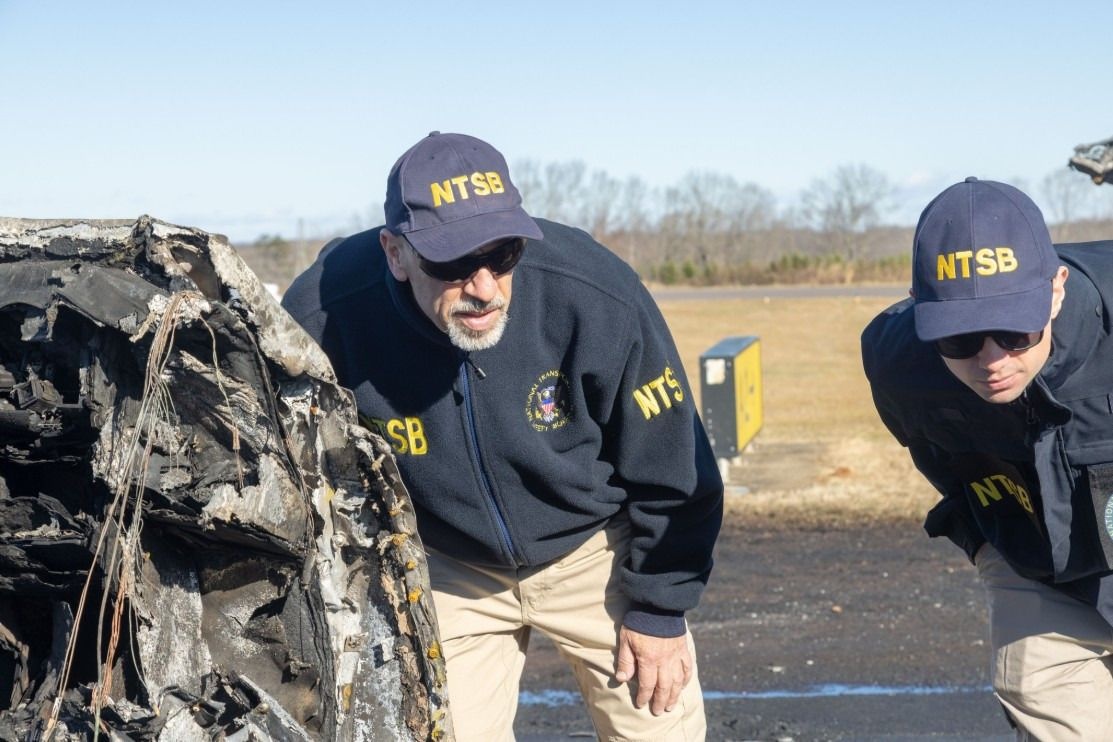
The National Transportation Safety Board released its preliminary findings after a 43-day investigation into the aviation incident that killed NASCAR veteran Greg Biffle, his immediate family, two pilots and one other associated individual at Statesville Regional Airport in North Carolina.
A full report will still take 12 to 18 additional months to complete. NTSB preliminary reports do not place blame but merely establishes a series of facts for the next phase of the investigation to begin working off of in the following months.
Advertisement
The report states that pilot Dennis Dutton was in the left seat, which is the primary pilot position, for the Cessna Citation 550 and his adult son, Jack, was in the right seat. However, the report also states that, while a pilot, Jack did not have the appropriate license to serve as a second-in-command on this type of plane.
While the Cessna Citation 550 can be piloted with a single pilot, that requires a license that the elder Dutton also did not have. The below italicized text is from the NTSB preliminary report.
“The pilot had type ratings for the A-320, A-330, A-350, B-737, B-757, B-767, CE-500, and DC-10. As part of the pilot’s CE-500 type rating, he had the limitation ‘CE-500 Second in Command Required.’ The pilot reported civil flight experience that included 17,000 total and 400 hours in the last six months as of his last first-class medical application dated April 29, 2025.
Advertisement
“Review of the right-seat passenger’s logbook indicated that he had 175.3 total flight hours in single engine land airplanes as of November 29, 2025. The right seat passenger’s most recent first-class medical certificate was issued on August 12, 2024. The right seat passenger was not qualified to perform second in command duties per Title 14 CFR part 61.55.”
As for Greg Biffle himself:
“A rear seat passenger with a private pilot certificate and ratings for multi-engine land, instrument airplane, and rotorcraft-helicopter was positioned near the cockpit in the cabin area.”
Advertisement
The report states that there was an issue initially starting the plane and another issue while on taxi to the runway.
“Engine start was initiated using onboard battery power and, following an initial unsuccessful start of the left (no. 1) engine, both engines were started about 0953. The airplane taxied from the south parking area at 0959, crossed runway 10/28 at midfield, and taxied to the approach end of runway 10. During taxi, the pilot and the two pilot-rated passengers discussed that a thrust reverser indicator light(s) for an unspecified engine was inoperative, but that the thrust reverser for the affected engine was working properly.”
Advertisement
Upon take-off to Sarasota, Florida, where the occupants were en route to visit Garrett ‘Cleetus McFarland’ Mitchell for a Christmas party, ‘the rear passenger commented that the left engine was producing more power than the right and indicated there may have been a faulty gauge’ but the pilot continued with take-off.
“The right-seat passenger attempted to contact ZTL ATC and activate the flight’s IFR flight plan three times between 1008 and 1010 but was unsuccessful due to the controller’s workload and associated radio communications.”
There was also another conversation about the engines.
Advertisement
“The pilot initiated a climb, and shortly after, the rear passenger noted a difference between the left and right engine interstage turbine temperature (ITT) indications.”
The report states that there were no further discussions about the difference in engine power between the two for the rest of the flight over the Cockpit Voice Recorder from that moment to the crash itself, which took place at 10:15.23 a.m.
Take-off took place at 10:06 a.m.
“Starting at 1010:18, the cockpit area microphone captured the pilot making remarks indicating his altitude indicator was not working properly and that additional left side flight instruments may not have been working properly. The Garmin GTN-750 stopped recording airspeed data at 1009:37 and heading data at 1010:58.
Advertisement
“About 1011, airplane control was transferred to the right seat passenger, at an altitude of about 4,500 ft msl. No comments were recorded during the remainder of the CVR recording toindicate there were any malfunctions with the right side cockpit flight instruments.”
The report says the left seat pilot has resumed control of the plane by 10:13 a.m. He requested that flaps be extended at 10:13.03 and the landing gear be deployed at 10:13.22.
“Subsequent discussions were consistent with the landing gear being configured; however, the gear indicator lights were not illuminated.”
Advertisement
The right seat passenger, Jack Dutton, was recorded as speaking over the common traffic advisory frequency that ‘we are having some issues here,’ at 10:13.48 a.m.
“At 1014:05 the rear passenger made a query to the pilot regarding power to the ‘alternator’ (NOTE: the CE-550 airplane is not equipped with an alternator). About 4 seconds later audio quality returned to previous levels on all recorded CVR audio channels. After the audio quality returned, the pilot made a comment indicating that was the ‘problem,’ however, did not specify what the ‘problem’ was or what actions were taken to correct it. There were no additional discussions regarding the pilot’s flight instrumentation for the remainder of the CVR recording.”
CVR and GPS data ended at 10:15.23 a.m., the presumed moment of impact. As for that impact:
Advertisement
“Examination of the accident site revealed that the first identified point of impact (FIPI) was the first (easternmost) light station of the runway 28 Medium Intensity Approach Light System with Runway Alignment Indicator Lights (MALSR), located about 1,380 ft from the runway threshold. Two lightbulbs, the left and fourth from the left position (when viewed looking towards the runway), approximately 6 ft apart, were separated from the otherwise intact 29 ft tall light station (below) and located on the ground near the station. The upper portion of the second MALSR light station located about 180 ft from the FIPI was separated, of which about 15 ft of the frangible pole was still standing. A group of damaged trees located about 235 ft from the FIPI, were sheared about 12 ft above ground level (agl). The first indication of fire was blackened branches and grass near the west side of the trees.
“A ground impression was observed about 350 ft from the FIPI, near the airport perimeter fence, and extended through the MALSR decision light station. The debris path continued along a westerly heading through the runway overrun to where the main wreckage came to rest on the runway blast area about 400 ft short of the runway 28 threshold, oriented on an easterly heading. Heavy charring of the ground began near the decision light station and continued along the remaining length of the debris field to the wreckage.”

In total, the incident killed Biffle, wife Cristina Grossu Biffle, daughter Emma (from first wife Nicole Lunders) and son Ryder. Also on board was long-time NASCAR everyman Craig Wadsworth, who long worked with Biffle, and the Duttons.
Advertisement
The report stated the plane did not come apart in any way prior to impact.
“A post impact fire consumed a majority of the fuselage and heat damaged both wings, empennage, and both engines (figure 3). All flight control surfaces were identified in the debris path and main wreckage. No evidence of pre-impact separation of any airplane component or structure was observed.”

The complete report can be consumed in its entirety below.
Biffle fatal plane crash NTSB report by mattweavermedia
To read more Motorsport.com articles visit our website.
