The NWSL Players Association has filed a grievance against the league arguing that the NWSL’s creation of the new “High Impact Player” mechanism violates terms of the collective bargaining agreement and federal labor law.
The grievance, which was submitted this week, is the second filed by the NWSLPA against the league in the past six weeks. The union’s other grievance against the league is still open and pending a resolution.
The NWSLPA said in a news release Wednesday that it is “seeking immediate rescission of the HIP Rule, an order requiring the League to bargain in good faith over any proposed player compensation rules prior to implementation, and to make-whole relief for any Players impacted by the League’s unilateral actions.”
“This was a unilateral decision by the League to change how a Player’s fair market value is evaluated,” NWSLPA executive director Meghann Burke said in a statement. “We agree that increasing investment in Player compensation is necessary to remain competitive in the global labor market. The solution is straightforward and collectively bargained by raising the salary cap.
“What the League cannot do is invent a parallel pay system outside the salary cap that was never negotiated, then limit access to compensation through League-controlled criteria that excludes some Players.”
Later on Wednesday, an NWSL spokesperson told ESPN the new mechanism to pay the league’s top stars was a necessity to keep high-profile players from leaving for other leagues around the world.
“It is critical to the growth and health of the NWSL that its teams have the ability to compete on the international stage for talent with the biggest soccer clubs in the world,” the NWSL spokesperson said. “The HIP Rule is a targeted mechanism that unlocks compensation for all players across the roster while giving NWSL teams the ability to sign athletes who exhibit the world-leading skill and ability to raise the competitive and commercial profile of the league.
“We disagree with the NWSLPA’s assertions challenging the NWSL’s ability to implement the HIP Rule. The NWSL has fully complied with the CBA and federal law and we will defend those positions in our collectively-bargained grievance process.”
Last month, the NWSL announced the new High Impact Player (HIP) rule that would allow teams to spend up to $1 million over the salary cap on certain players provided they meet one of a list of criteria created by the league’s board.
Five days before that announcement, NWSLPA executive director Meghann Burke told ESPN that the union opposed the creation of the rule, viewing it as the league trying to “control and interfere” with which players get paid more.
Burke and the union argue that any such rule should be collectively bargained. The union offered a counterproposal to the league to increase the cap by $1 million without any other qualifications, which would allow teams to spend how they choose on all players.
“We genuinely believe that how you measure a player’s value, both in terms of sporting merit and business criteria, is nuanced,” Burke told ESPN in December.
“It is more complicated than a handful of bullet points. It is within the purview of the teams to make those judgement calls, and in a system of free agency like we all agreed to, that’s how it works. It’s a free market.”
The CBA says that “NWSL may in its discretion, after consultation with the NWSLPA, reduce or eliminate the salary cap charge for certain roster classifications.”
What “consultation” should entail is not further defined, but Burke said that the players’ association does not view the HIP rule as a roster classification.
The NWSL does view it as that, and believes it has the right to push the rule forward despite the union’s opposition.
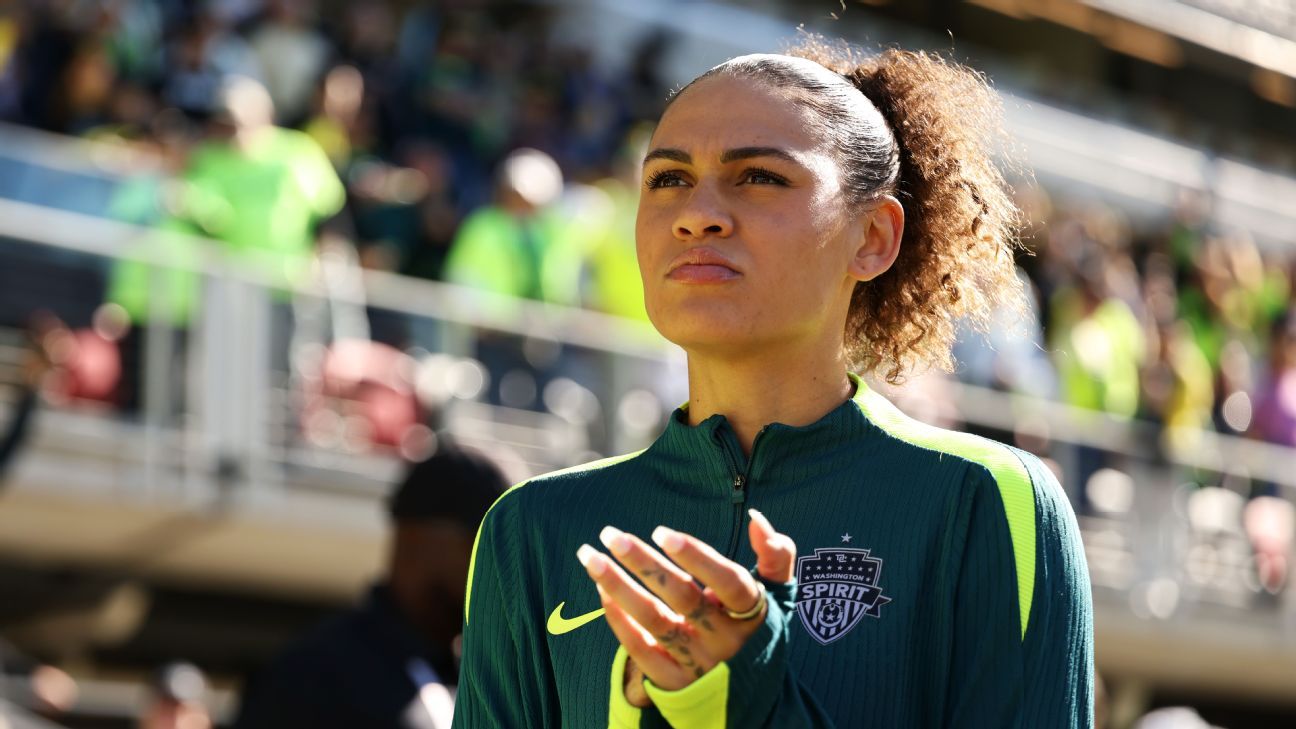
Sources previously told ESPN that the HIP rule had been discussed throughout 2025, but the implementation of it became urgent recently as the future of star United States women’s national team forward Trinity Rodman hung in the balance.
Rodman is seeking fair market value that she and crucially, the Washington Spirit, her team of the past four years, believe to be at or above $1 million annually.
Under the NWSL’s hard salary cap, which was $3.5 million in 2025, the Spirit could not compete with other prospective offers for Rodman. Rodman and the Spirit reached a creative solution in late November to backload a four-year contract and take the risk that the salary cap would increase drastically more than currently planned based on revenue share from a new media deal.
NWSL commissioner Jessica Berman rejected that agreed-upon contract because it violated the “spirit” of the rules, and the league accused Rodman of preemptive salary cap circumvention.
The NWSLPA quickly filed a grievance against the NWSL on behalf of Rodman, calling the league’s rejection of the deal a “flagrant violation” of the player’s free agency and a violation of at least five sections of the CBA.
Rodman’s old contract expired on Dec. 31; she is currently a free agent.
NWSL teams can begin reporting for preseason on Thursday.
Rodman will join the USWNT in training camp next week for the first time since April.
Per terms of the CBA, the NWSL was required to issue a written response sustaining or denying the union’s grievance.
Sources confirmed to ESPN that the league recently registered that response after an agreed-upon extension for the holidays, but it is unclear what that response says.
With a formal grievance filed against the HIP rule, the league will be required to do the same again.
The next steps in each process would be a review of the matter by a grievance committee consisting of one representative appointed by the league and one by the players’ association.
If it can’t be resolved there, the dispute would go to arbitration.
