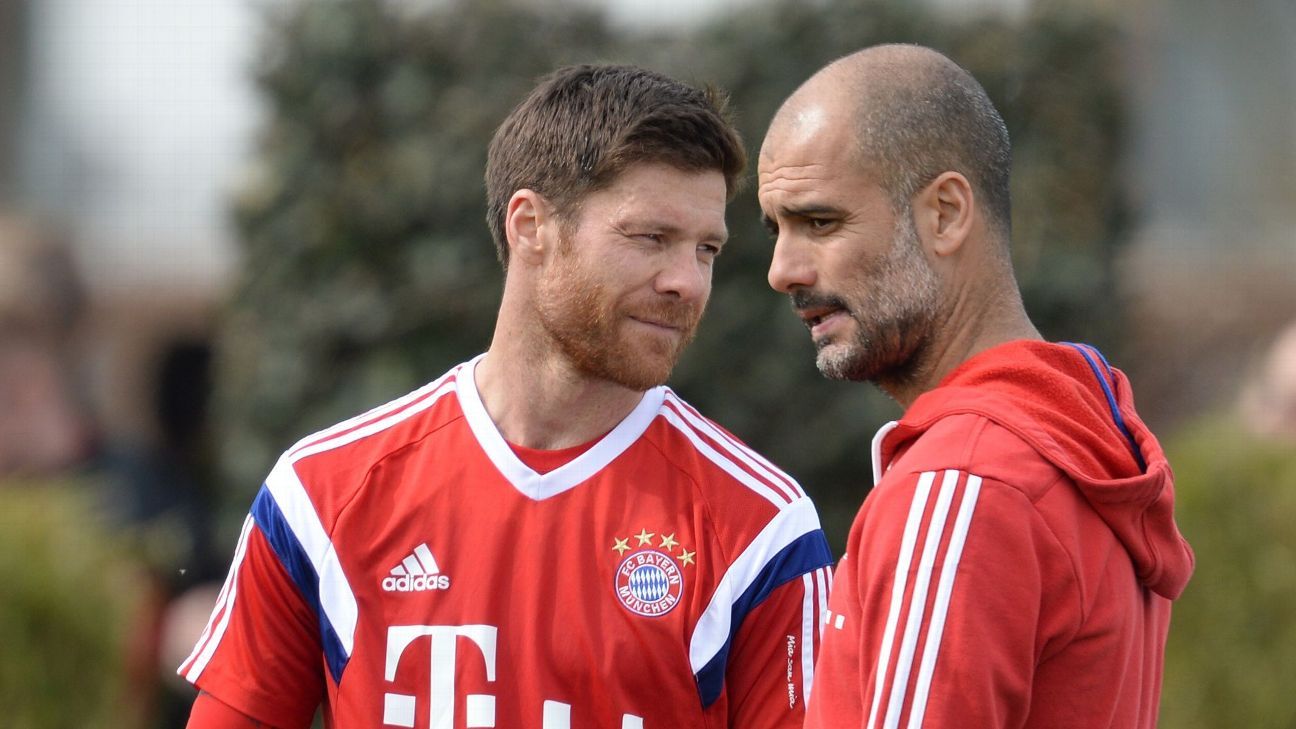
Soon after Pep Guardiola tempted Xabi Alonso away from Real Madrid to instal him as Bayern Munich‘s midfield general in August 2014, the Catalan coach admitted that “if I can help a player of mine become a coach, by adding something to his development, I’ll be happy. Johan Cruyff and others did that for me, and now it’s my obligation to pay it forward.”
So it was Alonso who studied, learned and duly ripped up the history books at Bayer Leverkusen, then landing where he is now: the obvious choice to take over from Carlo Ancelotti at the Bernabeu, but also a man whose job security is diminishing by the weekend.
Madrid’s under-pressure manager recently told the Coaches’ Voice that when working for Guardiola at Bayern, “I was 32, I already had a lot of career under my belt, but in two or three years, I learned so, so much.”
Making the first-ever reunion between master and pupil, billed as Pep vs. Xabi, bittersweet in that it comes this week, when the perpetual winners of the UEFA Champions League are shuddering at the menace that Manchester City bring just as everyone at Madrid — Alonso especially — is up to their necks in problems.
If there’s a worse imaginable preparation for facing City in a big Champions League match than winning once in five domestic matches, shipping three daft goals to lowly Olympiacos last time out in this competition, slumping apathetically to defeat against Celta Vigo on Sunday, showing total physical and mental indiscipline in the three red cards Madrid incurred during that defeat, losing Éder Militão to yet another long spell on the sidelines with a muscle injury and watching Barcelona turn a five-point deficit into a four-point lead atop the LaLiga table in the space of five matches, then I’d love to know what it is.
There will be time enough, and sufficient surrounding noise, to work out the odds of Alonso lasting much longer if another damaging result comes along on Wednesday.
I don’t see the need to add much to the incessant, unpleasant speculation about Alonso’s job security and the very lukewarm brand of football his team is producing. Except that, for the record, if I were club president Florentino Pérez, I’d stick by Alonso, reinforce his position, support his squad remodeling and assess things after two seasons
But, as Alonso said the last time he was asked on the subject, “I know where I am.”
Meaning, he is at a club with a president who has little patience for the idea of … patience; who treats anything other than domination of Spain and Europe as something of a personal humiliation; and who not only believes, but usually proves his point, that changing coach after a few months can be a solution — not a symptom of the problem. During Pérez’s reign alone, he’s had 10 coaches who lasted between three months and a year.
None of this is to say that City, even under a genius like Guardiola — a guy who admires, likes and mentored Alonso — will automatically come and put the 43-year-old Basque on the precipice of being replaced. Los Blancos usually treat City like unwelcome arrivistes when they come to Spain’s capital — lots of wins, only one home defeat ever and a habit of scoring three times against the Sky Blues. Sometimes in the most dramatic of circumstances.
It’s also a bit ironic that the last time Guardiola’s team played Champions League football, a couple of weeks ago, they lost at home to the club Alonso transformed into trophy winners after decades of failure and frustration: Manchester City 0-2 Bayer Leverkusen was one of the shocks of the European season.
So don’t build up to this fixture thinking, It’s an absolute given — City will win. But there are some harsh facts that point you to that conclusion and, thus, to the idea that Alonso’s current situation might be done fatal damage by the same guy who said in May: “Every single coach who ever had the marvelous pleasure of training Xabi as a player knew without any doubt that he’d become a coach.” That’s high praise from the high priest of player whispering.
However, Madrid, right now, look disconnected, sloppy, overly reliant on Kylian Mbappé (they’ve only won twice in 21 matches when the Frenchman hasn’t scored) and like a team of moments not a team of magic or momentum. They press poorly, they’re debilitated by constant injuries, the Bernabéu pitch is a foe, not a friend, and if Thibaut Courtois has an off day then they’re going to be easy meat.
Even though this version of Guardiola’s City is far from his most complete, most devastating or consistent, the truth is that Pep is brilliant at analyzing an opponent’s weakness, producing exactly the right strategy to damage them and then drilling it in to the heads of his players that This is how we can win.
Alonso, looking back at his time learning under Guardiola, told me when I interviewed him this earlier this season, “In terms of understanding the game — understanding, explaining and anticipating it — Pep was ahead of his time, and, in my opinion, he still is.”
One key phrase comes back to inform those of us who want to understand the dilemma that faces Alonso right now. As much as City are tough, hard-running, well-coached opponents, the fact remains that his own squad is under-performing and looks unconvinced as well as unconvincing.
When Alonso was still playing for Guardiola at Bayern, en route to winning five trophies despite coming up short in this very competition, he said: “Pep dominates all aspects of football, but he doesn’t impose his philosophy on his players — he convinces them.” What’s crystal clear is that it has been Alonso, rather than his players, who has had to adapt and reconfigure ideas, even if temporarily, in Madrid.
“Football today is really demanding; it’s like a game of chess with lots of pieces, different boards and different contexts,” he told me. “You have to try to make sure that your players share your vision. Because I could have a fantastic idea, but if the team doesn’t embrace it, it’s going to be very difficult for it to be effective.”
From the outside, frankly, it looks as if there are some players who either can’t come to terms with, or are unable to apply, their coach’s philosophies.
One final comparison with Guardiola is that when the Catalan took over at City in 2016, he was told, explicitly, that the club definitely would not be willing or able to satisfy the squad rebuild he was determined to impose as quickly as possible. City’s executives and owners told him there would be at least a 12-month period when they would be ultra patient with him, the team’s image, the trophy count, and results — but he needed to be patient with them, too.
Both sides stuck to their deal and, lo and behold, City have become a genuine seismic force in English and European football, that patience proven to be a virtue. No such culture exists at Madrid — which, admittedly, partially helps explain their constant overachieving.
Guardiola, one year into his coaching career, was able to show both Ronaldinho and Deco the exit because he was certain that his then club, Barcelona, would benefit and certain that his authority would be reinforced. However, no such conditions apply for Pep’s former apprentice because Madrid, frankly, is unique. It’s the president’s club first and foremost, then the players’. The coach is always jostling with the fans and the media to ensure he’s the third-most important force.
There’s a “B plot” here, of course, in that the world’s two scoring behemoths, Mbappé and Erling Haaland, go head to head for only the fourth time, in what is now also an appetizer for the France-vs.-Norway group-stage fixture in next summer’s FIFA World Cup.
Mbappé craves emulating Haaland by winning this elite tournament for the first time. He will view Wednesday as an opportunity to lay down a marker. Alonso needs his guy, his chess piece, to produce a masterclass, to silence the white noise around the club, to buy him some elusive patience while Madrid find something approaching form, consistency and positive momentum.
