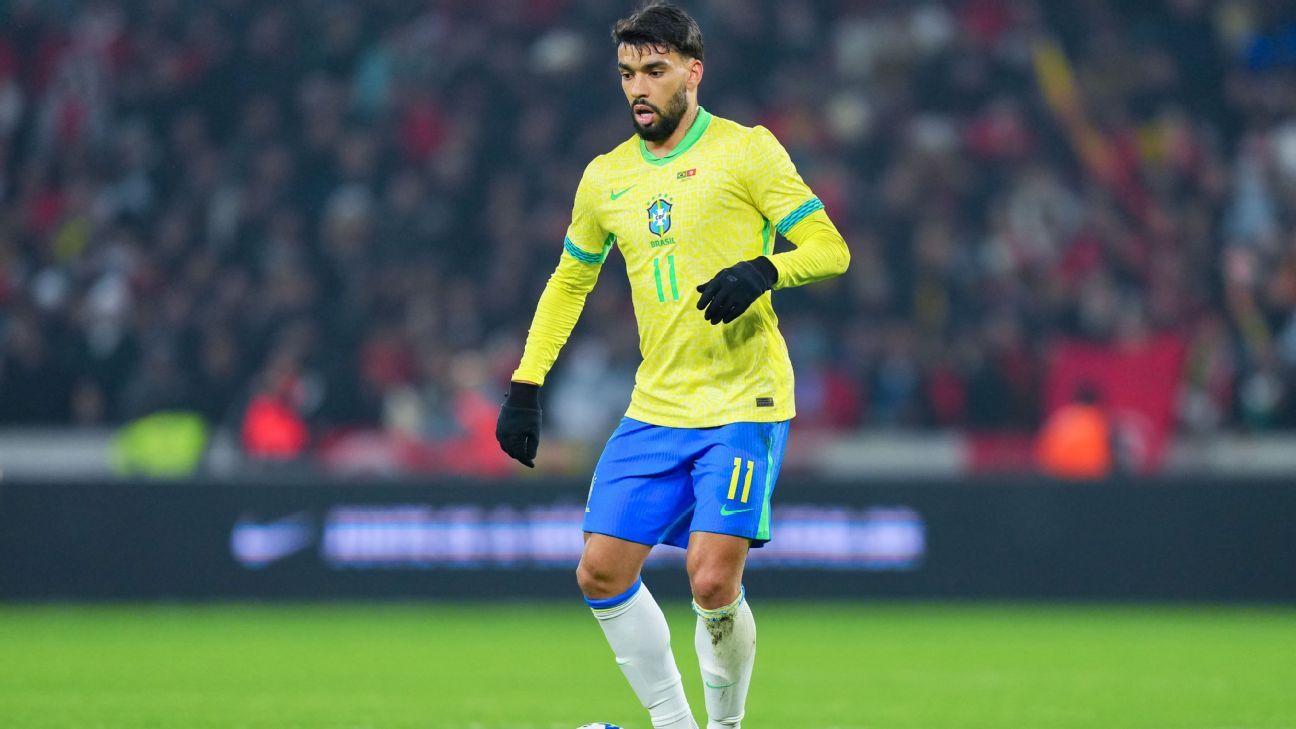
Welcome to a new global order. Rio de Janeiro giants Flamengo are champions of Brazil and South America. But even that is not enough, because they want it all. The new format of last year’s FIFA Club World Cup has provided them with the means and the opportunity to chase even bigger prizes. And this is the motive for a stunning transfer coup.
At a record fee for a Brazilian club of €42 million, they are bringing back 28-year-old midfielder Lucas Paquetá, theoretically at the height of his powers, on a five-year contract from West Ham United.
It was a very different Flamengo that Paquetá left — bound for AC Milan — some seven years ago. He spent 18 months in the first team with responsibility thrust upon him early, as the club were going through a period of financial restructuring, trading the possibility of short-term success for long-term stability and dominance.
– How has Palmeiras’ ‘Billion Generation’ fared out in Europe?
– Why PL clubs keep signing each other’s players for the same fee
– January transfer window: Grading big signings in men’s soccer
The Flamengo squad had nothing like the depth it now contains. There was a model — transfer the bright young hopes, the likes of Paquetá and Vinícius Júnior — to finance the acquisition of players coming home from Europe. These transfer targets fell into two broad types: veterans rounding out their careers, such as current coach Filipe Luís, and some who went to Europe but failed to live up to expectations, such as Gabriel ‘Gabigol’ Barbosa or current center forward Pedro.
Paquetá, though, is a very different case. A current Brazil international, with 59 caps to his name, he is by far the biggest fish that Flamengo and Brazilian soccer in general have been able to land in recent times.
How then, apart from the newly acquired financial muscle, have Flamengo been able to seduce a Premier League player in his prime years?
This deal is happening for one overwhelming reason: Paquetá really wanted it to happen. There are special circumstances here, notably the lengthy investigation when he was charged with spot-fixing — in this case with deliberately picking up yellow cards in a betting scam — although he was eventually cleared.
But the events reportedly had an effect. The legal spotlight contributed to a dip in form, and the allegations came at a moment when he appeared close to joining Manchester City, with Pep Guardiola reportedly identifying him as a potential successor to Kevin De Bruyne. With a World Cup place up for grabs, regular playing time for the biggest club in Brazil is a tantalizing stage for a Seleção hopeful.
In Carlo Ancelotti’s eight matches in charge of Brazil, Paquetá has started two and come off the bench in four. He is very much in contention for a place in the World Cup squad. But what about the team?
The way that Ancelotti is setting up the side would seem to be with a front four, leaving just two men in the center of midfield: Casemiro and Bruno Guimarães. But Casemiro is approaching 34, which leaves a big question here: Can Brazil really play this way in the extreme heat in which the World Cup will be played? The likely alternative is to have a third man in midfield, which would be Paquetá’s position.
But he has competition. For a while, Paquetá was behind Gerson, another left-footed midfielder, in the pecking order. However, after the Club World Cup, Gerson made a strange move, swapping Flamengo for Russian club Zenit St. Petersburg. It did not work out; he fell off the radar and lost his place in the Brazil squad. So, he has hurried back, joining Cruzeiro earlier this year in what was — until the Paquetá deal — the most expensive signing ever made by a Brazilian club.
Gerson, then, will be able to push his claims every week in front of the Brazilian public. It is this which appears to have tipped the balance in Paquetá’s mind. There are bad memories from Brazil’s last game, back in November against Tunisia. They were being held 1-1, and had a chance to win when they were awarded a late penalty. Paquetá stepped up — and sent his shot high over the bar. Coming home, then, gives him the chance to make a better impression on a twice-weekly basis.
So Paquetá was desperate for the move and Flamengo were very keen to sign him. But the key to the move was in London by getting West Ham to agree to the deal. This was tricky, as the club are in the Premier League relegation zone and they have just offloaded players such as Luis Guilherme and Guido Rodríguez.
More than the money, West Ham’s urgent need was for the kind of talent to help them up the table. Given that it would not be in Paquetá’s interests to throw a long-term sulk — nothing would be worse for his World Cup prospects — it looked more likely that the deal would be done in the summer.
But then West Ham won three games in a row without their Brazilian playmaker, so maybe they could save themselves without him, and Flamengo kept upping the offer. There was a dispute over the terms, with Flamengo wanting to stretch the payments out until 2028. West Ham did not agree until Flamengo increased the offer to €42m, and the deal was done.
The hope, then, is that Flamengo can unveil their glamorous new signing at Sunday’s Brazilian Super Cup in Brasilia, when they, as league champions, meet Brazilian Cup winners Corinthians.
That said, where might Paquetá feature in the side? His natural position is as a No. 10, where Flamengo already field the Uruguayan Giorgian de Arrascaeta, who was voted as the best player in South America last year. Paquetá, though, is highly versatile. He can play deeper, as a central midfielder, or wide, where he came up with some of his best displays for Brazil, and he can even operate as a center forward.
One thing is certain, he is going to play somewhere. And he should be a huge addition to a squad already overflowing with talent. The biggest triumph of his club career so far is the 2023 UEFA Conference League win with West Ham. Some 3½ years away, Paquetá and Flamengo are already dreaming of the 2029 Club World Cup.
