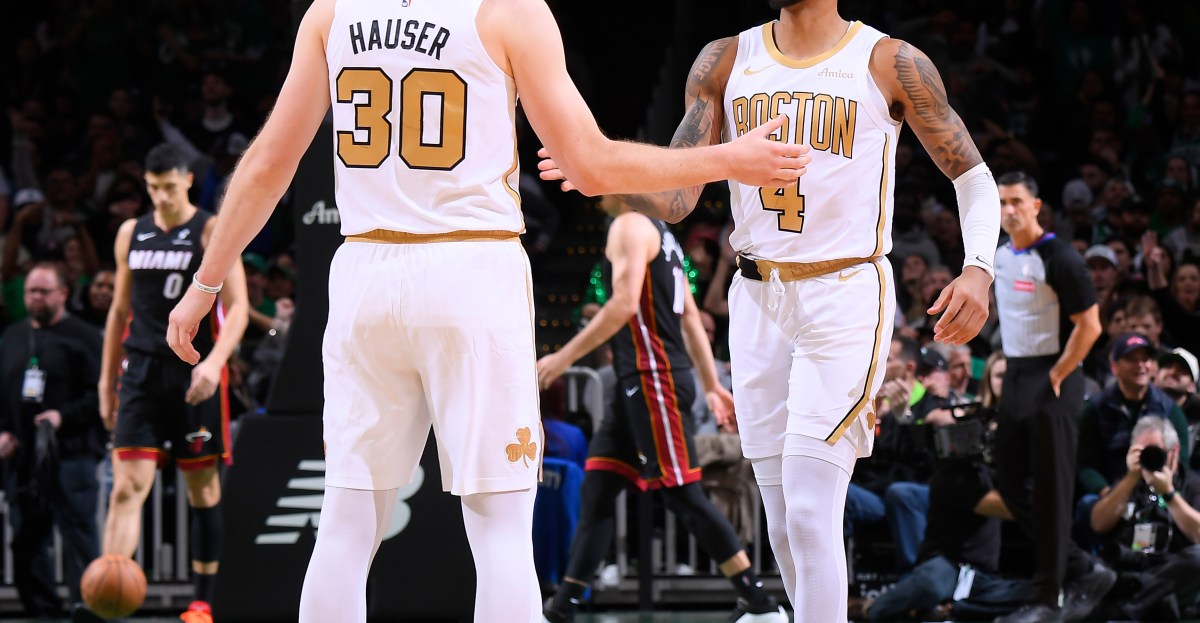
Facing the threat of a third consecutive loss, the Boston Celtics responded with a strong performance, defeating the Miami Heat 129–116 at home.
Derrick White and Jaylen Brown combined for 63 points, as Boston’s emphasis on speed and tempo proved decisive against the third-ranked defense in the league per NET rating.
“We just played so much faster on the offensive end,” said Joe Mazzulla after the game. While Boston’s small-ball lineups struggled at times on the glass against Kel’el Ware and Bam Adebayo, the increased pace created significant matchup problems for Miami.
With Neemias Queta on the court, Boston’s pace was 93.1 and with him off, it skyrocketed to 109.6. The team was still a +5 in Queta’s minutes, even with him playing through some pain taking two hard falls. What he does nightly is still super valuable, and the Celtics’ ability to find success with both traditional lineups and small-ball configurations speak to the roster’s versatility.
“We were able to create a bunch of 2-on-1s with our speed,” Mazzulla added. He later reiterated that, “the offensive pace and the speed that we had that kind of got us good looks against a team that’s one of the best defensive teams in the league.”
One of the ways I thought the Celtics used their speed on offense was with Ghost screens.
On this first play it looks like the Celtics were going to Stagger Spain.
Staggered screens are two of the same off balls screens with a little space in between.
After White comes off the screens to receive the ball, they set up in Spain but when Bam gets switched onto White, Queta just goes to the paint. Anfernee Simons then comes to set the Ghost screen, and that creates separation and another switch. Then, Simons beats one of the best defenders to the rim with his speed.
Celtics go to the same look here starting with the Stagger screens.
It’s important to note that on most of these clips, they elect to get the big guarding the ball before setting the ghost screen. Bam again is one of the most versatile defenders in the game, but any big would have some trouble moving laterally that fast while processing coverage.
Hauser eventually comes to set the Ghost screen and drills a three.
They get White to the wing here to get the play started. Again, Queta sets the ball screen to get the big on the ball. Simons comes over and notice how for a split-second Ware stops moving. That gives White just enough room to drive and step back over a good contest.
On this one the Ghost screen doesn’t do much to Ware, but I believe the purpose of this one was to clear space for Simons. Hauser was on the wing, meaning Norman Powell would’ve been in the gap to help on Simons. After the Hauser screen you can see how much driving room Simons has to work with. Bam becomes the only extra defender on that side and even he is in the corner. Simons uses his speed advantage and finishes.
This time, Hauser runs to the far side of Ware to set the Ghost screen and is still able to get an open look.
This time White is the screener and again the goal is getting the big guarding out in space. As White gets the ball, Ware is still moving towards him, which is the cue for White to drive it. Another slight hesitation gets him into the paint for an easy pull up.
Lastly, this one by Hugo causes complete discombobulation, giving White a lane to drive. This leads to advantage basketball and a corner three by Hauser.
