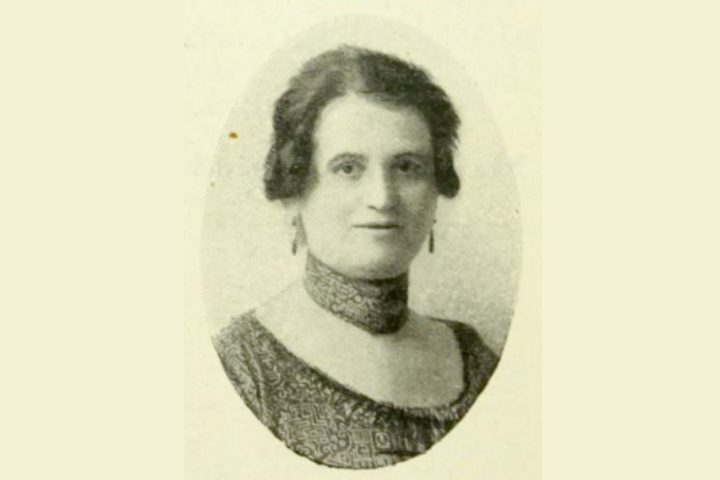
Paula Kalmar – as she was then known – was introduced to chess in 1913 when she was over 30 years of age. She joined Vienna’s Amateur Chess Club (later renamed Schlechter CC), and took lessons from Réti and Heinrich Wolf (who would later become her second husband).
Tartakower, in an October 1920 article about women and chess, said that she had distinguished herself in recent years. He also mentioned an upcoming Women’s Chess Tournament.1
The 1st Vienna Women’s Tournament took place because Paula had set out to encourage other women to participate in such events. She was supported in her efforts by the Schlechter Chess Club, and the result was that Paula won all her games in the five-player, double-round event. 2
Paula’s chess activities continued throughout the next decade and included three women’s world championships. (Some of her results are shown at the end of this article.) Paula Kalmar and Heinrich Wolf married 23 April 1925.3 Wolf thereafter recorded her name in his chess columns as Paula Wolf-Kalmar, though others preferred Kalmar-Wolf.
Paula, who had diabetes, died in Vienna on 29 September 1931. The city’s newspapers naturally reported her death, but without any biographical details. The November 1931 Deutsche Schachzeitung (p.330), said Paula was born March 1881 at Agram (Zagreb).
Paula Kalmar Wolf. Das interessante Blatt, 24. June 1926
MYSTERY
Michael Ehn, Austrian author and noted chess historian, wrote about Paula in an online article many years ago at http://www.frau-schach.at/paula-kalmar-wolf. He referred to her as ‘a forgotten Viennese chess champion.’ Several important points were highlighted in his article:
- ‘We know almost nothing about the first three decades of her life.’
- ‘According to the historical registration records of the Vienna Police, she was born Paula Klein in Agram (now Zagreb) on April 11, 1880, and not in March 1881, as can be erroneously read in almost all sources.’
- ‘It is not known when Paula Klein came to Vienna and when she became Paula Kalmar.’
- ‘It is also not known whether and when this marriage ended in divorce or whether Kalmar died.’
- ‘…there was at least one child from this marriage.’
We were intrigued, particularly when research showed that little biographical information had been added to Paula’s story since the publication of the above article.
Mr Ehn provided a few specific references that proved to be useful:
- Paula could be associated with Alserstrasse in Vienna district IX.
- Her occupation was Modistin (milliner) and business owner.
- A 1923 article by Paula entitled Die Frau in Schachleben.4
Paula revealed nothing about her family in that article – no names, nothing about her birthplace – other than to say that none of them played chess. But there was one particularly interesting paragraph:
„Growing up in a tough school of life, standing on my own two feet since early youth, despite marriage, despite economic and motherly worries, always earning a living with my own hands and my own head, a tremendous defiance of life developed in me early on, which enabled me to to fight and conquer all the adversities that fate intended to a great extent.” 5
Whatever had happened to her in her earlier years, she was not willing to discuss it. This suggested a need to protect her privacy, which was emphasised in a 1922 newspaper article. The piece, which was entitled Austritte aus dem Judentum (Renouncing Judaism), listed 22 people, 21 of whom provided their name and address. Paula Kalmar provided only her address, Alserstrasse 22, Vienna IX.
 Wiener Morgenzeitung, 30. March 1922, p6.
And another, symbolic, need for privacy was described in a report of the Women’s World Championship event at London, 1927 (by which time she was married to Heinrich Wolf).
From the Daily News (London), 27 July 1927, p3:
„Then there is Frau Wolf-Kalmar, the Austrian, who has put up barricades round herself while she plays, so that the silent onlookers shall not worry her by too close proximity. She makes a ring of chairs round her end of the table, and ties them together with white tape.“
So, did Paula, choose to mislead others about her past to protect her privacy? Did she give the incorrect birth details used in the Deutsche Schachzeitung article mentioned above, which was provided by her former chess club colleague Dr Heinrich V. Klein (not known to be related)?
Wilhelm Kalmar
Research in Austrian publications on the ANNO website at https://anno.onb.ac.at/ and in Vienna Address Books provided useful background material. Newspaper notices showed that a Wilhelm Kalmar, a tailor, was listed at addresses that were also used by Paula Kalmar, thus allowing us to find several addresses with which they were associated.
Pelikangasse 4, Vienna IX
No name is given in the following newspaper notice shown below. A milliner, Paula’s occupation, is available for in- and out-of-house work. And Wilhelm Kalmar, Tailor, is listed at Pelikangasse 4 in the 1908 and 1909 Vienna Address Books.
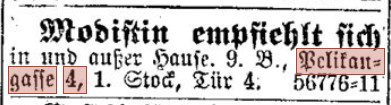
1906 Neue Freie Presse, 30 May, p23
Pelikangasse 4, 1st Floor, Door 4. Milliner available for in- and out-house work.
Alserstrasse 35, Vienna VIII
Wilhelm Kalmar, Tailor, is at Alserstrasse 35 in the 1907 Vienna Address Book.
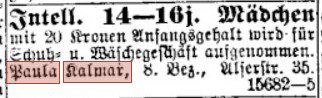
1908 Neues Wiener Journal, 19.01.1908, p26.
Paula Kalmar – Alserstr 35, Wien VIII. Intelligent girl, 14-16years, wanted for shoe and clothes shop business. Starting salary 20 kroner.
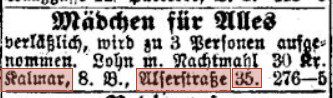
1909 Neues Wiener Journal, 10 January 1909, p28.
Kalmar at Alserstrasse 35, Wien VIII. Reliable girl wanted for 3 people. (Significant because of Michael Ehn’s comment about there being at least one child from the Kalmar marriage.)
Perhaps the apparent overlap with Pelikangasse 4 is that one address was home and the other was their business address (they are round the corner from each other).
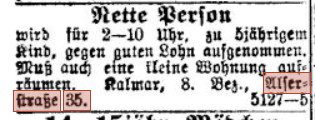
Alserstrasse 22, Vienna VIII
The 1910 Vienna Address Book has Wilhelm Kalmar, Tailor, at Alserstrasse 22. This was Paula’s home address until her death in 1931.
Wollzeile 21, Vienna I
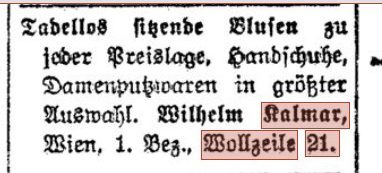
1913 Reichspost, 7 May, p15.
Wilhelm Kalmar at Wollziele 21. Their business address in Vienna’s primary district.
Paula continued to be associated with this address.
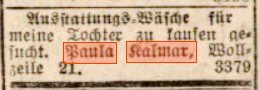
1920 Illustrierte Kronen Zeitung, 8 July 1920, p6.
Wollzeile 21. Paula Kalmar mentions her daughter.

1920 Vienna Address Book
Home: Alserstrasse 22, Vienna IX; Business: Wollzeile 21, Vienna I.
After the Kalmars separated/divorced, it was possible to ‘follow’ Wilhelm Kalmar (and Irma Kalmar) in the Vienna Address Book. Latterly he was at Hafnergasse 3, Vienna II, the address which appeared in his 1938 application for an exit visa from Austria.6
His visa application gave his date/place of birth as 30 January 1875, Cervenka. Wilhelm Kalmar travelled to Shanghai, where he died 15 January 1942.7
ADDITIONAL INFORMATION
Our research was now at a dead-end, but this changed after reaching out to the noted Austrian scholar and musicologist, Michael Lorenz. Mr Lorenz had some time before posted online a page that was part of a divorce document relating to Paula and Heinrich Wolf.
Mr Lorenz kindly answered our questions, as well as providing corrections to some of the document’s details:
- the date of divorce was 9.12.1929.
- Wolf’s date of birth 20.10.1874 was wrong; he was born 4 October 1874.
- Paula’s date of birth 24.4.1880 was also wrong; she was born 11 April 1880 (the date mentioned by Michael Ehn).
- After her marriage to Heinrich Wolf, “she was Paula Wolf”, but “she sometimes signed her name “Wolf-Kalmar” because this was the name of her fashion store”
- “Her divorce was not entirely ordinary, because in 1931 Heinrich Wolf was still living in their shared apartment at Alserstrasse 22.”
But the most important piece of information provided by Mr Lorenz was that Wilhelm Kalmar’s original name, until 1905, had been Kohn.
This allowed for another search of the ANNO website, which offered up the following item.
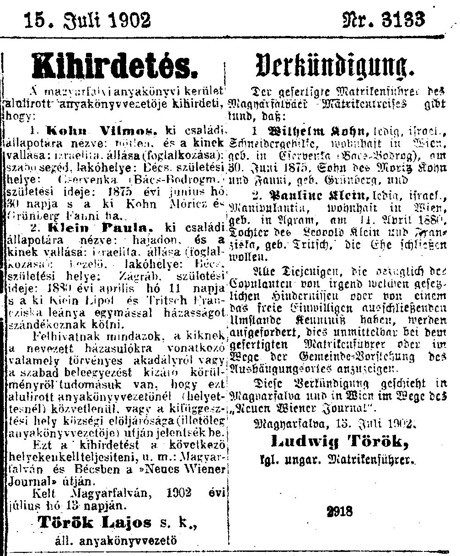
Neues Wiener Journal, 15 July 1902, p10.
This is an announcement of the intended marriage between:
Wilhelm Kohn, tailor’s assistant, living in Vienna, born in Cservenka (Bács Bodrog), on 30 June 1875, son of Moritz Kohn and Fanni, born Grünberg.
Pauline Klein of Vienna, born in Agram on 11 April 1880, daughter of Leopold Klein and Franziska, born Tritsch.
- Kohn’s birthplace is the Hungarian version of Crvenka in the Vojvodina area of Serbia.
- Pauline provided the date and place of birth details mentioned by Michael Ehn.
- Did she provide accurate parental information?
- Magyarfalva (or Magyarfalu) may refer to the town now known as Záhorská Ves in the Malacka region of Slovakia, on the border with Austria (convenient for those who for whatever reasons choose not to marry in Vienna).
PAULA’S BIRTH RECORD
The parental details provided by Pauline/Paula allowed for another search of genealogical records, which resulted in the following birth record being found.

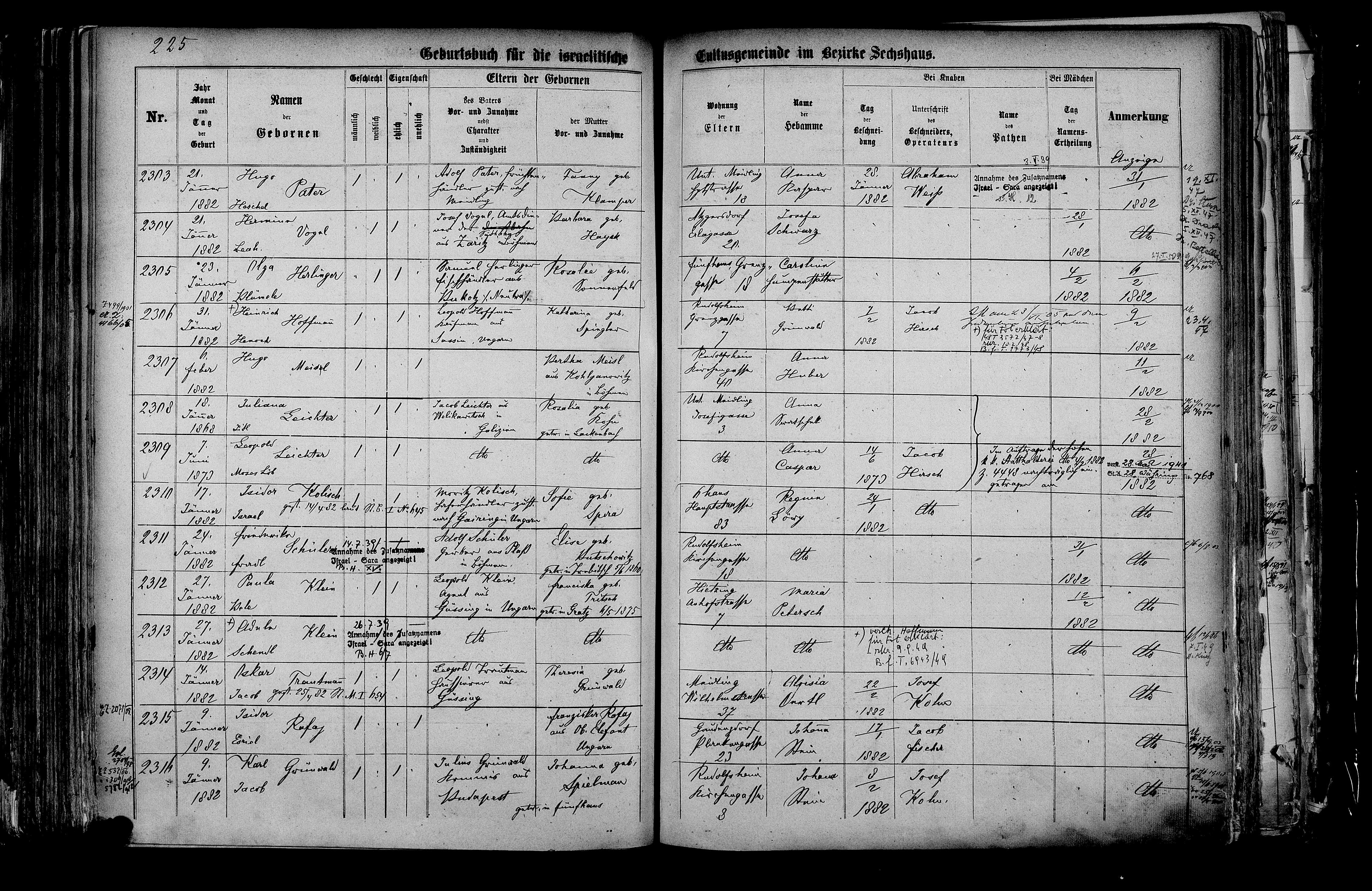

1882 January 27: Birth in Vienna of Paula Bele Klein and sister Adela Schendl Klein.
Father: Leopold Klein, of Güssing; Mother: Franciska, born Tritsch.
Home address (not shown here): Auhofstrasse 7, Hietzing, Vienna.8
Other births to the same parents were:
1. Ida Merl Klein, born 10 April 1883, Auhofstrasse 7, Hietzing, Vienna XIII.
2. Olga Klein, born 20 September 1891, Erlachstrasse 66, Vienna X.
PAULA’S DAUGHTER
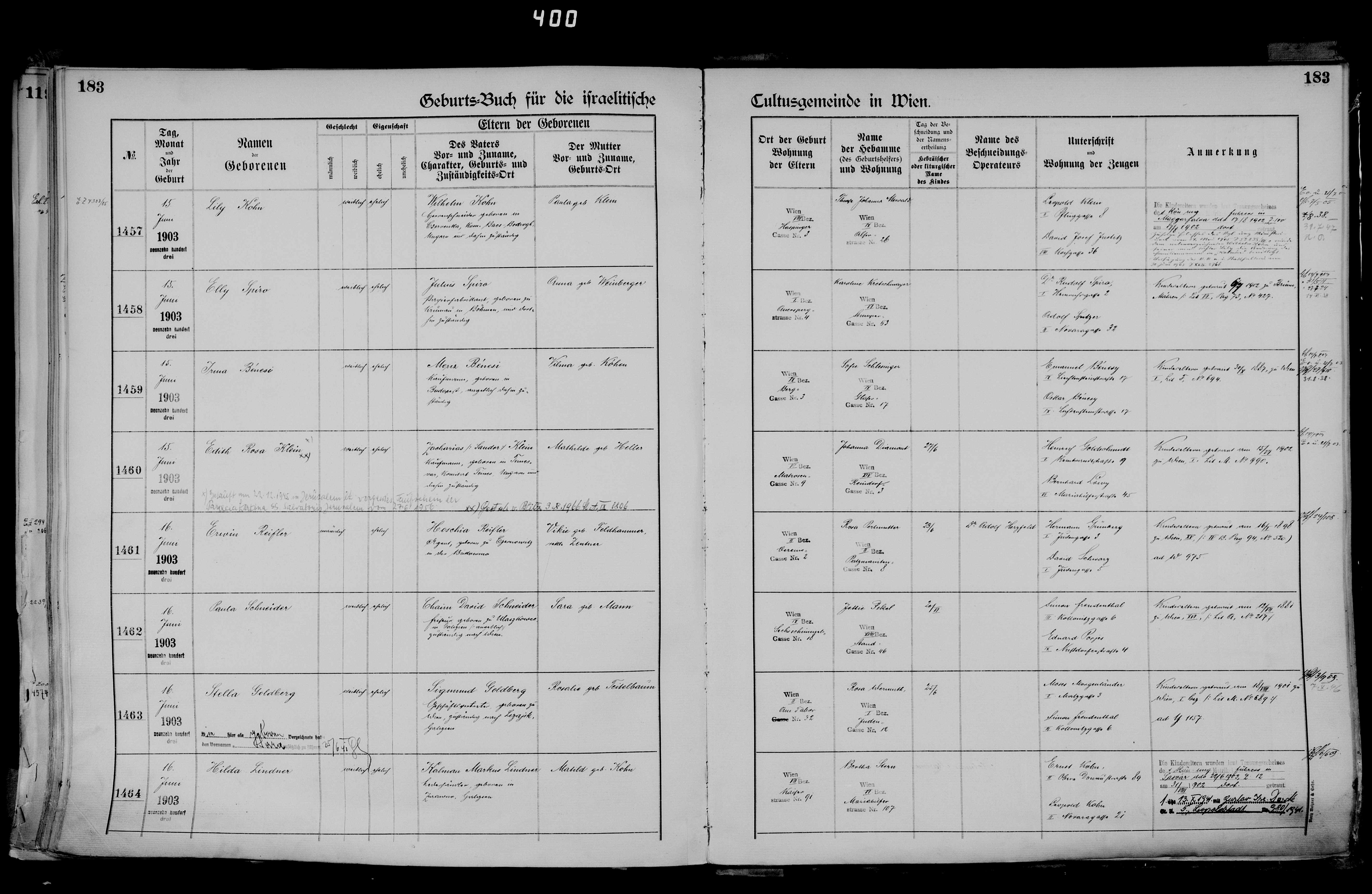
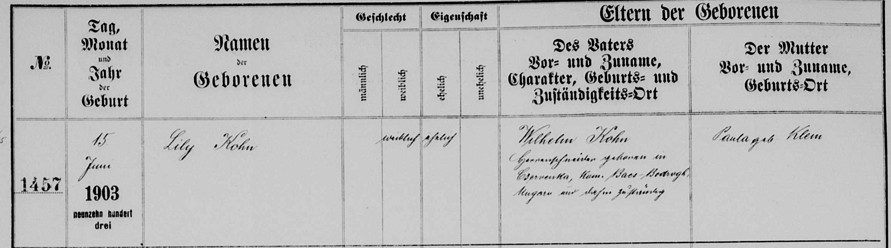
1903 June 15: Birth of Lily Kohn.
Father: Wilhelm Kohn, born in Cservenka (Bács Bodrog); Mother: Paula, born Klein.
Home address (not shown here): Haspingergasse 3, Vienna VIII.9
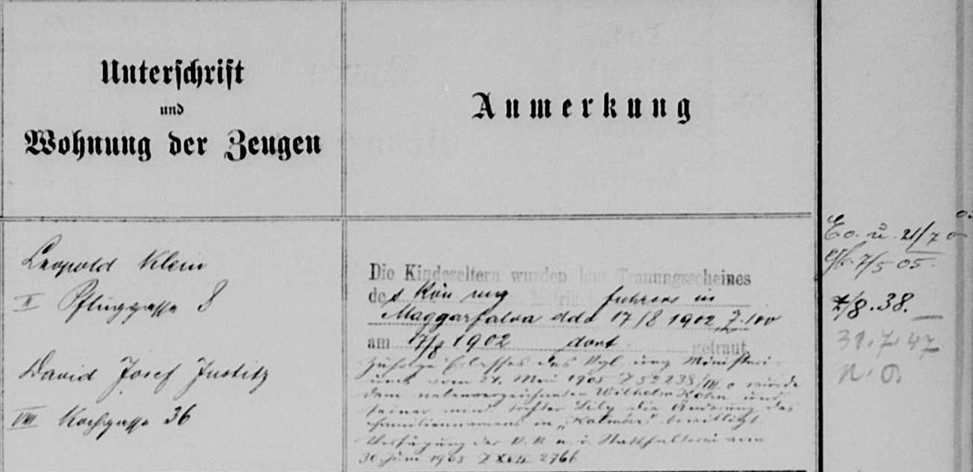
Witnesses: Leopold Klein (father?) and David Josef Justitz.
The notes (Anmerkung) show Magyarfalva and 17/8 1902, possibly their date of marriage.
THE ENDGAME
The result is that some additional information about our subject has been uncovered; perhaps others will decide to pursue the case even further.
Paula’s final tournament was the Women’s World Championship in Prague, held in July 1931.
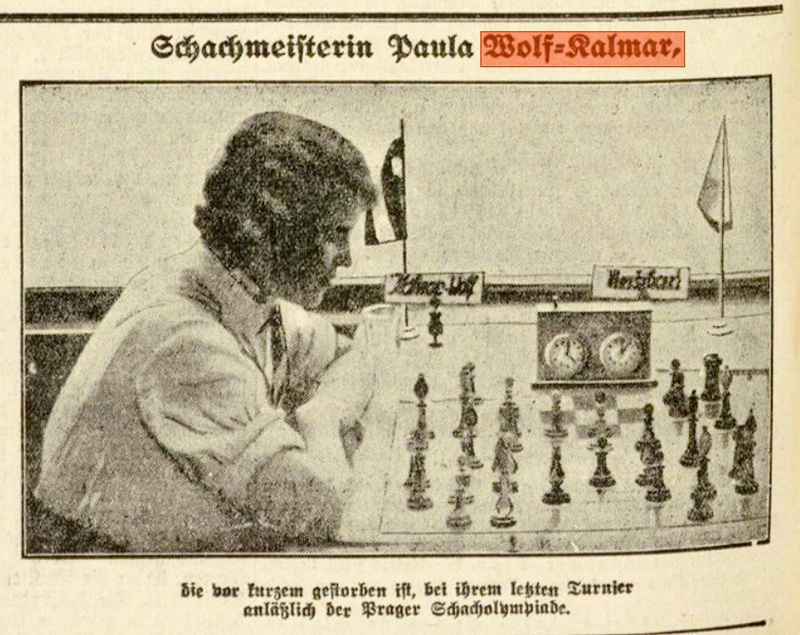
Neues Wiener Tagblatt, 9 October 1931, p20.
The inconsistencies in the use of her name of her name continued to the very end. Her tournament place-card shows Kalmar-Wolf, while the newspaper has Wolf-Kalmar. But when Paula died on 29 September 1931 she was ‘plain’ Paula Wolf, as mentioned by Michael Lorenz.

Vienna Death records for September 1931.
NOTES
1. Neues Wiener Tagblatt, 4 October 1920, p2; Das Schach und die Frau, by Dr S.G. Tartakower.
2. Neues Wiener Tagblatt, 11 February 1921, p6, and Neues Wiener Journal, 16 February 1921, p13. 1st Frau Paula Kalmar 8; 2nd Frau Josefine Pohlner 4½; 3rd Frau Cilly Ausch 3½; 4th Frau Sophie Kohn. No score was given for Kohn, and the fifth player was not named.
3. Neues Wiener Tagblatt, 26 April 1925, p10.
4. The article first appeared in the Neue Freie Presse, 20 February 1923, pp10-11. It was reprinted in the Neue Wiener Schachzeitung1923, Nr. 1, March, pp21-23.
5. Translation by Ian Marks.
6. The visa application can be viewed on the MyHeritage website, without the need to
register. The index showed William Kalmar. https://www.myheritage.com/research/record-11000-177519/william-kalmar-in-austria-vienna-jewish-emigrant-applications
7. Aufbau, 26 April 1946, p35. It was only after compiling information about Wilhelm Kalmar that we discovered his name was mentioned in a 2020 online biography for Paula Wolf- Kalmar, though without any other personal details. https://www.biographien.ac.at/ID-184.6570585874527-1
8. Österreich, Niederösterreich, Wien, Matriken der Israelitischen Kultusgemeinde, 1784-1938 at FamilySearch (https://www.familysearch.org/ark:/61903/1:1:QGJT-9Y3B
9. Österreich, Niederösterreich, Wien, Matriken der Israelitischen Kultusgemeinde, 1784-1938 at FamilySearch (https://www.familysearch.org/ark:/61903/1:1:DWZF-PWW2
Dates
1920
1st Vienna Women’s Tournament
Frau Paula Kalmar 8; Frau Josefine Pohlner 4½; Frau Cilly Ausch 3½; Frau Sophie Kohn (no score given). The fifth player was not named.
Neues Wiener Tagblatt, 11 February 1921, p6; Neues Wiener Journal, 16 February 1921, p13.
1921
Summer Tournament, Schlechter CC, Vienna
She competed in this event alongside her male club colleagues.
Sport-Tagblatt, 22 July 1921, p6.
Linz
She played for Lower Austria in a match against Upper Austria at Linz, winning her game on board 18.
Tagespost (Linz), 8 August 1921, p8. The match was played on 7 August 1921.
1922
Jubilee Tournament of the Schlechter CC, Vienna
Competing once again against her male club colleagues.
7th Bavarian Chess Federation Congress (Innsbruck)
Paula Kalmar provided a report of the tournament to the Neues Wiener Abendblatt of 22 September 1922, p4. She competed in Group 1 of the Hauptturnier: Wenh 7½; Prof. Zindler 6½; Kapferer 6; Paula Kalmar 5½ etc.
2nd Vienna Women’s Tournament (November–December)
There were 10 entrants this time, as opposed to only four in the first tournament (though one name was missing from the final results).
Frau Josefine Pohlner 7½; Frau Paula Kalmar and Frl. Gisela Harum 6½; Frau Malvine Stern 4½; Frau Marie Engel and Frau Olga Gulich 4; Frl. Leonore Manzoni 2; Frl. Hermine Täuber 1; Frau R. Prihoda 0. The Neues Wiener Journal of 19 November 1922, p14, listed the ten participants; The Österreichische Schachrundschau 1922, Nr. 10-12, p78 gave a crosstable, which is missing Hella Ludwig. The Neue Freie Presse, 4 December 1922, p6, named Anna Prihoda in last place.
1923
3rd Vienna Women’s Tournament
Paula won all six games in the four-player, double-round event, ahead of Josefine Pohlner, Gisela Harum, and Malvine Stern.
Neue Freie Presse, 11 February 1923, p9.
8th Bavarian Chess Federation Congress (Nuremberg)
Paula passed on the women’s event, instead playing in Group 1 of the Hauptturnier, where she won third prize.
Coburger Zeitung, 25 July 1923.
1924
International Women’s Tournament (Meran)
Paula was in poor form (perhaps affected by her diabetes), finishing in 4th place.
9th Bavarian Chess Federation Congress (Munich)
Paula played in Group 1 of the Hauptturnier, where she took 5th place.
Münchner neueste Nachrichten, 28 July 1924, p6.
1925
1st Austrian Women’s Championship
Held at the end of 1924 under the auspices of the Österreichische Schachverband.
Kalmar 6/7; Bauer 5; Manzoni and Stern 4; Berger and Pohlner 3; Frey 2; Stussig 1.
Österreichische Schachrundschau 1925, Nr. 1, p21.
Paula Kalmar married Heinrich Wolf on 23 April 1925. Later, she was shown as Wolf-Kalmar or Kalmar-Wolf. We prefer Wolf-Kalmar, as used by her husband in his chess columns.
24th German Chess Federation Congress (Breslau)
Frau Bernhagen (Stockholm) 7; Frau Wolf-Kalmar 5½; Frl. Marcus Leipzig) 4½; Frl. Daunke (Breslau) 4; Frl. Gülich (Vienna) and Frl. Stenzel (Breslau) 2½; Frau Pohlner (Vienna) 2; Frau Hase (Brieg) 0.
24. Kongress des Deutschen Schachbundes Breslau 1925.
4th Vienna (International) Women’s Tournament
Two of the players were from Germany. The event carried over to early January 1926.
Frau Wolf-Kalmar 6; Frl. Harum and Frau Pohlner (both Vienna) 4; Frl. Markus Leipzig) and Frl. Daunke (Breslau) 3½; Frau Reischer 3; Frau Stern and Frl. Manzoni 2.
Neues Wiener Journal, 3 January 1926, p7.
After the tournament ended, Wolf-Kalmar was challenged by both Markus and Harum. She defeated Markus 4-1.
Reichspost, 10 January 1926, p10.
1926
Austrian Women’s Champiosnship
Organised by the Österreichische Schachverband and held in the rooms of the Wiener Schachfreunde, Cafe Draschepark, Geissegasse 5, Vienna IV. Final date for entries, April 16, draw for pairings, April 20, tournament to begin April 23. Games to be played Tuesdays and Fridays. 10 players.
Frau Wolf-Kalmar 8; Frau Reischer 6½; Frau Stern and Frl. Harum 6; Frau Güllich 5½; Frau Engel and Frau Pohlner 4; Frau Freund and Frau Vranovits 2½; Stussig 0.
Neues Wiener Tagblatt, 16 April 1926, p24; Ostdeutsche Rundschau, 27 June 1926, p14.
Neues Wiener Abendblatt, 18 June 1926, p
Budapest (June 26–July 15)
Alongside the international congress, there was also a women’s tournament.
Holloway 6½; Wolf-Kalmar, Harum 5½, Faragó, Guga, Pohlner 3; Manzoni 1½; Reisz 0.
Magyar Sakkvilág 1926, July, p188.
Vienna (18 July–1 August)
The Deutsche Schachverein (German Chess Club) of Vienna organised a congress. The general tournament had five sections, each with six players. Paula was in Group V.
Felmer, Dr Freundlich 3½; Wolf-Kalmar, Dr Metanomski 3; Thomann 2, Buchwald 0.
Deutschösterreichische Tages-Zeitung, 22 August 1926, p16.
1927
Vienna Women’s Tournament (11 players – the original list included Hellvogt)
Frau Wolf-Kalmar, Frau Reischer 10; Frl. Harum 9½; Frau Güllich 7; Frau Pohlner, Frau Seitz 6; Frau Stern 5½; Frau Baronin Lieben 3½; Frl. Täubert 3; Ausch 2; Engel 1½.
Neue Freie Presse, 7 July 1927, p20; Deutschösterreichische Tages-Zeitung, 16 October 1927, p14.
1928
Vienna (Landstraßer Schachbund)
P. Robitsek 6½; Prof. Dr Kleemann, Rud. Müller, Frau Wolf-Kalmar 5; Dr O. Kohl 4; Hartl, Jungwirth 3; Sachs 2½; Hutter 2. A club tournament.
Ostdeutsche Rundschau, 24 June 1928, p14; Wiener Schachzeitung 1928, p174.
Vienna Women’s Tournament
Frl Harum 7; Frau Reischer 6; Frau Wolf-Kalmar 5; Frau Baronin Lieben and Frau Hofrat Stern 2½.
Öffentliche Sicherheit 1928, Nr. 11, p17.
1929
Vienna (Hauptturnier des Wiener Schachverbandes)
Played at the Wiener Schachfreunde club, Cafe Hofbauer, Fichtegasse1, Vienna I.
D. Podhorzer 8; Sonnenschein 7½; Kotek 6; Horner 5½; Frau Wolf-Kalmar 5; Ephron, Huber, Frau Reischer 4½; Hauser 3½; Haas, Rubinstein 2½.
Öffentliche Sicherheit 1929, Nr. 12, p10.
1930
Vienna (Hauptturnier des Wiener Schachverbandes)
Play began at the end of October at the Hietzing Chess Club.
Simon Rubinstein 8½; Dr Ing. Paul Kemp 8; Gottfried Kellner 7; Felmer, Dr Freundlich, Hysek, Haberditz 5½; Fuß, Kotek 5; Frau Wolf-Kalmar and Ullner 4½; Jachim 1½.
Öffentliche Sicherheit 1931, 1-2, p52; Deutschösterreichische Tages-Zeitung, 18 January, p18.
Women’s World Championships
1927 London: Vera Menchik 10½; Katarina Beskow 9’ Wolf-Kalmar 7 and nice others.
1930 Hamburg: Vera Menchik 6½; Wolf-Kalmar 5½ and three others.
Paula defeated Fraulein Harum 2½-1½ in a match to decide Austria’s representative.
Deutschösterreichische Tages-Zeitung, 1 June 1930, p18.
1931 Prague: Vera Menchik 8; Wolf-Kalmar 4 and three others.
